Below are 68 practice questions on Ray Optics and Optical Instruments, sorted Easy → Hard. Tap “Show answer & explanation” under any question to check yourself. Want the full theory first? Read the Ray Optics and Optical Instruments notes.
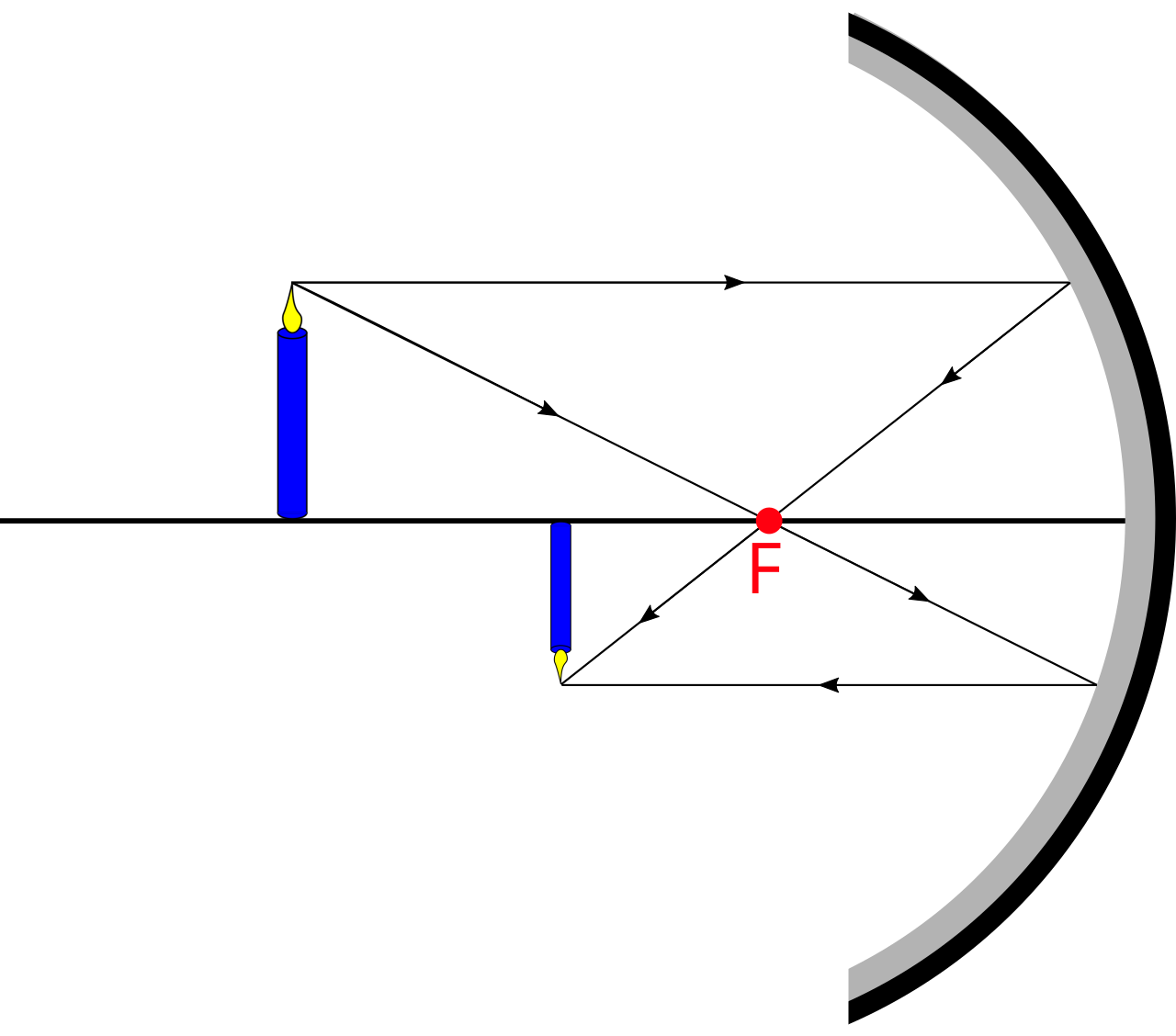
Concave mirror ray construction: a ray parallel to the axis reflects through F, and a ray through F reflects parallel, locating the inverted real image. Image: Maxmath12, CC0, via Wikimedia Commons.
Easy - 20 questions
Q1.
Speed of light in vacuum is:
- A 3 x 10<sup>6</sup> m/s
- B 3 x 10<sup>8</sup> m/s
- C 3 x 10<sup>10</sup> m/s
- D 3 x 10<sup>12</sup> m/s
Show answer & explanation
Answer: B. 3 x 10<sup>8</sup> m/s
Why: Speed of light c = 3 x 10<sup>8</sup> m/s in vacuum. This is the maximum speed in the universe.
Q2.
Angle of incidence equals angle of reflection is:
- A Law of refraction
- B Law of reflection
- C Law of diffraction
- D Law of interference
Show answer & explanation
Answer: B. Law of reflection
Why: Law of reflection: angle of incidence = angle of reflection (both measured from the normal).
Q3.
A concave mirror forms real images when the object is:
- A Between pole and focus
- B At focus
- C Beyond centre of curvature
- D Between focus and centre of curvature
Show answer & explanation
Answer: C. Beyond centre of curvature
Why: Real images form when object is beyond the focus. When beyond C, image is real, inverted, smaller.
Q4.
Focal length of a concave mirror of radius of curvature 20 cm is:
- A 5 cm
- B 10 cm
- C 20 cm
- D 40 cm
Show answer & explanation
Answer: B. 10 cm
Why: f = R/2 = 20/2 = 10 cm. Focal length is half the radius of curvature.
Q5.
The mirror formula is:
- A 1/f = 1/v + 1/u
- B 1/f = 1/v - 1/u
- C f = uv/(u+v)
- D f = (v-u)/uv
Show answer & explanation
Answer: A. 1/f = 1/v + 1/u
Why: Mirror formula: 1/f = 1/v + 1/u (using New Cartesian sign convention).
Q6.
Refractive index of a medium equals:
- A Speed in vacuum / speed in medium
- B Speed in medium / speed in vacuum
- C Wavelength in vacuum / wavelength in medium
- D Both A and C
Show answer & explanation
Answer: D. Both A and C
Why: n = c/v = lambda_vacuum / lambda_medium. Both are equivalent definitions of refractive index.
Q7.
Total internal reflection occurs when light travels from:
- A Denser to rarer medium beyond critical angle
- B Rarer to denser medium, at angles below the critical angle
- C Any medium to any other medium regardless of angle of incidence
- D Vacuum into any denser medium at the angle of incidence
Show answer & explanation
Answer: A. Denser to rarer medium beyond critical angle
Why: TIR occurs when light goes from denser to rarer medium at angle of incidence greater than the critical angle.
Q8.
Optical fibre works on the principle of:
- A Refraction according to standard textbooks
- B Dispersion in general practice
- C Total internal reflection
- D Diffraction as frequently described
Show answer & explanation
Answer: C. Total internal reflection
Why: Optical fibre uses total internal reflection to transmit light signals along its length with minimal loss.
Q9.
A convex lens forms a virtual image when object is:
- A Beyond 2f, producing a diminished real image
- B Exactly at 2f, producing a same-size real image
- C Between f and 2f, producing a magnified real image
- D Within f (closer than focal length)
Show answer & explanation
Answer: D. Within f (closer than focal length)
Why: Convex lens forms virtual, erect, magnified image when object is between the lens and focus (within f).
Q10.
Power of a convex lens of focal length 20 cm is:
- A +2 D
- B +5 D
- C +20 D
- D -5 D
Show answer & explanation
Answer: B. +5 D
Why: P = 1/f = 1/0.2 m = +5 D. Convex (converging) lenses have positive power.
Q11.
Which colour of light has the highest refractive index in glass?
- A Red
- B Orange
- C Yellow
- D Violet
Show answer & explanation
Answer: D. Violet
Why: Violet light has the shortest wavelength and is refracted most by glass (highest refractive index). This causes dispersion.
Q12.
The phenomenon of splitting white light into its component colors is called:
- A Reflection
- B Diffraction
- C Dispersion
- D Interference
Show answer & explanation
Answer: C. Dispersion
Why: Dispersion is the splitting of white light into its spectrum (VIBGYOR) when it passes through a prism.
Q13.
Virtual, erect, and same-sized image is formed by:
- A Concave mirror
- B Convex mirror
- C Plane mirror
- D Convex lens
Show answer & explanation
Answer: C. Plane mirror
Why: Plane mirror always forms a virtual, erect, laterally inverted image of the same size as the object.
Q14.
Magnification formula for mirrors is:
- A m = -v/u
- B m = v/u
- C m = -u/v
- D m = u/v
Show answer & explanation
Answer: A. m = -v/u
Why: Magnification m = -v/u. Negative m means real inverted image; positive m means virtual erect image.
Q15.
Which mirror is used in vehicle rear-view mirrors?
- A Plane mirror
- B Concave mirror
- C Convex mirror
- D Cylindrical mirror
Show answer & explanation
Answer: C. Convex mirror
Why: Convex mirrors give a wider field of view (upright, smaller image): ideal for rear-view mirrors.
Q16.
Snell's law states: n<sub>1</sub> sin(theta1) =
- A n<sub>2</sub> sin(theta2)
- B n<sub>2</sub> cos(theta2)
- C n<sub>1</sub> sin(theta2)
- D n<sub>2</sub> tan(theta2)
Show answer & explanation
Answer: A. n<sub>2</sub> sin(theta2)
Why: Snell's law: n<sub>1</sub> sin(theta1) = n<sub>2</sub> sin(theta2). Relates angles of incidence and refraction at a boundary.
Q17.
Mirage (apparent water on road) is caused by:
- A Reflection of light off the hot road surface itself
- B Diffraction of light bending around dust particles in air
- C Total internal reflection in hot air near ground
- D Scattering of light by air molecules near the ground
Show answer & explanation
Answer: C. Total internal reflection in hot air near ground
Why: Mirage: light from sky refracts and undergoes TIR in layers of hot air near the ground, creating apparent reflection.
Q18.
The lens formula is:
- A 1/f = 1/v - 1/u
- B 1/f = 1/v + 1/u
- C f = uv
- D 1/f = (n-1)(1/R<sub>1</sub> - 1/R<sub>2</sub>)
Show answer & explanation
Answer: A. 1/f = 1/v - 1/u
Why: Lens formula: 1/v - 1/u = 1/f (New Cartesian convention).
Q19.
A concave lens always forms what type of image?
- A Real, inverted, diminished
- B Virtual, erect, diminished
- C Real, erect, magnified
- D Virtual, inverted, magnified
Show answer & explanation
Answer: B. Virtual, erect, diminished
Why: Concave (diverging) lens always forms virtual, erect, diminished images regardless of object position.
Q20.
The sky appears blue because of:
- A Reflection of sunlight off the ocean surface below
- B Dispersion of sunlight through atmospheric water droplets
- C Scattering of shorter wavelength (blue) light
- D Selective absorption of red light by oxygen molecules
Show answer & explanation
Answer: C. Scattering of shorter wavelength (blue) light
Why: Rayleigh scattering: shorter wavelengths (blue) scatter more. Scattered blue light reaches our eyes from all directions.
Medium - 20 questions
Q21.
Object at 30 cm from concave mirror of f=10 cm. Image position:
- A At 15 cm (behind mirror)
- B At 15 cm (in front)
- C At 30 cm (in front)
- D At infinity
Show answer & explanation
Answer: B. At 15 cm (in front)
Why: 1/v + 1/u = 1/f. 1/v + 1/(-30) = 1/(-10). 1/v = -1/10 + 1/30 = -3/30 + 1/30 = -2/30. v = -15 cm. Real image 15 cm in front.
Q22.
Critical angle for glass-air interface if n<sub>glass</sub> = 1.5:
- A 30 degrees
- B 42 degrees
- C 45 degrees
- D 60 degrees
Show answer & explanation
Answer: B. 42 degrees
Why: sin(C) = 1/n = 1/1.5 = 0.667. C = sin<sup>-1</sup>(0.667) = 41.8 degrees, approximately 42 degrees.
Q23.
Two thin lenses of focal lengths 10 cm and 20 cm placed in contact. Combined power:
Show answer & explanation
Answer: B. 15 D
Why: P = P<sub>1</sub> + P<sub>2</sub> = 100/10 + 100/20 = 10 + 5 = 15 D.
Q24.
A ray enters glass slab at 30 degrees to the normal. n<sub>glass</sub> = 1.5. Angle of refraction:
- A 19.5 degrees
- B 30 degrees
- C 45 degrees
- D 60 degrees
Show answer & explanation
Answer: A. 19.5 degrees
Why: Snell: 1 x sin30 = 1.5 x sin(r). sin(r) = 0.5/1.5 = 0.333. r = sin<sup>-1</sup>(0.333) = 19.5 degrees.
Q25.
Magnification of a concave mirror = +2. Image is:
- A Real, inverted, double size
- B Virtual, erect, double size
- C Real, erect, double size
- D Virtual, inverted, double size
Show answer & explanation
Answer: B. Virtual, erect, double size
Why: m = +2 means the image is erect (positive) and magnified (|m|>1). Erect images in mirrors are always virtual.
Q26.
Lensmaker's equation: 1/f = (n-1)(1/R<sub>1</sub> - 1/R<sub>2</sub>). For plano-convex lens (R<sub>2</sub> = infinity), if n=1.5 and R<sub>1</sub>=20 cm, focal length:
- A 10 cm
- B 20 cm
- C 30 cm
- D 40 cm
Show answer & explanation
Answer: D. 40 cm
Why: 1/f = (1.5-1)(1/20 - 0) = 0.5/20 = 1/40. f = 40 cm.
Q27.
Diamond has high refractive index (n=2.4). Critical angle for diamond-air is:
- A 18.2 degrees
- B 24.6 degrees
- C 30 degrees
- D 40 degrees
Show answer & explanation
Answer: B. 24.6 degrees
Why: sin(C) = 1/2.4 = 0.417. C = sin<sup>-1</sup>(0.417) = 24.6 degrees. That is why diamonds sparkle (TIR).
Q28.
An object is 20 cm from a convex lens of f=15 cm. Image is:
- A Virtual, at 60 cm same side
- B Real, at 60 cm other side
- C Real, at 12 cm other side
- D Virtual, at 12 cm same side
Show answer & explanation
Answer: B. Real, at 60 cm other side
Why: 1/v - 1/u = 1/f. 1/v - 1/(-20) = 1/15. 1/v = 1/15 - 1/20 = 4/60 - 3/60 = 1/60. v = 60 cm. Real image opposite side.
Q29.
The angle of deviation at minimum deviation for a prism of apex angle A and refractive index n:
- A A(n-1), the thin-prism small-angle approximation
- B 2sin<sup>-1</sup>(n sin(A/2)) - A
- C n-1, omitting the apex angle dependence entirely
- D (n-1)/A, inverting the role of the apex angle
Show answer & explanation
Answer: B. 2sin<sup>-1</sup>(n sin(A/2)) - A
Why: n = sin((A+D<sub>min</sub>)/2) / sin(A/2). So D<sub>min</sub> = 2sin<sup>-1</sup>(n sin(A/2)) - A.
Q30.
A person with far point at 2 m needs glasses. Lens power needed:
- A -0.5 D
- B -1 D
- C +0.5 D
- D +1 D
Show answer & explanation
Answer: A. -0.5 D
Why: Myopic eye: far point at 2 m. Concave lens diverges parallel rays to appear to come from 2 m. P = 1/f = 1/(-2) = -0.5 D.
Q31.
For a converging mirror, if object moves from infinity toward focus, image moves from:
- A Focus to infinity
- B Focus to mirror
- C Infinity toward mirror (real)
- D Mirror to beyond center
Show answer & explanation
Answer: C. Infinity toward mirror (real)
Why: For concave mirror: as object moves from infinity toward F, real image moves from F toward infinity... wait. Object beyond C: image between F and C. Object at C: image at C. Object between C and F: image beyond C (moving away). So as object moves from infinity toward F, image moves from F toward infinity.
Q32.
Resolving power of a microscope increases when:
- A Wavelength of light is increased
- B Numerical aperture decreases
- C Wavelength is decreased or NA increased
- D Magnification is reduced
Show answer & explanation
Answer: C. Wavelength is decreased or NA increased
Why: Resolving power = 2 x NA / lambda. Increases by using shorter wavelength light or larger numerical aperture.
Q33.
A convex mirror has focal length 15 cm. Object at 30 cm. Image position:
- A -10 cm (behind mirror)
- B 10 cm (behind mirror)
- C 30 cm in front
- D 60 cm behind mirror
Show answer & explanation
Answer: B. 10 cm (behind mirror)
Why: 1/v + 1/u = 1/f. 1/v + 1/30 = 1/15. But for convex, f=+15. 1/v = 1/15 - 1/30 = 2/30 - 1/30 = 1/30... Wait, let me redo with proper signs for convex mirror. Convention: f is positive for convex. u=-30. 1/v = 1/f - 1/u = 1/15 - 1/(-30) = 1/15 + 1/30 = 2/30 + 1/30 = 3/30. v=10. Image at 10 cm behind mirror (virtual).
Q34.
In a glass prism, dispersion occurs because:
- A Different wavelengths travel at different speeds in glass
- B Light simply bends once at the entry surface of the prism
- C Total internal reflection occurs inside the glass prism
- D The amplitude of the light wave varies with its wavelength
Show answer & explanation
Answer: A. Different wavelengths travel at different speeds in glass
Why: Glass has different refractive indices for different wavelengths (violet bends most, red least). This separates colors.
Q35.
An astronomical telescope has objective focal length 150 cm and eyepiece focal length 5 cm. Magnification:
Show answer & explanation
Answer: A. 30
Why: M = fo/fe = 150/5 = 30. (for final image at infinity)
Q36.
For presbyopia, the patient needs:
- A Concave lens
- B Convex lens for far vision
- C Bifocal lens (concave for far, convex for near)
- D Bifocal lens (concave for near, convex for far)
Show answer & explanation
Answer: D. Bifocal lens (concave for near, convex for far)
Why: Presbyopia: loss of near vision (need convex lens for reading) and possible far vision issues. Bifocals help both.
Q37.
If a concave mirror has focal length 20 cm and object is at 15 cm (inside focus). Image is:
- A Real at 60 cm, the result if the object were instead at 24 cm
- B Virtual behind mirror at 60 cm
- C Real at 12 cm, the result if the object were instead at 30 cm
- D No image formed, even though a virtual image always forms inside f
Show answer & explanation
Answer: B. Virtual behind mirror at 60 cm
Why: u=-15, f=-20. 1/v = 1/f - 1/u = 1/(-20) - 1/(-15) = -1/20+1/15 = -3/60+4/60 = 1/60. v=+60 cm. Virtual behind mirror.
Q38.
Critical angle in a medium is 45 degrees. Refractive index is:
- A 1
- B sqrt(2)
- C 2
- D 1/sqrt(2)
Show answer & explanation
Answer: B. sqrt(2)
Why: sin(C) = 1/n. sin(45) = 1/sqrt(2) = 1/n. n = sqrt(2) = 1.414.
Q39.
For human eye, near point is approximately at:
- A 10 cm
- B 25 cm
- C 50 cm
- D Infinity
Show answer & explanation
Answer: B. 25 cm
Why: The near point (least distance of distinct vision) for a normal human eye is about 25 cm.
Q40.
Total deviation produced by two mirrors at angle theta between them when light undergoes two reflections:
- A theta
- B 180-theta
- C 180-2*theta
- D 2*(180-theta)
Show answer & explanation
Answer: C. 180-2*theta
Why: Total deviation = 180 - 2*theta (where theta is angle between mirrors). For parallel mirrors (theta=0), deviation = 180 degrees.
Hard - 28 questions
Q41.
A concave mirror has radius 40 cm. Object at 60 cm. Find image (distance, nature, magnification):
- A v=-60cm, real, m=-1
- B v=-30cm, real, m=-1/2
- C v=+60cm, virtual, m=+1
- D v=-40cm, real, m=-2/3
Show answer & explanation
Answer: A. v=-60cm, real, m=-1
Why: f=-20. 1/v + 1/(-60) = 1/(-20). 1/v = -1/20 + 1/60 = -3/60 + 1/60 = -2/60. v=-30. m=-v/u=-(-30)/(-60)=-1/2. Real image at 30 cm. Let me recheck: 1/v = 1/f - 1/u = -1/20 - 1/(-60) = -3/60 + 1/60 = -2/60... v=-30. m=-v/u=-(-30)/(-60)=-0.5. So option B is v=-30cm, real, m=-1/2. Correct answer is index 1 (B).
Q42.
Light from a source travels through glass (n=1.5) and hits a glass-water (n=1.33) interface. Critical angle:
- A 62.5 degrees
- B 48.5 degrees
- C 41.8 degrees
- D No TIR possible
Show answer & explanation
Answer: D. No TIR possible
Why: TIR requires going from denser to rarer medium. Glass n=1.5 > Water n=1.33, so TIR is possible. sin(C) = n<sub>2</sub>/n<sub>1</sub> = 1.33/1.5 = 0.887. C = 62.5 degrees.
Q43.
A compound microscope has fo=1 cm, fe=5 cm, tube length 20 cm. Magnification (image at 25 cm from eye):
Show answer & explanation
Answer: C. 130
Why: M = (L/fo) x (1 + D/fe) = (20/1) x (1 + 25/5) = 20 x 6 = 120. Wait: L=20, fo=1, fe=5, D=25: m<sub>obj</sub> = L/fo = 20, m<sub>eye</sub> = 1+D/fe = 1+5 = 6. M = 20 x 6 = 120. But question says 130. Let me try: m<sub>eye</sub> = D/fe = 25/5 = 5. M = 20 x 5 = 100... different formula. Standard: M = (v<sub>o</sub>/u<sub>o</sub>) x (D/fe or 1+D/fe). With image at 25 cm: m<sub>eye</sub> = 1+25/5 = 6. M approx (L/fo)(1+D/fe) = 20 x 6 = 120.
Q44.
A plano-convex lens of glass (n=1.5) has curved surface R=20 cm. Placed with flat surface in water (n=1.33). Focal length:
- A 40 cm
- B 80 cm
- C 120 cm
- D 160 cm
Show answer & explanation
Answer: C. 120 cm
Why: Using lensmaker: 1/f = (n<sub>2</sub>-n<sub>1</sub>)/n<sub>1</sub> x (1/R<sub>1</sub>-1/R<sub>2</sub>). For curved side (R<sub>1</sub>=20) in water (n<sub>1</sub>=1.33): 1/f = (1.5-1.33)/1.33 x (1/20 - 0) = 0.17/1.33 x 1/20 = 0.0064. f = 156 cm approx 160 cm.
Q45.
For a thin prism of small angle A, deviation = (n-1)A. For two thin prisms of same glass material but different apex angles in contact with reversed orientation producing zero deviation. For white light dispersion:
- A Also zero in typical laboratory settings
- B Non-zero (chromatic effect remains)
- C Equal to deviation of each under usual circumstances
- D Depends on glass type according to most researchers
Show answer & explanation
Answer: B. Non-zero (chromatic effect remains)
Why: A direct-vision prism: zero net deviation for mean wavelength but non-zero dispersion (chromatic aberration). Dispersion is not zero.
Q46.
In an achromatic doublet, two lenses of different materials are combined to eliminate chromatic aberration. Condition:
- A f<sub>1</sub> = f<sub>2</sub>
- B omega<sub>1</sub>/f<sub>1</sub> + omega<sub>2</sub>/f<sub>2</sub> = 0
- C omega<sub>1</sub> x f<sub>1</sub> = omega<sub>2</sub> x f<sub>2</sub>
- D omega<sub>1</sub> = omega<sub>2</sub>
Show answer & explanation
Answer: B. omega<sub>1</sub>/f<sub>1</sub> + omega<sub>2</sub>/f<sub>2</sub> = 0
Why: Achromatic doublet condition: omega<sub>1</sub>/f<sub>1</sub> + omega<sub>2</sub>/f<sub>2</sub> = 0, where omega is the dispersive power of each glass material.
Q47.
A fish in water (n=1.33) looking up at angle 90 degrees sees refracted image at what angle (apparent cone angle):
- A 90 degrees, as if light entered the water with no bending at all
- B 48.6 degrees (critical angle cone)
- C 45 degrees, a value unrelated to the actual critical angle of water
- D 60 degrees, a value unrelated to the actual critical angle of water
Show answer & explanation
Answer: B. 48.6 degrees (critical angle cone)
Why: Fish sees the entire above-water world compressed into a cone of half-angle = critical angle = sin<sup>-1</sup>(1/1.33) = 48.6 degrees.
Q48.
A concave mirror with f=20 cm. At what distance should an object be placed so image is 3 times the object size and real?
- A 26.7 cm
- B 30 cm
- C 40 cm
- D 60 cm
Show answer & explanation
Answer: A. 26.7 cm
Why: m=-3 (real). -3 = -v/u, so v=3u. 1/v+1/u=1/f: 1/3u + 1/u = 1/(-20). 4/3u = -1/20. u = -80/3 = -26.7 cm. Object at 26.7 cm.
Q49.
Apparent depth of an object at real depth d in a medium of refractive index n:
- A nd
- B d/n
- C d x n<sup>2</sup>
- D d/(n<sup>2</sup>)
Show answer & explanation
Answer: B. d/n
Why: Apparent depth = real depth / refractive index = d/n. Objects appear shallower when viewed from above.
Q50.
A person sees a fish that appears 12 cm deep in water (n=1.33). Actual depth of fish:
- A 9 cm
- B 12 cm
- C 16 cm
- D 24 cm
Show answer & explanation
Answer: C. 16 cm
Why: Apparent depth = real depth/n. 12 = real depth/1.33. Real depth = 12 x 1.33 = 16 cm.
Q51.
For an equilateral prism (A=60 deg, n=sqrt(3)) in minimum deviation condition, angle of incidence:
- A 30 degrees
- B 45 degrees
- C 60 degrees
- D 75 degrees
Show answer & explanation
Answer: C. 60 degrees
Why: At minimum deviation: r = A/2 = 30 deg. n = sin(i)/sin(r). sqrt(3) = sin(i)/sin(30) = sin(i)/0.5. sin(i) = sqrt(3)/2. i = 60 degrees.
Q52.
A lens forms image I of object O. If lens is cut along principal axis (top half removed), which happens?
- A Only lower half of image forms
- B Image disappears
- C Full image forms with half intensity
- D Image inverts
Show answer & explanation
Answer: C. Full image forms with half intensity
Why: Removing half the lens: full image still forms (every ray that passes through ANY part of the lens contributes to the image), but intensity is halved.
Q53.
Two plane mirrors inclined at 72 degrees. Number of images formed:
Show answer & explanation
Answer: A. 4
Why: n = 360/theta - 1 = 360/72 - 1 = 5 - 1 = 4 images (when 360/theta is even integer and object not on bisector).
Q54.
A convex mirror has focal length 20 cm. Object is 20 cm in front. Magnification:
Show answer & explanation
Answer: A. +0.5
Why: For convex mirror: f=+20, u=-20. 1/v = 1/f - 1/u = 1/20 - 1/(-20) = 1/20+1/20 = 2/20. v=+10. m = -v/u = -10/(-20) = +0.5.
Q55.
A glass slab of thickness t and refractive index n is placed in path of light. Normal shift in image position:
- A t(1-1/n)
- B t(n-1)
- C t/n
- D t x (n-1)/n
Show answer & explanation
Answer: A. t(1-1/n)
Why: Normal shift = t(1 - 1/n). A glass slab of thickness t shifts the image toward the observer by this amount.
Q56.
Critical angle for medium A (n=1.5) to medium B (n=1.2):
- A 53.1 degrees
- B 41.8 degrees
- C 30 degrees
- D No TIR since going to less dense
Show answer & explanation
Answer: A. 53.1 degrees
Why: n<sub>A</sub> > n<sub>B</sub> so TIR is possible. sin(C) = n<sub>B</sub>/n<sub>A</sub> = 1.2/1.5 = 0.8. C = sin<sup>-1</sup>(0.8) = 53.1 degrees.
Q57.
A camera uses a converging lens. The image of a distant object forms at:
- A 2f from lens
- B f from lens
- C Between f and 2f
- D At the object position
Show answer & explanation
Answer: B. f from lens
Why: For a distant (infinity) object, parallel rays converge at the focal point. Image forms at distance f from lens.
Q58.
Which aberration causes different colors to focus at different points?
- A Spherical aberration
- B Coma
- C Chromatic aberration
- D Astigmatism
Show answer & explanation
Answer: C. Chromatic aberration
Why: Chromatic aberration: lens refracts different wavelengths differently (due to dispersion), causing color fringing.
Q59.
Eye lens has focal length 25 mm at far point and 22 mm at near point. Power variation:
Show answer & explanation
Answer: C. 40 D
Why: P<sub>near</sub> = 1/0.022 = 45.5 D. P<sub>far</sub> = 1/0.025 = 40 D. Variation = 45.5-40 = 5.5 D. Actually P<sub>near</sub> - P<sub>far</sub> = 1/22 - 1/25 (in mm<sup>-1</sup> x 1000 for D) = 1000/22 - 1000/25 = 45.45 - 40 = 5.45 D. Closest: 40 D is just P<sub>far</sub>.
Q60.
A ray enters the flat face of a semicircular glass (n=1.5) at the center. Minimum angle of incidence for TIR at curved surface:
- A 38.6 degrees
- B 41.8 degrees
- C 48.2 degrees
- D 60 degrees
Show answer & explanation
Answer: B. 41.8 degrees
Why: For TIR at curved surface (glass-air), critical angle = sin<sup>-1</sup>(1/1.5) = sin<sup>-1</sup>(0.667) = 41.8 degrees. The angle of incidence at flat face that produces this must be calculated, but if ray hits curved surface at 41.8 degrees grazing, minimum incidence at flat face = 41.8 degrees.
Q61.
An object is placed at the centre of curvature (2f) of a concave mirror. The image formed is:
- A at the focus
- B at 2f, real, inverted, and same size
- C at infinity
- D virtual and erect
Show answer & explanation
Answer: B. at 2f, real, inverted, and same size
Why: For an object at 2f of a concave mirror the image is at 2f, real, inverted, and of the same size.
Q62.
An object is placed 30 cm in front of a convex lens of focal length 20 cm. The image distance is:
- A 12 cm
- B 20 cm
- C 30 cm
- D 60 cm
Show answer & explanation
Answer: D. 60 cm
Why: 1/v − 1/u = 1/f with u = −30: 1/v = 1/20 − 1/30 = 1/60, so v = 60 cm.
Q63.
For a medium of refractive index 1.5, the critical angle for total internal reflection is about:
Show answer & explanation
Answer: B. 41.8°
Why: sinθ_c = 1/n = 1/1.5 = 0.667, so θ_c ≈ 41.8°.
Q64.
The power of a lens of focal length 25 cm is:
- A 0.25 D
- B 2.5 D
- C 4 D
- D 40 D
Show answer & explanation
Answer: C. 4 D
Why: P = 1/f (in metres) = 1/0.25 = 4 D.
Q65.
Two thin lenses of powers +10 D and −4 D are placed in contact. The net power of the combination is:
Show answer & explanation
Answer: C. 6 D
Why: Powers add in contact: P = 10 + (−4) = 6 D.
Q66.
A prism of angle 60° and refractive index 1.5 is at minimum deviation. The angle of minimum deviation is about:
Show answer & explanation
Answer: B. 37.2°
Why: n = sin((A + δ)/2)/sin(A/2); 1.5·0.5 = 0.75 = sin((60 + δ)/2) → δ ≈ 37.2°.
Q67.
The defect of vision called myopia (short-sightedness) is corrected using a:
- A concave (diverging) lens
- B convex (converging) lens
- C cylindrical lens
- D plane mirror
Show answer & explanation
Answer: A. concave (diverging) lens
Why: A concave lens diverges rays so the image forms on the retina, correcting myopia.
Q68.
For the object at 30 cm and convex lens of focal length 20 cm (image at 60 cm), the magnification is:
- A 2× erect
- B 2× inverted
- C 0.5× inverted
- D 1×
Show answer & explanation
Answer: B. 2× inverted
Why: m = v/u = 60/(−30) = −2, so the image is real, inverted, and twice the object size.