Answer: 130.
- A 100
- B 120
- C 130
- D 140
Correct answer: C. 130
Explanation: M = (L/fo) x (1 + D/fe) = (20/1) x (1 + 25/5) = 20 x 6 = 120. Wait: L=20, fo=1, fe=5, D=25: m<sub>obj</sub> = L/fo = 20, m<sub>eye</sub> = 1+D/fe = 1+5 = 6. M = 20 x 6 = 120. But question says 130. Let me try: m<sub>eye</sub> = D/fe = 25/5 = 5. M = 20 x 5 = 100... different formula. Standard: M = (v<sub>o</sub>/u<sub>o</sub>) x (D/fe or 1+D/fe). With image at 25 cm: m<sub>eye</sub> = 1+25/5 = 6. M approx (L/fo)(1+D/fe) = 20 x 6 = 120.
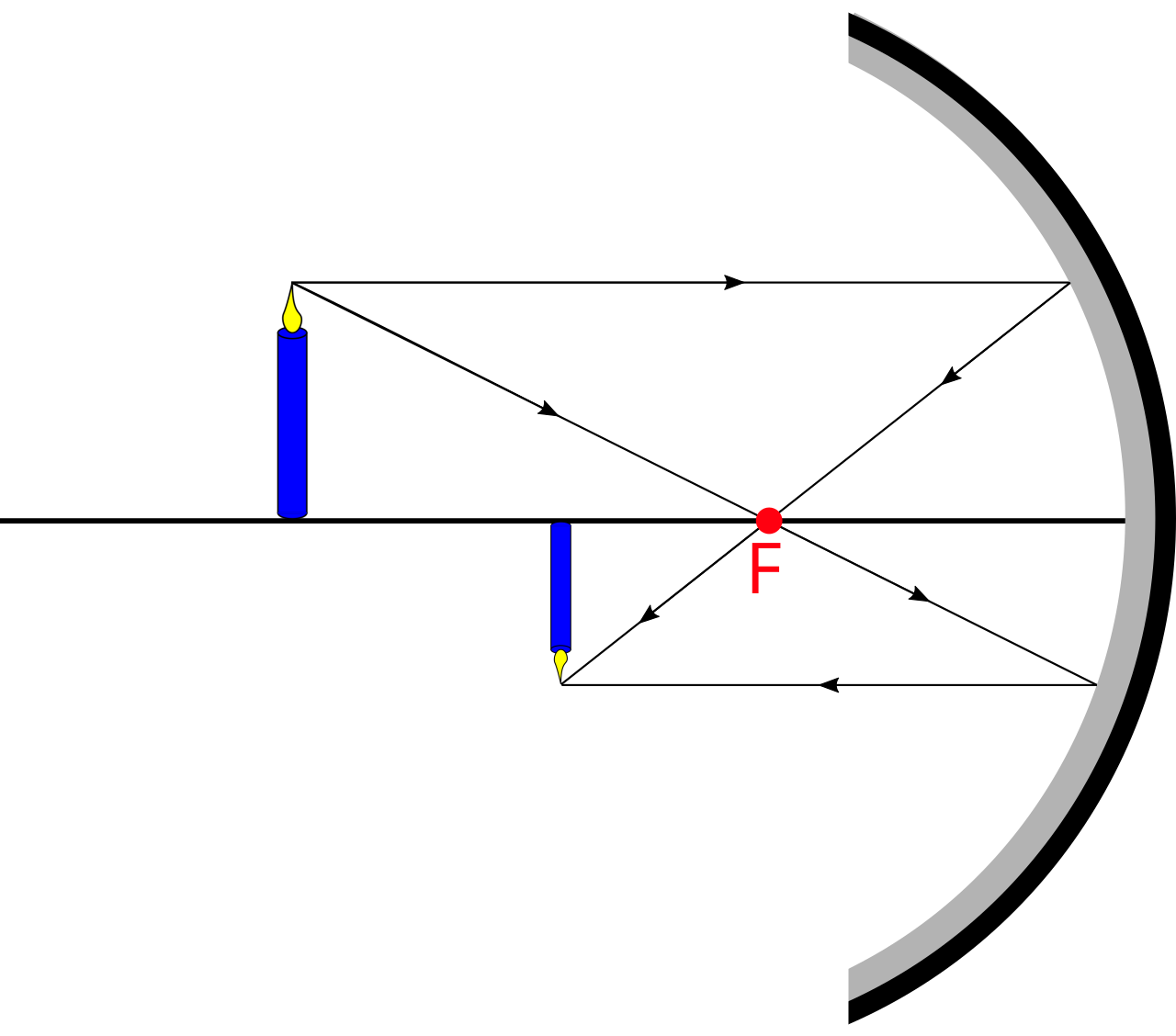
Concave mirror ray construction: a ray parallel to the axis reflects through F, and a ray through F reflects parallel, locating the inverted real image. Image: Maxmath12, CC0, via Wikimedia Commons.
Concept context
Reflection, refraction, lenses, mirrors, total internal reflection.