Answer: the 2 cm sphere to the 4 cm sphere.
- A the 4 cm sphere to the 2 cm sphere
- B the 2 cm sphere to the 4 cm sphere
- C neither, the potentials are equal
- D the wire to both spheres
Correct answer: B. the 2 cm sphere to the 4 cm sphere
Explanation: For equal charge, the smaller sphere has the higher potential (V = kq/r). So charge flows from the 2 cm sphere to the 4 cm sphere until the potentials equalise.
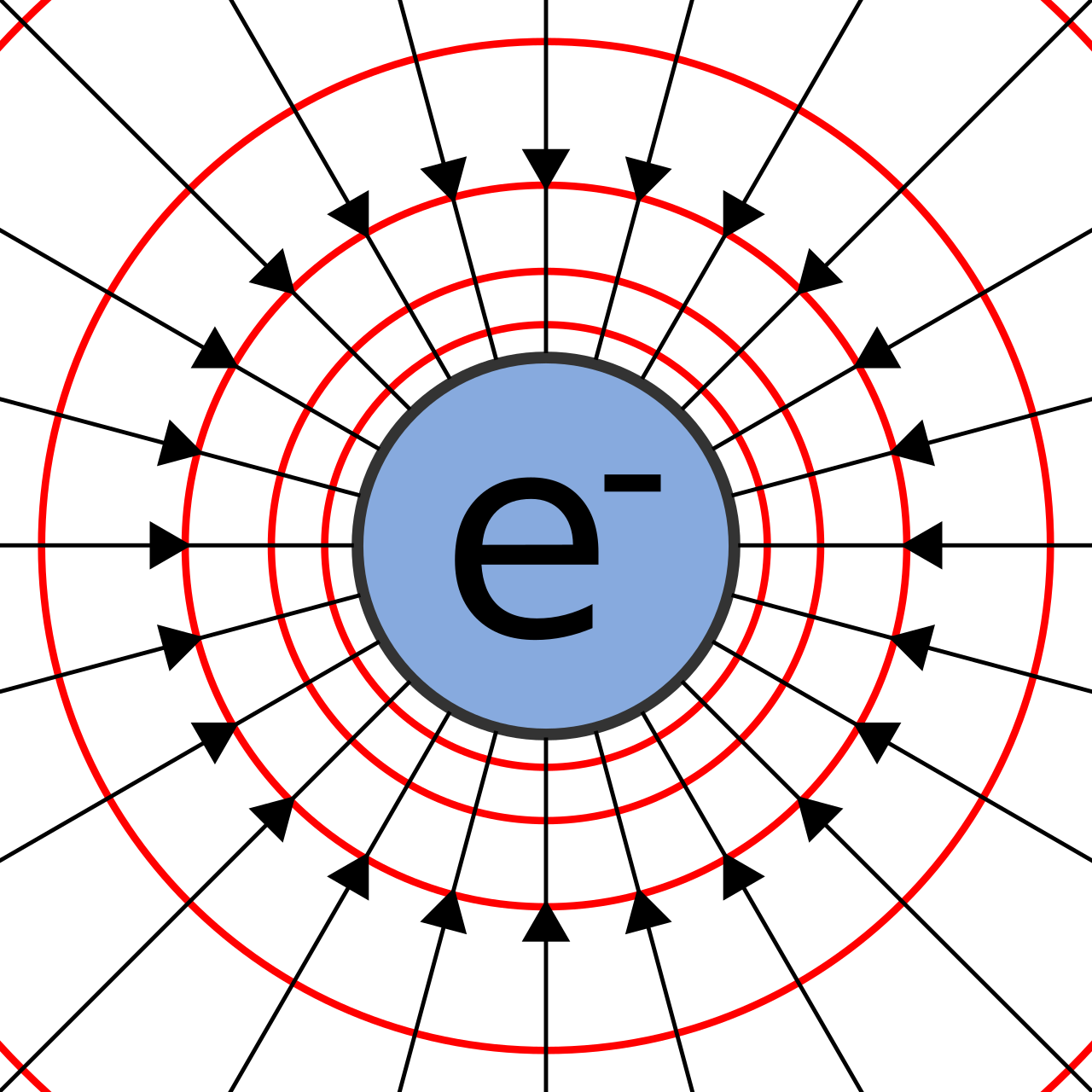
Field lines (radial) and equipotential lines (concentric circles) of a point charge. Equipotential surfaces are always perpendicular to the field lines. Image: Sjlegg, Public Domain, via Wikimedia Commons.
Concept context
Electric potential, equipotential surfaces, potential energy of charge systems, conductors, dielectrics, capacitors, combinations, and energy storage.
Read the full Electrostatic Potential and Capacitance notes →