Answer: Because real gas molecules have finite size and intermolecular forces not accounted for in the ideal derivation.
- A Because the numerical value of Avogadro's number actually shifts for real gases during normal conditions as generally observed
- B Because real gas molecules have finite size and intermolecular forces not accounted for in the ideal derivation
- C Because real gases supposedly do not possess any measurable molar mass in typical laboratory settings under usual circumstances
- D Because the effusion phenomenon is said to apply mainly to liquids, not gases according to most researchers
Correct answer: B. Because real gas molecules have finite size and intermolecular forces not accounted for in the ideal derivation
Explanation: Graham Law is strictly derived from ideal kinetic theory; real gases show small deviations because of intermolecular attraction and finite molecular volume.
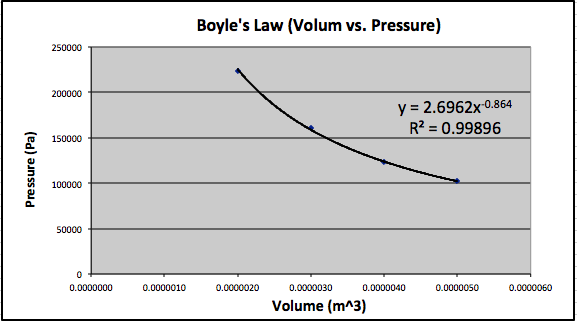
Boyle's law: at constant temperature the pressure of a fixed mass of gas is inversely proportional to its volume (P ∝ 1/V), so the P–V plot is a hyperbola — halving the volume doubles the pressure. Image: Reginaprice2013, CC BY-SA 3.0, via Wikimedia Commons.
Concept context
Discover why gases expand to fill any container while liquids flow and solids hold their shape. Master the gas laws, the ideal gas equation, and the reasons real gases deviate from ideal behavior.