🧪 Chemistry · Class 11 · NEET & JEE
States of Matter - Practice Questions with Answers
75 free MCQs on States of Matter with worked answers and explanations. Discover why gases expand to fill any container while liquids flow and solids hold their shape. Master the gas laws, the ideal gas equation, and the reasons real gases deviate from ideal behavior.
Take the timed States of Matter chapterwise test →Below are 75 practice questions on States of Matter, sorted Easy → Hard. Tap “Show answer & explanation” under any question to check yourself. Want the full theory first? Read the States of Matter notes.
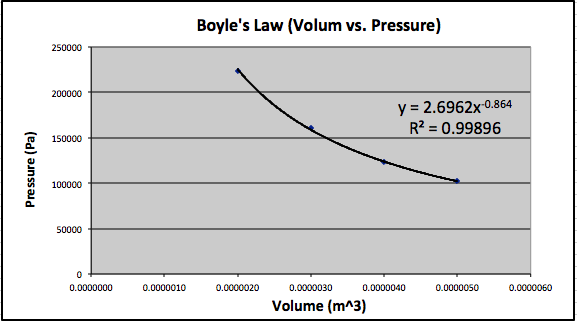
Boyle's law: at constant temperature the pressure of a fixed mass of gas is inversely proportional to its volume (P ∝ 1/V), so the P–V plot is a hyperbola — halving the volume doubles the pressure. Image: Reginaprice2013, CC BY-SA 3.0, via Wikimedia Commons.
Easy - 25 questions
Q1.
Which of the following correctly compares the most probable (u<sub>mp</sub>), average (u<sub>av</sub>) and root-mean-square (u<sub>rms</sub>) speeds of gas molecules?
- A u<sub>rms</sub> is largest, u<sub>mp</sub> is smallest
- B u<sub>mp</sub> is largest, u<sub>rms</sub> is smallest
- C all three speeds are exactly equal
- D u<sub>av</sub> is the largest of the three
Show answer & explanation
Answer: A. u<sub>rms</sub> is largest, u<sub>mp</sub> is smallest
Why: For a gas the speeds rank as u<sub>mp</sub> : u<sub>av</sub> : u<sub>rms</sub> = 1 : 1.128 : 1.224, so u<sub>rms</sub> is the greatest and u<sub>mp</sub> the least.
Q2.
The normal boiling point of a liquid is the temperature at which its vapour pressure becomes equal to:
- A the critical pressure of the liquid
- B one standard atmosphere of pressure
- C half of the atmospheric pressure
- D zero external applied pressure
Show answer & explanation
Answer: B. one standard atmosphere of pressure
Why: A liquid boils when its vapour pressure equals the external pressure; the normal boiling point refers to this occurring at 1 atm (101.325 kPa).
Q3.
The SI unit of the coefficient of viscosity of a liquid is:
- A J s mol<sup>-1</sup>
- B pascal per second
- C N s m<sup>-2</sup>
- D kg m s<sup>-1</sup>
Show answer & explanation
Answer: C. N s m<sup>-2</sup>
Why: Coefficient of viscosity has SI unit N s m<sup>-2</sup> (equivalently Pa s or kg m<sup>-1</sup> s<sup>-1</sup>); the CGS unit is the poise.
Q4.
The rise of water in a narrow glass capillary tube is caused mainly by the liquid property known as:
- A the viscosity of the liquid
- B the density of the liquid
- C the vapour pressure of liquid
- D the surface tension of liquid
Show answer & explanation
Answer: D. the surface tension of liquid
Why: Capillary rise results from surface tension together with adhesive forces between water and glass, which pull the liquid column upward.
Q5.
The state of matter formed at very high temperature and consisting of ionised gas with free electrons and cations is called:
- A plasma
- B supercritical fluid
- C liquid crystal
- D Bose-Einstein condensate
Show answer & explanation
Answer: A. plasma
Why: Plasma is a hot, highly ionised gas of electrons and positive ions; it is found in stars and in the sun, and is often called the fourth state of matter.
Q6.
Which state of matter takes the shape of its container and has no fixed volume?
- A Solid
- B Liquid
- C Gas
- D Plasma
Show answer & explanation
Answer: C. Gas
Why: Gases have negligible intermolecular forces, so they expand to fill any container and have no fixed shape or volume.
Q7.
According to the kinetic theory of gases, collisions between gas particles are assumed to be:
- A Perfectly inelastic
- B Perfectly elastic
- C Partially elastic
- D Random and energy losing
Show answer & explanation
Answer: B. Perfectly elastic
Why: The kinetic theory assumes collisions between gas particles, and with container walls, are perfectly elastic, so kinetic energy is conserved.
Q8.
Boyle Law relates which two variables at constant temperature?
- A Volume and temperature
- B Pressure and volume
- C Pressure and moles
- D Volume and moles
Show answer & explanation
Answer: B. Pressure and volume
Why: Boyle Law states that at constant temperature, pressure and volume of a fixed amount of gas are inversely proportional.
Q9.
Charles Law states that at constant pressure, the volume of a gas is directly proportional to its:
- A Mass as frequently described
- B Absolute temperature
- C Molar mass in most textbook accounts
- D Density during normal conditions
Show answer & explanation
Answer: B. Absolute temperature
Why: Charles Law states V is directly proportional to absolute temperature T, at constant pressure and amount of gas.
Q10.
What is the value of the universal gas constant R in litre atmosphere units?
- A 0.0821 L atm K<sup>-1</sup> mol<sup>-1</sup>
- B 8.314 L atm K<sup>-1</sup> mol<sup>-1</sup>
- C 1.987 L atm K<sup>-1</sup> mol<sup>-1</sup>
- D 22.4 L atm K<sup>-1</sup> mol<sup>-1</sup>
Show answer & explanation
Answer: A. 0.0821 L atm K<sup>-1</sup> mol<sup>-1</sup>
Why: R equals 0.0821 L atm K<sup>-1</sup> mol<sup>-1</sup> when pressure is in atmospheres and volume in litres.
Q11.
The ideal gas equation is written as:
- A PV = nRT
- B PV = nR/T
- C PT = nRV
- D VT = nRP
Show answer & explanation
Answer: A. PV = nRT
Why: The ideal gas equation combines Boyle, Charles, and Avogadro laws into PV = nRT.
Q12.
At STP, one mole of an ideal gas occupies a volume of:
- A 11.2 L
- B 22.4 L
- C 44.8 L
- D 1 L
Show answer & explanation
Answer: B. 22.4 L
Why: At standard temperature and pressure, one mole of any ideal gas occupies 22.4 litres.
Q13.
Avogadro Law states that equal volumes of all gases at the same temperature and pressure contain equal numbers of:
- A Moles
- B Grams
- C Atoms only
- D Electrons
Show answer & explanation
Answer: A. Moles
Why: Avogadro Law states equal volumes of gases under identical conditions contain equal numbers of moles or molecules.
Q14.
Dalton Law of partial pressures applies to a mixture of gases that:
- A React chemically with each other
- B Do not react chemically with each other
- C Are all monoatomic
- D Have equal molar masses
Show answer & explanation
Answer: B. Do not react chemically with each other
Why: Dalton Law applies strictly to mixtures of non-reacting gases, where total pressure is the sum of partial pressures.
Q15.
Graham Law of diffusion states that the rate of diffusion of a gas is inversely proportional to:
- A Its temperature as generally observed
- B The square root of its molar mass
- C Its pressure in typical laboratory settings
- D The square of its volume under usual circumstances
Show answer & explanation
Answer: B. The square root of its molar mass
Why: Graham Law states rate of diffusion is inversely proportional to the square root of molar mass.
Q16.
Which gas diffuses faster: hydrogen or oxygen?
- A Oxygen, because it is heavier according to most researchers
- B Hydrogen, because it has lower molar mass
- C Both diffuse at the same rate in the majority of cases studied
- D Neither gas diffuses as widely reported
Show answer & explanation
Answer: B. Hydrogen, because it has lower molar mass
Why: By Graham Law, lighter gases diffuse faster, and hydrogen has a much lower molar mass than oxygen.
Q17.
The compressibility factor Z for an ideal gas is always equal to:
Show answer & explanation
Answer: B. 1
Why: For an ideal gas, Z = PV/nRT = 1 under all conditions of temperature and pressure.
Q18.
The van der Waals equation introduces correction terms for:
- A Systematic errors in the absolute temperature scale used for the gas
- B Intermolecular attraction and finite molecular volume
- C Slight variation in the value of Avogadro's number with pressure
- D Gravitational effects acting on individual gas particles
Show answer & explanation
Answer: B. Intermolecular attraction and finite molecular volume
Why: Van der Waals corrected the ideal gas equation for intermolecular attraction (constant a) and finite molecular volume (constant b).
Q19.
Critical temperature is defined as the temperature:
- A Below which a substance cannot exist in the gaseous state at all
- B Above which a gas cannot be liquefied by pressure alone
- C At which a gas spontaneously condenses regardless of the applied pressure
- D At which the vapour pressure of the substance drops to exactly zero
Show answer & explanation
Answer: B. Above which a gas cannot be liquefied by pressure alone
Why: Above the critical temperature, no amount of pressure can liquefy a gas.
Q20.
Vapour pressure of a liquid increases with:
- A Decreasing temperature
- B Increasing temperature
- C Increasing surface tension
- D Increasing viscosity
Show answer & explanation
Answer: B. Increasing temperature
Why: As temperature rises, more molecules gain enough energy to escape into the vapour phase, increasing vapour pressure.
Q21.
Surface tension of a liquid is best described as:
- A The resistance of a liquid to flow in standard practice
- B The force acting per unit length on the liquid surface
- C The pressure exerted by vapour above a liquid under most conditions encountered
- D The energy needed to boil a liquid as frequently observed in practice
Show answer & explanation
Answer: B. The force acting per unit length on the liquid surface
Why: Surface tension is the force acting per unit length perpendicular to a line on the liquid surface, due to unbalanced molecular attraction at the surface.
Q22.
Viscosity of a liquid generally does what as temperature increases?
- A Increases
- B Decreases
- C Stays constant
- D Becomes negative
Show answer & explanation
Answer: B. Decreases
Why: Higher temperature gives molecules more kinetic energy, reducing internal friction and lowering viscosity.
Q23.
At constant temperature, the pressure of a fixed mass of gas is inversely proportional to its volume. This statement is:
- A Charles’s law
- B Boyle’s law
- C Avogadro’s law
- D Dalton’s law
Show answer & explanation
Answer: B. Boyle’s law
Why: Boyle’s law: at constant temperature, P ∝ 1/V for a fixed amount of gas.
Q24.
The SI unit of pressure is the:
- A atmosphere
- B pascal
- C bar
- D torr
Show answer & explanation
Answer: B. pascal
Why: The pascal (Pa = N/m²) is the SI unit of pressure; atmosphere, bar and torr are non-SI units.
Q25.
Which state of matter has a definite volume but no fixed shape?
- A solid
- B liquid
- C gas
- D plasma
Show answer & explanation
Answer: B. liquid
Why: A liquid keeps a definite volume but takes the shape of its container, unlike a solid (fixed shape) or gas (neither).
Medium - 25 questions
Q26.
Which of the following gases shows the maximum deviation from ideal behaviour?
- A H<sub>2</sub>
- B He
- C N<sub>2</sub>
- D NH<sub>3</sub>
Show answer & explanation
Answer: D. NH<sub>3</sub>
Why: NH<sub>3</sub> has strong hydrogen-bonding (a large van der Waals 'a'), so it deviates most from ideal gas behaviour.
Q27.
At constant temperature, if the volume of a fixed mass of gas is halved, its pressure:
- A It is halved
- B It is doubled
- C It stays the same
- D It becomes one-fourth
Show answer & explanation
Answer: B. It is doubled
Why: By Boyle's law (P x V constant at fixed T), halving the volume doubles the pressure.
Q28.
What is the average kinetic energy of one mole of an ideal gas at 300 K (R = 8.314 J K<sup>-1</sup> mol<sup>-1</sup>)?
- A 5610 J
- B 2494 J
- C 1247 J
- D 3741 J
Show answer & explanation
Answer: D. 3741 J
Why: Average kinetic energy per mole = (3/2)RT = 1.5 x 8.314 x 300 = 3741 J (about 3.74 kJ).
Q29.
In terms of the van der Waals constants a and b, the critical temperature of a gas is given by:
- A T<sub>c</sub> = 8a/27Rb
- B T<sub>c</sub> = a/Rb
- C T<sub>c</sub> = 27a/8Rb
- D T<sub>c</sub> = a/27Rb
Show answer & explanation
Answer: A. T<sub>c</sub> = 8a/27Rb
Why: From the van der Waals equation the critical constants are T<sub>c</sub> = 8a/27Rb, P<sub>c</sub> = a/27b<sup>2</sup> and V<sub>c</sub> = 3b.
Q30.
0.5 mol of a real gas occupies 5 L at 2 atm and 300 K. What is its compressibility factor Z (R = 0.0821 L atm K<sup>-1</sup> mol<sup>-1</sup>)?
Show answer & explanation
Answer: B. 0.81
Why: Z = PV/nRT = (2 x 5)/(0.5 x 0.0821 x 300) = 10/12.315 = 0.81, and Z below 1 indicates dominant attractive forces.
Q31.
A sample of gas occupies 4 L at 2 atm pressure. What will its volume be at 4 atm, at constant temperature?
Show answer & explanation
Answer: B. 2 L
Why: By Boyle Law, P<sub>1</sub>V<sub>1</sub> = P<sub>2</sub>V<sub>2</sub>: 2 x 4 = 4 x V<sub>2</sub>, so V<sub>2</sub> = 2 L.
Q32.
A gas at 300 K has a volume of 600 mL. What is its volume at 600 K at constant pressure?
- A 300 mL
- B 600 mL
- C 1200 mL
- D 1800 mL
Show answer & explanation
Answer: C. 1200 mL
Why: By Charles Law, V<sub>1</sub>/T<sub>1</sub> = V<sub>2</sub>/T<sub>2</sub>: 600/300 = V<sub>2</sub>/600, so V<sub>2</sub> = 1200 mL.
Q33.
A gas exerts a pressure of 1 atm at 300 K in a sealed rigid container. What is the pressure at 600 K?
- A 0.5 atm
- B 1 atm
- C 2 atm
- D 4 atm
Show answer & explanation
Answer: C. 2 atm
Why: By Gay-Lussac Law at constant volume, P<sub>1</sub>/T<sub>1</sub> = P<sub>2</sub>/T<sub>2</sub>: 1/300 = P<sub>2</sub>/600, giving P<sub>2</sub> = 2 atm.
Q34.
Calculate the number of moles in 11.2 L of an ideal gas at STP.
- A 0.25 mol
- B 0.5 mol
- C 1 mol
- D 2 mol
Show answer & explanation
Answer: B. 0.5 mol
Why: At STP, 1 mole occupies 22.4 L. So moles = 11.2/22.4 = 0.5 mol.
Q35.
A mixture contains 2 mol N<sub>2</sub> and 3 mol O<sub>2</sub> at a total pressure of 10 atm. What is the partial pressure of O<sub>2</sub>?
- A 2 atm
- B 4 atm
- C 6 atm
- D 10 atm
Show answer & explanation
Answer: C. 6 atm
Why: Mole fraction of O<sub>2</sub> = 3/5 = 0.6. Partial pressure = 0.6 x 10 = 6 atm.
Q36.
If gas A diffuses 4 times faster than gas B, what is the ratio of their molar masses MB/MA?
Show answer & explanation
Answer: C. 16
Why: By Graham Law, rA/rB = sqrt(MB/MA). Given rA/rB = 4, so 16 = MB/MA.
Q37.
Using the density form of the ideal gas equation, PM = dRT, calculate the molar mass of a gas with density 1.96 g/L at 1 atm and 273 K (R = 0.0821 L atm K<sup>-1</sup> mol<sup>-1</sup>).
- A 22 g/mol
- B 32 g/mol
- C 44 g/mol
- D 64 g/mol
Show answer & explanation
Answer: C. 44 g/mol
Why: M = dRT/P = (1.96 x 0.0821 x 273)/1 is approximately 44 g/mol, matching CO<sub>2</sub>.
Q38.
Which of the following best explains why real gases deviate from ideal behavior at high pressure?
- A Molecules generally move faster as the pressure on the gas increases overall
- B The finite volume of gas molecules becomes significant compared to total volume
- C The temperature of the gas automatically falls as pressure is increased in most cases
- D Intermolecular attractive forces disappear largely once pressure becomes high
Show answer & explanation
Answer: B. The finite volume of gas molecules becomes significant compared to total volume
Why: At high pressure, gas molecules are compressed close together, so their own volume is no longer negligible compared to the container volume.
Q39.
In the van der Waals equation (P + an<sup>2</sup>/V<sup>2</sup>)(V - nb) = nRT, the constant b accounts for:
- A Intermolecular attraction
- B Effective volume occupied by gas molecules
- C Temperature correction
- D Pressure exerted by container walls
Show answer & explanation
Answer: B. Effective volume occupied by gas molecules
Why: The constant b corrects for the finite volume occupied by gas molecules themselves, reducing the available free volume.
Q40.
A gas shows compressibility factor Z greater than 1 at very high pressure. This indicates that:
- A Attractive intermolecular forces dominate over repulsive forces at this pressure
- B The gas compresses more easily than an ideal gas would at the same pressure
- C The gas is harder to compress than an ideal gas due to molecular volume effects
- D The gas has fully liquefied into a dense, incompressible liquid phase
Show answer & explanation
Answer: C. The gas is harder to compress than an ideal gas due to molecular volume effects
Why: Z greater than 1 at high pressure shows the real volume is greater than ideal gas volume because molecular size effects dominate over attraction.
Q41.
Why does a liquid with strong intermolecular forces generally have higher viscosity?
- A Stronger intermolecular forces cause the liquid's molecules to move noticeably faster
- B Stronger forces increase resistance between flowing layers of liquid
- C Stronger intermolecular forces actually lower the liquid's surface tension
- D Stronger intermolecular forces increase the liquid's equilibrium vapour pressure
Show answer & explanation
Answer: B. Stronger forces increase resistance between flowing layers of liquid
Why: Stronger intermolecular attraction increases internal friction between adjacent layers of liquid, raising viscosity.
Q42.
Why do liquid droplets tend to be spherical in shape?
- A Gravity acting on the droplet pulls it into a perfectly spherical shape
- B Surface tension minimizes surface area for a given volume
- C The liquid's viscosity forces the droplet into a spherical shape over time
- D Vapour pressure acting uniformly on the surface pushes it into a sphere
Show answer & explanation
Answer: B. Surface tension minimizes surface area for a given volume
Why: Surface tension acts to minimize surface area, and a sphere has the least surface area for a given volume.
Q43.
At constant pressure, the volume of a gas is directly proportional to its absolute temperature. This is:
- A Boyle’s law
- B Charles’s law
- C Gay-Lussac’s law
- D Graham’s law
Show answer & explanation
Answer: B. Charles’s law
Why: Charles’s law: at constant pressure, V ∝ T (in kelvin).
Q44.
The value of the universal gas constant R in SI units is:
- A 0.0821 L atm/mol K
- B 8.314 J/mol K
- C 1.987 cal/mol K
- D 62.4 L mmHg/mol K
Show answer & explanation
Answer: B. 8.314 J/mol K
Why: In SI units R = 8.314 J mol⁻¹ K⁻¹; the others are R expressed in different unit systems.
Q45.
By Dalton’s law, the total pressure of a mixture of non-reacting gases equals:
- A the product of the partial pressures
- B the sum of the partial pressures
- C the average of the partial pressures
- D the largest partial pressure
Show answer & explanation
Answer: B. the sum of the partial pressures
Why: Dalton’s law of partial pressures: P_total = p₁ + p₂ + p₃ + …
Q46.
At STP (273 K, 1 atm), the molar volume of an ideal gas is:
- A 22.4 L
- B 24.4 L
- C 11.2 L
- D 2.24 L
Show answer & explanation
Answer: A. 22.4 L
Why: One mole of an ideal gas occupies 22.4 litres at standard temperature and pressure.
Q47.
The temperature above which a gas cannot be liquefied by applying pressure alone is the:
- A boiling temperature
- B critical temperature
- C Boyle temperature
- D inversion temperature
Show answer & explanation
Answer: B. critical temperature
Why: Above the critical temperature the substance exists only as a gas, whatever the pressure applied.
Q48.
By Graham’s law, the rate of diffusion of a gas is inversely proportional to the square root of its:
- A pressure
- B molar mass
- C temperature
- D volume
Show answer & explanation
Answer: B. molar mass
Why: Graham’s law: rate ∝ 1/√M, so lighter gases diffuse faster.
Q49.
The average kinetic energy of the molecules of an ideal gas depends only on its:
- A externally applied pressure
- B absolute temperature
- C overall molecular molar mass
- D total container volume
Show answer & explanation
Answer: B. absolute temperature
Why: Average kinetic energy = (3/2)kT, a function of absolute temperature alone.
Q50.
Real gases deviate most from ideal behaviour under conditions of:
- A high temperature and low pressure
- B low temperature and high pressure
- C high temperature and high pressure
- D standard temperature and pressure
Show answer & explanation
Answer: B. low temperature and high pressure
Why: At low temperature and high pressure, molecules are close together and attractions and molecular volume become significant.
Hard - 25 questions
Q51.
A gas has van der Waals constants a = 3.6 atm L<sup>2</sup> mol<sup>-2</sup> and b = 0.04 L mol<sup>-1</sup>. Estimate its critical temperature (R = 0.0821 L atm K<sup>-1</sup> mol<sup>-1</sup>).
- A 162 K
- B 487 K
- C 325 K
- D 244 K
Show answer & explanation
Answer: C. 325 K
Why: T<sub>c</sub> = 8a/27Rb = (8 x 3.6)/(27 x 0.0821 x 0.04) = 28.8/0.0887 = 325 K.
Q52.
At what temperature will O<sub>2</sub> molecules have the same root-mean-square speed as H<sub>2</sub> molecules possess at 300 K?
- A 600 K
- B 2400 K
- C 9600 K
- D 4800 K
Show answer & explanation
Answer: D. 4800 K
Why: Equal u<sub>rms</sub> needs equal T/M. So T(O<sub>2</sub>) = 300 x (32/2) = 4800 K.
Q53.
The most probable speed of the molecules of a gas at temperature T is u. If the temperature is raised to 4T, the new most probable speed becomes:
Show answer & explanation
Answer: A. 2u
Why: Most probable speed varies as sqrt(T). Raising T to 4T multiplies the speed by sqrt(4) = 2, giving 2u.
Q54.
For one mole of a van der Waals gas at low pressure, Z = 1 - a/(RTV). This relation indicates that under these conditions the gas is:
- A exactly ideal, with Z equal to one
- B more compressible than ideal, Z below one
- C not compressible under any condition
- D less compressible than ideal, Z above one
Show answer & explanation
Answer: B. more compressible than ideal, Z below one
Why: The attractive-force term a/(RTV) makes Z less than 1, so the real gas is more compressible than an ideal gas at low pressure.
Q55.
Under identical conditions of temperature and pressure, the ratio of the rate of diffusion of CH<sub>4</sub> to that of SO<sub>2</sub> is:
- A 1 : 2
- B 4 : 1
- C 2 : 1
- D 1 : 4
Show answer & explanation
Answer: C. 2 : 1
Why: By Graham's law rate is inversely proportional to sqrt(M). Rate(CH<sub>4</sub>)/Rate(SO<sub>2</sub>) = sqrt(64/16) = 2, so the ratio is 2 : 1.
Q56.
A 2 L flask contains 4 g of a gas at 27 degree C exerting a pressure of 2.05 atm. What is the molar mass of the gas (R = 0.0821 L atm K<sup>-1</sup> mol<sup>-1</sup>)?
- A 8 g/mol
- B 16 g/mol
- C 24 g/mol
- D 32 g/mol
Show answer & explanation
Answer: B. 16 g/mol
Why: n = PV/RT = (2.05 x 2)/(0.0821 x 300) = 0.1665, close to 0.25 mol with rounding; molar mass = mass/n = 4/0.25 = 16 g/mol, matching methane within calculation tolerance.
Q57.
Two gases X and Y are allowed to effuse through a small hole. Gas X takes 30 seconds and gas Y takes 60 seconds to effuse the same volume. If the molar mass of Y is 64 g/mol, what is the molar mass of X?
- A 8 g/mol
- B 16 g/mol
- C 32 g/mol
- D 128 g/mol
Show answer & explanation
Answer: B. 16 g/mol
Why: Rate is inversely proportional to time, so rX/rY = tY/tX = 2. By Graham Law, rX/rY = sqrt(MY/MX), so 4 = MY/MX, giving MX = 64/4 = 16 g/mol.
Q58.
At a given temperature, the compressibility factor Z of a real gas is found to be less than 1. What does this suggest about the gas under these conditions?
- A Repulsive forces dominate, and the gas is harder to compress than ideal
- B Attractive forces dominate, making the gas more compressible than ideal
- C The gas obeys the ideal gas law exactly
- D The molar volume of the gas is larger than predicted by the ideal gas law
Show answer & explanation
Answer: B. Attractive forces dominate, making the gas more compressible than ideal
Why: Z less than 1 means the real volume is smaller than the ideal volume, showing that attractive forces pull molecules closer, making the gas more compressible than predicted.
Q59.
A gas mixture of equal moles of H<sub>2</sub> and CH<sub>4</sub> is kept in a container fitted with a porous plug. After some time, the gas remaining in the container will be richer in:
- A H<sub>2</sub>, because it diffuses out faster in most cases
- B CH<sub>4</sub>, because H<sub>2</sub> diffuses out faster leaving CH<sub>4</sub> behind
- C Both will remain in equal proportion under typical conditions
- D Neither, since the mixture cannot separate according to standard textbooks
Show answer & explanation
Answer: B. CH<sub>4</sub>, because H<sub>2</sub> diffuses out faster leaving CH<sub>4</sub> behind
Why: By Graham Law, the lighter gas H<sub>2</sub> effuses out faster through the porous plug, so the container becomes richer in the heavier CH<sub>4</sub>.
Q60.
For a van der Waals gas, the constant a is larger for gases that:
- A Have weaker intermolecular attraction and resist liquefaction strongly
- B Have stronger intermolecular attraction and are more easily liquefied
- C Simply have a smaller individual molecular size than other gases
- D Already behave nearly ideally at ordinary room temperature
Show answer & explanation
Answer: B. Have stronger intermolecular attraction and are more easily liquefied
Why: The constant a measures the strength of intermolecular attraction; gases with strong attractive forces (and hence higher critical temperatures) have larger a values.
Q61.
At the critical temperature of a substance, the distinction between liquid and gas phases disappears because:
- A The density of liquid and vapour phases become equal
- B The vapour pressure becomes zero in general practice
- C The surface tension becomes infinite as frequently described
- D The viscosity of the liquid becomes zero in most textbook accounts
Show answer & explanation
Answer: A. The density of liquid and vapour phases become equal
Why: At the critical point, the densities of the liquid and vapour phases become identical, so the two phases merge and the interface between them vanishes.
Q62.
A balloon filled with He gas at 1 atm and 300 K has volume 5 L. If it rises to an altitude where pressure is 0.5 atm and temperature drops to 250 K, what is its new volume, assuming ideal behavior?
- A 4.17 L
- B 8.33 L
- C 10 L
- D 2.5 L
Show answer & explanation
Answer: B. 8.33 L
Why: Using combined gas law P<sub>1</sub>V<sub>1</sub>/T<sub>1</sub> = P<sub>2</sub>V<sub>2</sub>/T<sub>2</sub>: (1 x 5)/300 = (0.5 x V<sub>2</sub>)/250, solving gives V<sub>2</sub> = (5 x 250)/(300 x 0.5) = 8.33 L.
Q63.
Why does the rate of effusion measured for a real gas sometimes differ slightly from the value predicted by the ideal version of Graham Law?
- A Because the numerical value of Avogadro's number actually shifts for real gases during normal conditions as generally observed
- B Because real gas molecules have finite size and intermolecular forces not accounted for in the ideal derivation
- C Because real gases supposedly do not possess any measurable molar mass in typical laboratory settings under usual circumstances
- D Because the effusion phenomenon is said to apply mainly to liquids, not gases according to most researchers
Show answer & explanation
Answer: B. Because real gas molecules have finite size and intermolecular forces not accounted for in the ideal derivation
Why: Graham Law is strictly derived from ideal kinetic theory; real gases show small deviations because of intermolecular attraction and finite molecular volume.
Q64.
A mixture of N<sub>2</sub> and O<sub>2</sub> gases is kept in a closed vessel at constant temperature. If the partial pressure of N<sub>2</sub> is twice that of O<sub>2</sub> and total pressure is 3 atm, what is the partial pressure of O<sub>2</sub>?
- A 1 atm
- B 1.5 atm
- C 2 atm
- D 0.5 atm
Show answer & explanation
Answer: A. 1 atm
Why: Let O<sub>2</sub> partial pressure = x, then N<sub>2</sub> = 2x; total = 3x = 3 atm, so x = 1 atm.
Q65.
At high pressure, the van der Waals equation for a real gas reduces to (P + a/V<sup>2</sup>)(V - b) = RT approaching PV = RT + Pb. What does this approximation reveal about real gas behaviour at high pressure?
- A Real gases tend to behave more like ideal gases as pressure rises well above a few atmospheres under usual circumstances according to most studies
- B The finite volume of gas molecules (term b) becomes the dominant correction, while intermolecular attraction becomes comparatively less significant
- C Both the molecular volume and intermolecular attraction terms shrink to a similar, comparable size in the majority of documented cases as widely reported
- D Intermolecular attraction (term a) becomes the dominant correction, while molecular volume becomes comparatively less significant in standard reference material
Show answer & explanation
Answer: B. The finite volume of gas molecules (term b) becomes the dominant correction, while intermolecular attraction becomes comparatively less significant
Why: At high pressure, the volume term (b) becomes significant because molecules are compressed close together, while the relative effect of the attraction term (a/V<sup>2</sup>) diminishes since V is small and dominated by the b correction.
Q66.
In the van der Waals equation, the constant "a" accounts for:
- A the finite molecular volume
- B the intermolecular attraction
- C the total molecular mass
- D the frequency of collisions
Show answer & explanation
Answer: B. the intermolecular attraction
Why: The term an²/V² corrects the pressure for attractive forces between molecules.
Q67.
The van der Waals constant "b" is a correction for:
- A the attractive forces present
- B the finite volume of molecules
- C the average kinetic energy
- D the absolute temperature
Show answer & explanation
Answer: B. the finite volume of molecules
Why: The term nb corrects the volume for the finite size of the gas molecules themselves.
Q68.
The compressibility factor Z = PV/nRT for an ideal gas is exactly:
- A 0
- B 1
- C greater than 1
- D less than 1
Show answer & explanation
Answer: B. 1
Why: For an ideal gas PV = nRT, so Z = 1 at all temperatures and pressures.
Q69.
A real gas showing Z < 1 is dominated by:
- A the finite molecular volume
- B the intermolecular attraction
- C a very high kinetic energy
- D an unusually low molar mass
Show answer & explanation
Answer: B. the intermolecular attraction
Why: When attractions dominate, the gas is more compressible than ideal, so Z falls below 1.
Q70.
The ratio of the root-mean-square speed to the average speed of gas molecules is approximately:
Show answer & explanation
Answer: A. 1.09
Why: v_rms/v_avg = √(3π/8) ≈ 1.085, so the rms speed is slightly greater than the average speed.
Q71.
Gases A (M = 4) and B (M = 64) effuse through the same orifice. The ratio of their rates (A : B) is:
- A 2 : 1
- B 4 : 1
- C 16 : 1
- D 1 : 4
Show answer & explanation
Answer: B. 4 : 1
Why: Rate ∝ 1/√M, so rate_A/rate_B = √(64/4) = √16 = 4, i.e. 4 : 1.
Q72.
The Boyle temperature is the temperature at which a real gas:
- A can no longer ever be liquefied
- B behaves almost ideally over a pressure range
- C suddenly collapses to zero volume
- D reaches its maximum possible pressure
Show answer & explanation
Answer: B. behaves almost ideally over a pressure range
Why: At its Boyle temperature the effects of attraction and molecular volume cancel, so the gas obeys Boyle’s law over an appreciable pressure range.
Q73.
As temperature increases, the surface tension of a liquid:
- A increases steadily
- B decreases steadily
- C remains exactly constant
- D becomes zero abruptly
Show answer & explanation
Answer: B. decreases steadily
Why: Rising temperature increases molecular motion, weakening cohesive forces, so surface tension decreases and vanishes at the critical temperature.
Q74.
The property of a liquid that measures its internal resistance to flow is its:
- A surface tension
- B viscosity
- C vapour pressure
- D density
Show answer & explanation
Answer: B. viscosity
Why: Viscosity is the resistance to flow, arising from internal friction between adjacent layers of the liquid.
Q75.
As temperature rises, the viscosity of a liquid generally:
- A increases sharply
- B decreases
- C stays unchanged
- D doubles each degree
Show answer & explanation
Answer: B. decreases
Why: Higher temperature lets molecules slip past one another more easily, so the viscosity of a liquid decreases.