Answer: Have stronger intermolecular attraction and are more easily liquefied.
- A Have weaker intermolecular attraction and resist liquefaction strongly
- B Have stronger intermolecular attraction and are more easily liquefied
- C Simply have a smaller individual molecular size than other gases
- D Already behave nearly ideally at ordinary room temperature
Correct answer: B. Have stronger intermolecular attraction and are more easily liquefied
Explanation: The constant a measures the strength of intermolecular attraction; gases with strong attractive forces (and hence higher critical temperatures) have larger a values.
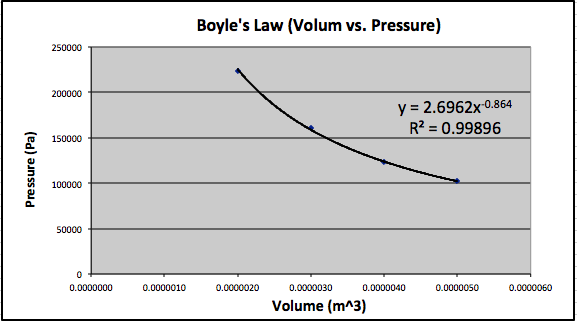
Boyle's law: at constant temperature the pressure of a fixed mass of gas is inversely proportional to its volume (P ∝ 1/V), so the P–V plot is a hyperbola — halving the volume doubles the pressure. Image: Reginaprice2013, CC BY-SA 3.0, via Wikimedia Commons.
Concept context
Discover why gases expand to fill any container while liquids flow and solids hold their shape. Master the gas laws, the ideal gas equation, and the reasons real gases deviate from ideal behavior.