Answer: the sum of the partial pressures.
- A the product of the partial pressures
- B the sum of the partial pressures
- C the average of the partial pressures
- D the largest partial pressure
Correct answer: B. the sum of the partial pressures
Explanation: Dalton’s law of partial pressures: P_total = p₁ + p₂ + p₃ + …
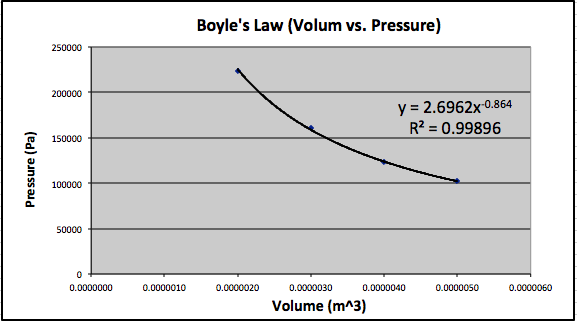
Boyle's law: at constant temperature the pressure of a fixed mass of gas is inversely proportional to its volume (P ∝ 1/V), so the P–V plot is a hyperbola — halving the volume doubles the pressure. Image: Reginaprice2013, CC BY-SA 3.0, via Wikimedia Commons.
Concept context
Discover why gases expand to fill any container while liquids flow and solids hold their shape. Master the gas laws, the ideal gas equation, and the reasons real gases deviate from ideal behavior.