Answer: The density of liquid and vapour phases become equal.
- A The density of liquid and vapour phases become equal
- B The vapour pressure becomes zero in general practice
- C The surface tension becomes infinite as frequently described
- D The viscosity of the liquid becomes zero in most textbook accounts
Correct answer: A. The density of liquid and vapour phases become equal
Explanation: At the critical point, the densities of the liquid and vapour phases become identical, so the two phases merge and the interface between them vanishes.
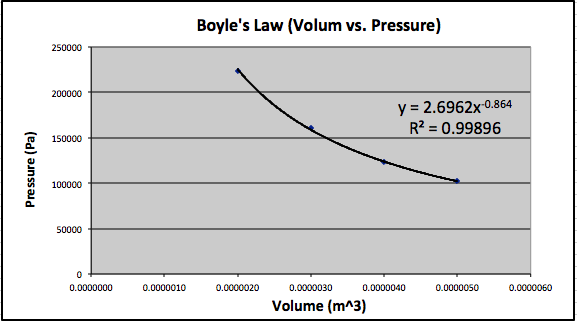
Boyle's law: at constant temperature the pressure of a fixed mass of gas is inversely proportional to its volume (P ∝ 1/V), so the P–V plot is a hyperbola — halving the volume doubles the pressure. Image: Reginaprice2013, CC BY-SA 3.0, via Wikimedia Commons.
Concept context
Discover why gases expand to fill any container while liquids flow and solids hold their shape. Master the gas laws, the ideal gas equation, and the reasons real gases deviate from ideal behavior.