Answer: The finite volume of gas molecules (term b) becomes the dominant correction, while intermolecular attraction becomes comparatively less significant.
- A Real gases tend to behave more like ideal gases as pressure rises well above a few atmospheres under usual circumstances according to most studies
- B The finite volume of gas molecules (term b) becomes the dominant correction, while intermolecular attraction becomes comparatively less significant
- C Both the molecular volume and intermolecular attraction terms shrink to a similar, comparable size in the majority of documented cases as widely reported
- D Intermolecular attraction (term a) becomes the dominant correction, while molecular volume becomes comparatively less significant in standard reference material
Correct answer: B. The finite volume of gas molecules (term b) becomes the dominant correction, while intermolecular attraction becomes comparatively less significant
Explanation: At high pressure, the volume term (b) becomes significant because molecules are compressed close together, while the relative effect of the attraction term (a/V<sup>2</sup>) diminishes since V is small and dominated by the b correction.
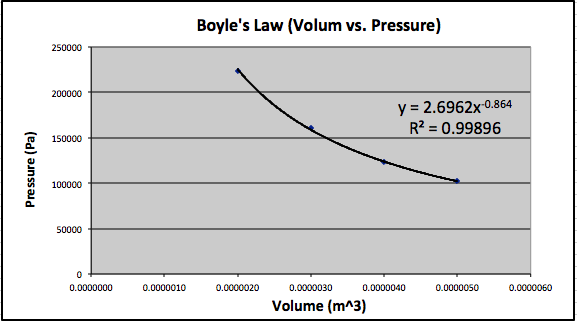
Boyle's law: at constant temperature the pressure of a fixed mass of gas is inversely proportional to its volume (P ∝ 1/V), so the P–V plot is a hyperbola — halving the volume doubles the pressure. Image: Reginaprice2013, CC BY-SA 3.0, via Wikimedia Commons.
Concept context
Discover why gases expand to fill any container while liquids flow and solids hold their shape. Master the gas laws, the ideal gas equation, and the reasons real gases deviate from ideal behavior.