🧪 Chemistry · Class 11 · NEET & JEE
Classification of Elements and Periodicity in Properties - Practice Questions with Answers
75 free MCQs on Classification of Elements and Periodicity in Properties with worked answers and explanations. The periodic table organises all 118 elements by atomic number and similar properties. Study periodic trends like atomic radius, ionization energy, and electronegativity, and learn how an element's position predicts its behaviour.
Take the timed Classification of Elements and Periodicity in Properties chapterwise test →Below are 75 practice questions on Classification of Elements and Periodicity in Properties, sorted Easy → Hard. Tap “Show answer & explanation” under any question to check yourself. Want the full theory first? Read the Classification of Elements and Periodicity in Properties notes.
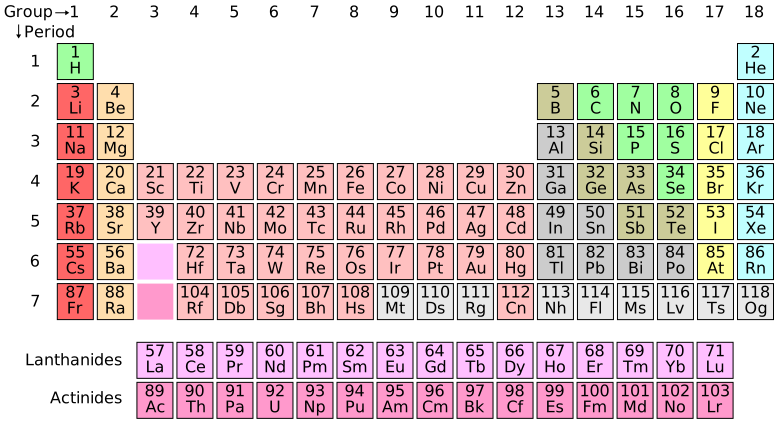
The complete modern periodic table (118 elements). Image: Cepheus et al., Public Domain, via Wikimedia Commons.
Easy - 25 questions
Q1.
In Dobereiner's triads, the atomic mass of the middle element is approximately:
- A the average of the other two elements
- B the sum of the other two elements
- C twice that of the lightest element
- D half that of the heaviest element
Show answer & explanation
Answer: A. the average of the other two elements
Why: In a Dobereiner triad of three elements with similar properties, the atomic mass of the middle element is roughly the arithmetic mean of the other two.
Q2.
Mendeleev arranged the elements in his periodic table in the increasing order of their:
- A atomic number
- B atomic mass
- C density
- D valency
Show answer & explanation
Answer: B. atomic mass
Why: Mendeleev's periodic law arranged elements by increasing atomic mass; the modern table later used atomic number instead.
Q3.
The modern periodic law states that the physical and chemical properties of elements are a periodic function of their:
- A atomic mass
- B number of neutrons
- C atomic number
- D density
Show answer & explanation
Answer: C. atomic number
Why: Moseley's work led to the modern periodic law: properties of elements are a periodic function of their atomic number.
Q4.
The number of elements present in the second period of the modern periodic table is:
Show answer & explanation
Answer: D. 8
Why: The second period runs from lithium to neon and contains 8 elements.
Q5.
Among Na, Mg, Al and Si, the element with the largest atomic size is:
Show answer & explanation
Answer: A. Na
Why: Atomic size decreases across a period as nuclear charge increases; Na, being leftmost in period 3, is the largest.
Q6.
How many periods are there in the modern periodic table?
Show answer & explanation
Answer: A. 7
Why: The modern periodic table has 7 horizontal rows called periods.
Q7.
How many groups (columns) are there in the modern periodic table?
Show answer & explanation
Answer: A. 18
Why: The modern periodic table has 18 vertical columns called groups.
Q8.
The modern periodic table is based on the atomic number. This was proposed by:
- A Moseley
- B Mendeleev
- C Dobereiner
- D Newlands
Show answer & explanation
Answer: A. Moseley
Why: Henry Moseley's work showed that atomic number (not atomic mass) is the basis of periodicity.
Q9.
Elements in the same group have the same:
- A Number of valence electrons
- B Atomic mass in most textbook accounts
- C Number of neutrons during normal conditions
- D Atomic radius as generally observed
Show answer & explanation
Answer: A. Number of valence electrons
Why: Elements in the same group have the same number of valence electrons, giving them similar chemical properties.
Q10.
Which element has the highest electronegativity?
- A Fluorine
- B Chlorine
- C Oxygen
- D Nitrogen
Show answer & explanation
Answer: A. Fluorine
Why: Fluorine is the most electronegative element (Pauling scale: 4.0).
Q11.
Atomic radius generally decreases across a period because:
- A Nuclear charge increases while electrons are added to the same shell
- B The number of occupied electron shells increases steadily in typical laboratory settings
- C Electron shielding from inner shells increases sharply under usual circumstances
- D Atomic mass decreases steadily across the period according to most researchers
Show answer & explanation
Answer: A. Nuclear charge increases while electrons are added to the same shell
Why: Increasing nuclear charge across a period pulls electrons closer without adding a new shell.
Q12.
Atomic radius generally increases down a group because:
- A New electron shells are added
- B Nuclear charge decreases
- C Electronegativity increases
- D Fewer protons
Show answer & explanation
Answer: A. New electron shells are added
Why: Each successive period adds a new electron shell, increasing the distance from the nucleus.
Q13.
Which element is the most reactive metal?
- A Caesium (Cs)
- B Sodium (Na)
- C Potassium (K)
- D Lithium (Li)
Show answer & explanation
Answer: A. Caesium (Cs)
Why: Caesium is the most reactive naturally occurring alkali metal, though francium is more reactive (but radioactive).
Q14.
The elements in Group 17 are called:
- A Halogens
- B Alkali metals
- C Noble gases
- D Transition metals
Show answer & explanation
Answer: A. Halogens
Why: Group 17 elements (F, Cl, Br, I, At) are called halogens ('salt-formers').
Q15.
The elements in Group 18 are called:
- A Noble gases
- B Halogens
- C Alkali metals
- D Alkaline earth metals
Show answer & explanation
Answer: A. Noble gases
Why: Group 18 elements are noble (inert) gases; they have complete valence shells.
Q16.
The first element in the periodic table is:
- A Hydrogen
- B Helium
- C Lithium
- D Carbon
Show answer & explanation
Answer: A. Hydrogen
Why: Hydrogen (atomic number 1) is the first element in the periodic table.
Q17.
Which property increases across a period (left to right)?
- A Ionisation energy
- B Atomic radius
- C Metallic character
- D Electropositive character
Show answer & explanation
Answer: A. Ionisation energy
Why: Ionisation energy generally increases across a period as the nuclear charge pulls electrons more tightly.
Q18.
Mendeleev predicted the existence of undiscovered elements by leaving gaps. He called them by names like:
- A Eka-aluminium, Eka-silicon
- B Proto-metal in the majority of cases studied
- C Pseudo-metals as widely reported
- D Quasi-elements in standard practice
Show answer & explanation
Answer: A. Eka-aluminium, Eka-silicon
Why: Mendeleev used the prefix 'eka-' (Sanskrit for 'one beyond') to name predicted undiscovered elements.
Q19.
The law of triads was proposed by:
- A Dobereiner
- B Mendeleev
- C Newlands
- D Moseley
Show answer & explanation
Answer: A. Dobereiner
Why: Dobereiner (1829) observed that the atomic mass of the middle element of a triad is the average of the other two.
Q20.
Which block contains the transition metals?
- A d-block
- B s-block
- C p-block
- D f-block
Show answer & explanation
Answer: A. d-block
Why: Transition metals occupy the d-block (Groups 3-12) of the periodic table.
Q21.
The lanthanides and actinides are in which block?
- A f-block
- B d-block
- C p-block
- D s-block
Show answer & explanation
Answer: A. f-block
Why: Lanthanides and actinides are inner transition metals belonging to the f-block.
Q22.
Which element is a metalloid?
- A Silicon
- B Sodium
- C Sulfur
- D Selenium
Show answer & explanation
Answer: A. Silicon
Why: Silicon is a metalloid (semi-metal) with properties intermediate between metals and non-metals.
Q23.
Period 3 elements include:
- A Na, Mg, Al, Si, P, S, Cl, Ar
- B Li, Be, B, C, N, O, F, Ne
- C K, Ca, Sc...
- D H, He
Show answer & explanation
Answer: A. Na, Mg, Al, Si, P, S, Cl, Ar
Why: Period 3 spans from sodium (Na, Z=11) to argon (Ar, Z=18).
Q24.
Electron affinity is the energy released when:
- A A neutral atom gains an electron
- B A cation loses an electron
- C An atom forms a cation
- D Two atoms bond
Show answer & explanation
Answer: A. A neutral atom gains an electron
Why: Electron affinity measures the energy change when a neutral gaseous atom gains an electron to form an anion.
Q25.
Which element has the lowest first ionisation energy among noble gases?
- A Radon (Rn)
- B Helium (He)
- C Neon (Ne)
- D Argon (Ar)
Show answer & explanation
Answer: A. Radon (Rn)
Why: Radon is the largest noble gas; its outermost electrons are furthest from the nucleus and easiest to remove.
Medium - 25 questions
Q26.
Which of the following elements has the highest second ionisation enthalpy?
Show answer & explanation
Answer: C. Na
Why: After losing one electron, Na<sup>+</sup> attains the stable Ne configuration, so removing a second electron needs exceptionally high energy.
Q27.
Beryllium shows a diagonal relationship in the periodic table with which element?
- A Boron
- B Magnesium
- C Aluminium
- D Silicon
Show answer & explanation
Answer: C. Aluminium
Why: Due to similar charge/size ratios, Be resembles Al (diagonally placed), sharing properties such as amphoteric oxides and covalent halides.
Q28.
The increasing order of ionic radius for the isoelectronic species Na<sup>+</sup>, Mg<sup>2+</sup>, F<sup>-</sup> and O<sup>2-</sup> is:
- A O<sup>2-</sup> < F<sup>-</sup> < Na<sup>+</sup> < Mg<sup>2+</sup>
- B Na<sup>+</sup> < Mg<sup>2+</sup> < F<sup>-</sup> < O<sup>2-</sup>
- C F<sup>-</sup> < O<sup>2-</sup> < Na<sup>+</sup> < Mg<sup>2+</sup>
- D Mg<sup>2+</sup> < Na<sup>+</sup> < F<sup>-</sup> < O<sup>2-</sup>
Show answer & explanation
Answer: D. Mg<sup>2+</sup> < Na<sup>+</sup> < F<sup>-</sup> < O<sup>2-</sup>
Why: For isoelectronic species, the higher the nuclear charge the smaller the radius, so size increases as Mg<sup>2+</sup> < Na<sup>+</sup> < F<sup>-</sup> < O<sup>2-</sup>.
Q29.
The correct order of first ionisation enthalpy for the elements B, C, N and O is:
- A B < C < O < N
- B B < C < N < O
- C O < N < C < B
- D C < B < O < N
Show answer & explanation
Answer: A. B < C < O < N
Why: Ionisation enthalpy rises across the period, but N (half-filled 2p<sup>3</sup>) exceeds O, giving the order B < C < O < N.
Q30.
The shielding (screening) effect exerted by electrons in different subshells follows the order:
- A f > d > p > s
- B s > p > d > f
- C p > s > d > f
- D d > p > s > f
Show answer & explanation
Answer: B. s > p > d > f
Why: The more penetrating an orbital, the better it screens; penetration (and hence shielding) decreases in the order s > p > d > f.
Q31.
The effective nuclear charge (Zeff) increases across a period because:
- A Shielding remains roughly constant while nuclear charge increases
- B Shielding from inner electrons increases faster than nuclear charge
- C The total electron count decreases steadily across the period
- D Atomic mass decreases steadily across the period
Show answer & explanation
Answer: A. Shielding remains roughly constant while nuclear charge increases
Why: Core electrons provide roughly constant shielding; adding protons increases Zeff and pulls valence electrons in.
Q32.
Ionisation energy of sulfur (S) is lower than phosphorus (P) even though S has higher atomic number. This is because:
- A Phosphorus has a half-filled 3p subshell (extra stability)
- B Sulfur simply has more total electrons than phosphorus
- C Phosphorus has a lower nuclear charge than sulfur
- D Sulfur has a noticeably larger atomic radius than phosphorus
Show answer & explanation
Answer: A. Phosphorus has a half-filled 3p subshell (extra stability)
Why: Phosphorus has a half-filled 3p<sup>3</sup> configuration, which is extra stable; pairing in S's 3p<sup>4</sup> makes one electron easier to remove.
Q33.
Which element has the highest first ionisation energy in period 2?
- A Neon (Ne)
- B Fluorine (F)
- C Nitrogen (N)
- D Oxygen (O)
Show answer & explanation
Answer: A. Neon (Ne)
Why: Neon has a fully filled valence shell (2p<sup>6</sup>), giving the highest first ionisation energy in period 2.
Q34.
The electron affinity of fluorine is less than that of chlorine because:
- A F's small size causes electron-electron repulsion in the compact 2p subshell
- B Fluorine generally has fewer protons in its nucleus than chlorine as widely reported
- C Fluorine is less electronegative than chlorine on the Pauling scale in standard practice
- D Fluorine has a noticeably larger atomic radius than chlorine under most conditions encountered
Show answer & explanation
Answer: A. F's small size causes electron-electron repulsion in the compact 2p subshell
Why: Fluorine's small atomic size leads to significant electron repulsion when an extra electron is added to the already crowded 2p shell.
Q35.
Diagonal relationship in the periodic table exists between:
- A Li & Mg, Be & Al, B & Si
- B Li & Na, Be & Ca as frequently observed in practice
- C H & Li in many documented cases
- D C & Si according to conventional understanding
Show answer & explanation
Answer: A. Li & Mg, Be & Al, B & Si
Why: Diagonal relationships occur between elements diagonally adjacent (e.g., Li-Mg, Be-Al) due to similar charge/radius ratio.
Q36.
The shielding effect of orbitals follows the order:
- A s > p > d > f
- B f > d > p > s
- C p > s > d > f
- D d > f > s > p
Show answer & explanation
Answer: A. s > p > d > f
Why: s orbitals are closest to the nucleus and shield most effectively; shielding decreases as orbital distance increases.
Q37.
Screening constant in Slater's rules: electrons in the same shell contribute a shielding constant of:
- A 0.35 per electron
- B 0.85 per electron
- C 1.00 per electron
- D 0 per electron
Show answer & explanation
Answer: A. 0.35 per electron
Why: According to Slater's rules, each other electron in the same shell contributes 0.35 to the shielding constant.
Q38.
Second ionisation energy is always greater than first ionisation energy because:
- A Electron is removed from a positive ion with higher nuclear charge attraction
- B The electron configuration rearranges into a higher-energy state in routine practice
- C The surrounding temperature rises during ionisation overall in most cases
- D The resulting ion becomes larger than the neutral atom under typical conditions
Show answer & explanation
Answer: A. Electron is removed from a positive ion with higher nuclear charge attraction
Why: After losing the first electron, the remaining electrons experience greater effective nuclear charge, so more energy is needed.
Q39.
The period number corresponds to the:
- A Principal quantum number of the outermost electron
- B The total number of valence electrons in the outer shell
- C The group number assigned to that element's column
- D The atomic number of the first element in that row
Show answer & explanation
Answer: A. Principal quantum number of the outermost electron
Why: The period number equals the principal quantum number (n) of the valence shell of that period's elements.
Q40.
Why do noble gases have very high ionisation energies?
- A They have completely filled valence shells with high Zeff
- B They have unusually large atomic radii compared to their period
- C They possess very few electrons in their outer shell
- D They are inherently radioactive elements
Show answer & explanation
Answer: A. They have completely filled valence shells with high Zeff
Why: Noble gases have fully filled valence shells and the highest Zeff in their period, requiring maximum energy to ionise.
Q41.
Metallic character decreases across a period because:
- A Ionisation energy increases and the tendency to lose electrons decreases
- B Atomic mass steadily decreases from left to right according to standard textbooks
- C The total number of electrons decreases across the period in general practice
- D Valence electrons are progressively removed across the period as frequently described
Show answer & explanation
Answer: A. Ionisation energy increases and the tendency to lose electrons decreases
Why: Across a period, increasing nuclear charge holds valence electrons more tightly, reducing the tendency to form cations.
Q42.
The oxidising power of halogens follows the order:
- A F<sub>2</sub> > Cl<sub>2</sub> > Br<sub>2</sub> > I<sub>2</sub>
- B I<sub>2</sub> > Br<sub>2</sub> > Cl<sub>2</sub> > F<sub>2</sub>
- C Cl<sub>2</sub> > F<sub>2</sub> > Br<sub>2</sub> > I<sub>2</sub>
- D All equal
Show answer & explanation
Answer: A. F<sub>2</sub> > Cl<sub>2</sub> > Br<sub>2</sub> > I<sub>2</sub>
Why: Oxidising power (electron-gaining tendency) decreases down Group 17 as atomic radius increases and electron affinity decreases.
Q43.
Which element in period 3 has the highest ionisation energy?
- A Argon (Ar)
- B Chlorine (Cl)
- C Phosphorus (P)
- D Silicon (Si)
Show answer & explanation
Answer: A. Argon (Ar)
Why: Argon (noble gas) has the highest ionisation energy in period 3 due to its filled valence shell.
Q44.
Electronegativity increases across a period and decreases down a group. This is due to:
- A Changes in atomic radius and effective nuclear charge
- B Atomic mass alone, independent of nuclear charge or radius
- C The number of neutrons present in the nucleus
- D Electron configuration alone, independent of radius or charge
Show answer & explanation
Answer: A. Changes in atomic radius and effective nuclear charge
Why: Smaller atoms with higher Zeff attract bonding electrons more strongly, increasing electronegativity.
Q45.
The oxide of which period 3 element is amphoteric?
- A Al<sub>2</sub>O<sub>3</sub>
- B Na<sub>2</sub>O
- C P<sub>2</sub>O<sub>5</sub>
- D SiO<sub>2</sub>
Show answer & explanation
Answer: A. Al<sub>2</sub>O<sub>3</sub>
Why: Aluminium oxide (Al<sub>2</sub>O<sub>3</sub>) is amphoteric; it reacts with both acids and bases.
Q46.
Anomalous properties of Li compared to other alkali metals are due to:
- A Its very small size giving high charge density and polarising power
- B Its position as the most reactive metal in Group 1
- C Its unusually low melting point relative to the other alkali metals
- D Its comparatively low first ionisation energy among Group 1 metals
Show answer & explanation
Answer: A. Its very small size giving high charge density and polarising power
Why: Lithium's tiny ionic radius gives it a very high charge/radius ratio, causing it to behave more like Mg (diagonal relationship).
Q47.
The first element in each period (alkali metals, except Period 1) is in which block?
- A s-block
- B p-block
- C d-block
- D f-block
Show answer & explanation
Answer: A. s-block
Why: Alkali metals have the electron configuration [noble gas] ns<sup>1</sup>, so they are in the s-block.
Q48.
Ionisation energy shows a dip between Group 2 and Group 13 because:
- A The p orbital electron is easier to remove than the s orbital electron
- B Group 13 elements simply have more protons in the nucleus
- C Group 2 elements experience unusually higher electron shielding
- D The extra electron in Group 13 is added to an inner shell
Show answer & explanation
Answer: A. The p orbital electron is easier to remove than the s orbital electron
Why: Going from Group 2 (s<sup>2</sup>) to Group 13 (s<sup>2</sup>p<sup>1</sup>), the p electron is higher in energy and more shielded than the s electrons.
Q49.
Which period 2 element forms the most stable +3 ion?
- A Aluminium (period 3 actually)
- B Nitrogen
- C Carbon
- D Oxygen
Show answer & explanation
Answer: B. Nitrogen
Why: Nitrogen (Group 15) can form N<sup>3-</sup> rather than a cation, but among the choices, N has a stable +3 state in certain coordination compounds. Actually the question is better answered as Al in period 3 - but that's period 3. Among period 2 elements, boron forms +3 with high ionisation energies compensated by hydration.
Q50.
Isoelectronic species have the same:
- A Number of electrons
- B Number of protons
- C Atomic mass
- D Atomic number
Show answer & explanation
Answer: A. Number of electrons
Why: Isoelectronic species (e.g., N<sup>3-</sup>, O<sup>2-</sup>, F-, Ne, Na+) have the same number of electrons but different nuclear charges.
Hard - 25 questions
Q51.
The successive ionisation enthalpies (kJ mol<sup>-1</sup>) of an element are 738, 1451, 7733 and 10540. The element most likely belongs to:
- A Group 1
- B Group 13
- C Group 2
- D Group 14
Show answer & explanation
Answer: C. Group 2
Why: The large jump after the 2nd ionisation shows only two easily removed electrons, indicating two valence electrons, i.e. a Group 2 element (magnesium).
Q52.
Among Na, Mg, Al and K, the element with the highest second ionisation enthalpy is:
Show answer & explanation
Answer: D. Na
Why: After losing one electron, Na<sup>+</sup> attains the stable neon configuration, so removing a second electron is extremely difficult, giving Na the highest second ionisation enthalpy.
Q53.
As a direct consequence of the lanthanide contraction, which pair of elements has almost identical atomic radii?
- A Zr and Hf
- B Fe and Co
- C Na and K
- D Cu and Ag
Show answer & explanation
Answer: A. Zr and Hf
Why: The lanthanide contraction nearly cancels the expected size increase from period 5 to 6, making Zr and Hf almost equal in size.
Q54.
The general formula of the highest (most common) oxide formed by an element of Group 15 is:
- A EO<sub>2</sub>
- B E<sub>2</sub>O<sub>3</sub>
- C E<sub>2</sub>O<sub>5</sub>
- D EO<sub>3</sub>
Show answer & explanation
Answer: C. E<sub>2</sub>O<sub>5</sub>
Why: Group 15 elements have 5 valence electrons, and their highest oxide corresponds to the +5 state, giving the formula E<sub>2</sub>O<sub>5</sub>.
Q55.
According to IUPAC nomenclature for elements with atomic number greater than 100, the element with atomic number 104 is named:
- A Unniltrium
- B Unnilquadium
- C Unnilpentium
- D Ununbium
Show answer & explanation
Answer: B. Unnilquadium
Why: Using the roots un (1), nil (0) and quad (4), the systematic name for element 104 is Unnilquadium (symbol Unq).
Q56.
The successive ionisation energies of magnesium show a large jump between the 2nd and 3rd ionisation energies. This indicates:
- A Mg has 2 valence electrons (after removing 2, the 3rd comes from a noble gas core)
- B Mg actually has 3 valence electrons available for removal
- C The third electron occupies a higher principal energy level than the first two
- D Mg behaves as a transition metal with variable oxidation states
Show answer & explanation
Answer: A. Mg has 2 valence electrons (after removing 2, the 3rd comes from a noble gas core)
Why: After removing 2 valence electrons, the 3rd must come from the filled 2p<sup>6</sup> shell (noble gas core), requiring much more energy.
Q57.
Using Slater's rules, the effective nuclear charge for a 3p electron in chlorine (Z=17) is approximately:
Show answer & explanation
Answer: A. 6.10
Why: For Cl 3p: Z*=17 - [2(1.00) + 8(0.85) + 6(0.35)] = 17 - [2 + 6.8 + 2.1] = 17 - 10.9 = 6.1.
Q58.
Fluorine's electron affinity (-328 kJ/mol) is less negative than chlorine's (-349 kJ/mol). This anomaly is best explained by:
- A High electron-electron repulsion in the compact 2p subshell of fluorine
- B Fluorine's notably higher electronegativity value on the Pauling scale
- C Fluorine's higher first ionisation energy compared to chlorine
- D Chlorine's greater nuclear charge compared to fluorine
Show answer & explanation
Answer: A. High electron-electron repulsion in the compact 2p subshell of fluorine
Why: Fluorine's extremely small 2p orbitals are already quite crowded; adding another electron causes more repulsion than in the larger 3p of Cl.
Q59.
The second electron affinity of oxygen is endothermic (+744 kJ/mol) because:
- A Adding an electron to O- (a negative ion) requires energy to overcome repulsion
- B Oxygen's atomic radius is generally too small to accept another electron in typical laboratory settings
- C Oxygen has an unusually low electronegativity for its period under usual circumstances
- D The process instead forms an unstable O<sup>3-</sup> trianion intermediate according to most researchers
Show answer & explanation
Answer: A. Adding an electron to O- (a negative ion) requires energy to overcome repulsion
Why: The first EA is exothermic (neutral O gains e-), but the second EA is endothermic because adding e- to an already negative O- requires overcoming electrostatic repulsion.
Q60.
Elements of the 6th and 7th period in Groups 4-10 have nearly identical atomic radii to their 5th period counterparts. This is called:
- A Lanthanide contraction
- B Actinide expansion
- C Diagonal relationship
- D Inert pair effect
Show answer & explanation
Answer: A. Lanthanide contraction
Why: Lanthanide contraction: filling of 4f orbitals (poor shielding) causes a gradual size decrease, making 5d elements nearly the same size as their 4d analogues.
Q61.
The 'inert pair effect' in Group 14 and 15 heavy elements (Pb, Bi) refers to:
- A Reluctance of the 6s<sup>2</sup> electrons to participate in bonding
- B The complete loss of all valence electrons during bonding
- C The unusually high reactivity of the inner d electrons
- D The preferential formation of purely metallic bonds in these elements
Show answer & explanation
Answer: A. Reluctance of the 6s<sup>2</sup> electrons to participate in bonding
Why: In heavy p-block elements (Pb, Bi, Tl), the 6s<sup>2</sup> electrons are stabilised by relativistic effects and poor shielding, making them non-bonding.
Q62.
Why does phosphorus form PCl<sub>5</sub> but nitrogen does not form NCl<sub>5</sub>?
- A N has no available d orbitals to expand beyond octet; P uses 3d orbitals
- B Nitrogen is less electronegative than phosphorus in the majority of cases studied
- C Phosphorus has a higher first ionisation energy than nitrogen as widely reported
- D Nitrogen behaves as a metal rather than a non-metal in standard practice
Show answer & explanation
Answer: A. N has no available d orbitals to expand beyond octet; P uses 3d orbitals
Why: Nitrogen is in period 2 (2s and 2p only, no d orbitals); phosphorus is in period 3 and can use 3d orbitals for expanded octet.
Q63.
Across period 3 (Na to Cl), the oxides change from basic to acidic. The amphoteric oxide is:
- A Al<sub>2</sub>O<sub>3</sub>
- B MgO
- C P<sub>2</sub>O<sub>5</sub>
- D SiO<sub>2</sub>
Show answer & explanation
Answer: A. Al<sub>2</sub>O<sub>3</sub>
Why: Al<sub>2</sub>O<sub>3</sub> is the amphoteric oxide in period 3, reacting with both strong acids (H<sub>2</sub>SO<sub>4</sub>) and strong bases (NaOH).
Q64.
The Bohr-Bury rule states that the maximum number of electrons in any shell is:
- A 2n<sup>2</sup>
- B n<sup>2</sup>
- C 2n
- D 4n<sup>2</sup>
Show answer & explanation
Answer: A. 2n<sup>2</sup>
Why: The maximum number of electrons in the nth shell is 2n<sup>2</sup> (e.g., n=1: 2; n=2: 8; n=3: 18).
Q65.
Which period 4 element has an anomalous electronic configuration [Ar]3d<sup>5</sup> 4s<sup>1</sup> instead of [Ar]3d<sup>4</sup> 4s<sup>2</sup>?
- A Chromium (Cr)
- B Calcium (Ca)
- C Titanium (Ti)
- D Vanadium (V)
Show answer & explanation
Answer: A. Chromium (Cr)
Why: Chromium adopts [Ar]3d<sup>5</sup> 4s<sup>1</sup> because a half-filled 3d subshell (d<sup>5</sup>) is extra stable.
Q66.
The Newlands' law of octaves failed because:
- A It did not work for elements beyond calcium and did not account for undiscovered elements
- B It used the atomic mass values of the elements incorrectly under most conditions encountered
- C It largely ignored the existence of isotopes of each element as frequently observed in practice
- D It deliberately placed metals and non-metals in the same octave group in many documented cases
Show answer & explanation
Answer: A. It did not work for elements beyond calcium and did not account for undiscovered elements
Why: Newlands' octaves broke down after calcium; he also placed two elements in the same position, and the law did not predict new elements.
Q67.
In which group does the element with configuration [Xe] 4f<sup>14</sup> 5d<sup>6</sup> 6s<sup>2</sup> belong?
- A Group 8 (d-block, 5d series = Osmium Os)
- B Group 6, matching the chromium-molybdenum-tungsten family
- C Group 18, the noble gas family with filled valence shells
- D Group 2, the alkaline earth metal family
Show answer & explanation
Answer: A. Group 8 (d-block, 5d series = Osmium Os)
Why: [Xe] 4f<sup>14</sup> 5d<sup>6</sup> 6s<sup>2</sup>: 5d<sup>6</sup> means 6 d-electrons in period 6. Group = 6+2 = 8. This is Osmium (Os).
Q68.
Pauling's electronegativity scale is based on:
- A Bond energy data (extra ionic resonance energy)
- B Ionisation energy values alone, without bond energy data
- C Electron affinity values alone, without bond energy data
- D Atomic radius measurements alone, without bond energy data
Show answer & explanation
Answer: A. Bond energy data (extra ionic resonance energy)
Why: Pauling defined electronegativity using the extra bond energy above the geometric mean of homonuclear bond energies (ionic resonance).
Q69.
The isoelectronic series O<sup>2-</sup>, F-, Ne, Na+, Mg<sup>2+</sup> all have 10 electrons. Their ionic radii decrease because:
- A Increasing nuclear charge attracts the same 10 electrons more strongly
- B Each successive species actually has fewer than 10 electrons according to conventional understanding
- C Electron shielding increases steadily across the series in routine practice
- D Each species occupies a different number of electron shells overall
Show answer & explanation
Answer: A. Increasing nuclear charge attracts the same 10 electrons more strongly
Why: Same electron count (10), but Z increases from 8 (O) to 12 (Mg); greater nuclear charge compresses the electron cloud.
Q70.
Which factor primarily determines the position of hydrogen in the periodic table as ambiguous?
- A It can lose one electron like alkali metals (1s<sup>1</sup>) but also gain one like halogens (1s<sup>2</sup>)
- B It exists as a diatomic gas under ordinary atmospheric conditions like the halogens
- C Its most abundant isotope, protium, contains no neutron in its nucleus in general practice
- D It is generally the lightest and smallest element found on the entire periodic table
Show answer & explanation
Answer: A. It can lose one electron like alkali metals (1s<sup>1</sup>) but also gain one like halogens (1s<sup>2</sup>)
Why: Hydrogen can form H+ (like alkali metals) or H- (like halogens), making its placement in Group 1 or Group 17 debatable.
Q71.
The period 4 transition metals show irregular filling because 3d and 4s energies are close. Copper's configuration is [Ar]3d<sup>10</sup> 4s<sup>1</sup> (not 3d<sup>9</sup> 4s<sup>2</sup>) because:
- A A completely filled 3d<sup>10</sup> is extra stable, as is d<sup>5</sup>
- B 3d orbitals are always lower in energy than the 4s orbital
- C The 4s orbital is filled before the 3d orbital in every transition metal
- D Copper's odd atomic number forces an unpaired 4s electron
Show answer & explanation
Answer: A. A completely filled 3d<sup>10</sup> is extra stable, as is d<sup>5</sup>
Why: A fully filled 3d<sup>10</sup> subshell (like half-filled d<sup>5</sup>) has extra stability due to symmetrical electron distribution and exchange energy.
Q72.
Moseley's experiment showed a linear relationship between sqrt(frequency of X-ray) and:
- A Atomic number (Z)
- B Atomic mass
- C Number of neutrons
- D Group number
Show answer & explanation
Answer: A. Atomic number (Z)
Why: Moseley found that sqrt(nu) is proportional to (Z - sigma), establishing atomic number as the fundamental property of an element.
Q73.
The reason the 3d subshell fills before 4p but after 4s in order of energy is explained by:
- A n+l rule: subshell with lower n+l fills first; if equal, lower n fills first
- B A simple rule that the lowest n value always fills first regardless of l
- C Shielding provided specifically by the 4s electrons pushes 3d lower
- D Unpredictable quantum fluctuations that vary by element
Show answer & explanation
Answer: A. n+l rule: subshell with lower n+l fills first; if equal, lower n fills first
Why: The Aufbau principle uses the (n+l) rule: 4s (n+l=4) fills before 3d (n+l=5). After filling, 3d is lower in energy than 4s in transition metal ions.
Q74.
Van der Waals radius is always larger than covalent radius for the same element because:
- A It represents the distance in non-bonded contact (weak attraction), while covalent radius is within a bond
- B The two radii are conventionally reported using largely different units of measurement in most cases
- C The comparison is actually being made between two chemically different elements under typical conditions
- D The two radii are generally measured at very different experimental temperatures according to standard textbooks
Show answer & explanation
Answer: A. It represents the distance in non-bonded contact (weak attraction), while covalent radius is within a bond
Why: Covalent radius = half the internuclear distance in a homonuclear bond; van der Waals radius = half the distance in non-bonded contact, which is always larger.
Q75.
Predicted by Mendeleev, which element confirmed his predictions most spectacularly?
- A Germanium (eka-silicon, discovered 1886)
- B Silicon, whose properties were already well known before Mendeleev
- C Gallium, discovered independently without matching a gap prediction
- D Scandium, discovered before Mendeleev published his periodic law
Show answer & explanation
Answer: A. Germanium (eka-silicon, discovered 1886)
Why: Germanium's discovery in 1886 closely matched Mendeleev's eka-silicon predictions for atomic mass, density, and oxide properties.