Answer: Agents that cause birth defects; most harmful during organogenesis (weeks 3-8 of embryonic period) when organs are forming; different organ systems have specific sensitive periods.
- A Teratogens are sometimes thought to be actually beneficial agents that meaningfully support healthy fetal growth and organ development throughout pregnancy as widely reported
- B Agents that cause birth defects; most harmful during organogenesis (weeks 3-8 of embryonic period) when organs are forming; different organ systems have specific sensitive periods
- C Teratogens are sometimes understood to be equally harmful across most stage of pregnancy, with little particular sensitive window identified in standard practice under most conditions encountered
- D Teratogens are sometimes thought to affect mainly neural tissue specifically, sparing most other developing organ systems from harmful effects as frequently observed in practice
Correct answer: B. Agents that cause birth defects; most harmful during organogenesis (weeks 3-8 of embryonic period) when organs are forming; different organ systems have specific sensitive periods
Explanation: Teratogens (drugs, radiation, viruses, chemicals) cause structural malformations: most harm during organogenesis (weeks 3-8). Each organ has a specific critical period. Week 3-4: neural tube; week 4: heart, limbs; week 5-6: ears, eyes, limbs. After organogenesis, mainly cause growth restriction. Thalidomide: limb defects; rubella: heart, eyes, hearing; alcohol: fetal alcohol syndrome.
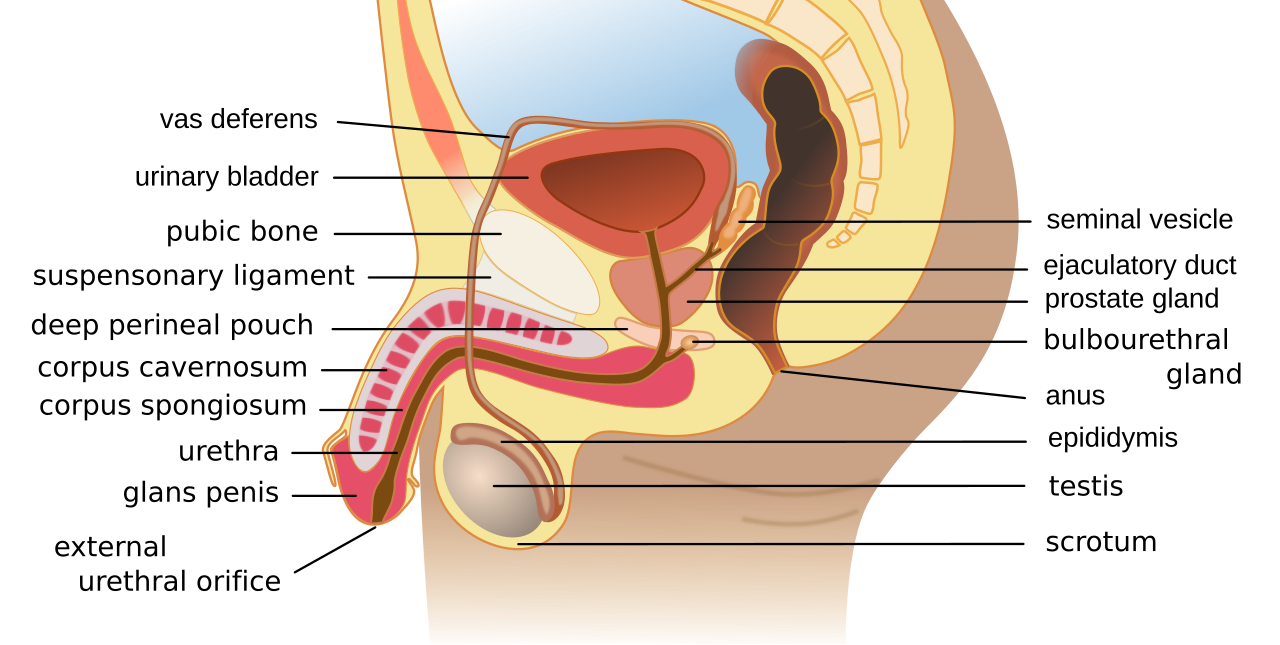
The human male reproductive system: sperm formed in the testis mature in the epididymis and travel via the vas deferens, mixing with secretions of the seminal vesicle, prostate and bulbourethral glands. Image: Wumingbai, CC BY-SA 4.0, via Wikimedia Commons.
Concept context
Male and female reproductive systems, gametogenesis, fertilization, implantation, pregnancy, and reproductive health.