⚛️ Physics · Class 11 · NEET & JEE
Motion in a Plane - Practice Questions with Answers
68 free MCQs on Motion in a Plane with worked answers and explanations. Vectors, projectile motion, uniform circular motion, and relative velocity - the foundation of 2D kinematics for NEET and JEE.
Take the timed Motion in a Plane chapterwise test →Below are 68 practice questions on Motion in a Plane, sorted Easy → Hard. Tap “Show answer & explanation” under any question to check yourself. Want the full theory first? Read the Motion in a Plane notes.
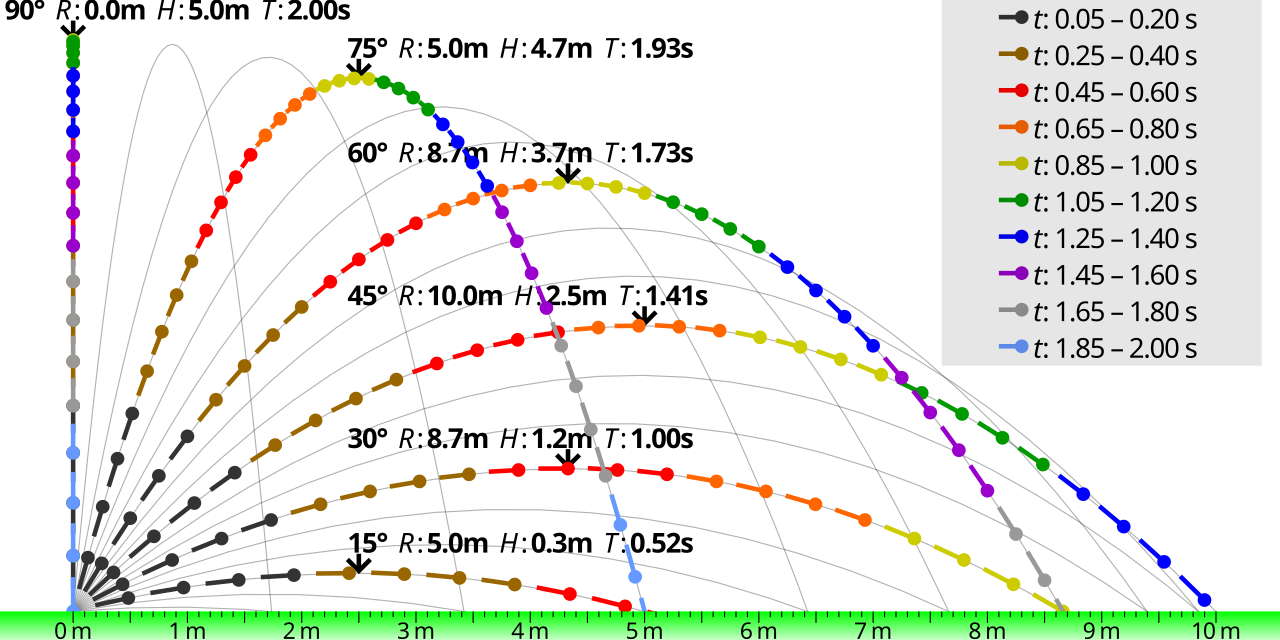
Projectiles at equal speed: range is maximum at 45°, and complementary angles (30° and 60°) share the same range. Image: Cmglee, CC BY-SA 3.0, via Wikimedia Commons.
Easy - 20 questions
Q1.
A stone is thrown vertically upward. At the highest point, its velocity is:
- A Maximum
- B Equal to initial
- C Zero
- D 9.8 m/s
Show answer & explanation
Answer: C. Zero
Why: At the highest point, the vertical component of velocity becomes zero before the stone returns.
Q2.
A car decelerates from 20 m/s to rest in 4 seconds. Its deceleration is:
- A 2.5 m/s²
- B 4 m/s²
- C 5 m/s²
- D 8 m/s²
Show answer & explanation
Answer: C. 5 m/s²
Why: a = (v-u)/t = (0-20)/4 = -5 m/s². Deceleration = 5 m/s².
Q3.
Relative velocity of a body A with respect to B is given by:
- A vA + vB
- B vA - vB
- C vB - vA
- D |vA| - |vB|
Show answer & explanation
Answer: B. vA - vB
Why: Relative velocity of A with respect to B = vA - vB.
Q4.
A runner completes one full lap around a circular track of radius R. The displacement is:
Show answer & explanation
Answer: D. Zero
Why: After one full lap, the runner returns to the starting point. Net displacement = 0.
Q5.
A body starts from rest and travels 45 m in 3 seconds with uniform acceleration. The acceleration is:
- A 5 m/s²
- B 8 m/s²
- C 10 m/s²
- D 15 m/s²
Show answer & explanation
Answer: C. 10 m/s²
Why: s = ½at² → 45 = ½×a×9 → a = 10 m/s².
Q6.
If a body moves with constant speed in a circular path, what changes?
- A Speed
- B Kinetic energy
- C Velocity
- D Mass
Show answer & explanation
Answer: C. Velocity
Why: In circular motion at constant speed, direction changes continuously, so velocity (a vector) changes.
Q7.
A body moving at 10 m/s is brought to rest by a constant force. If deceleration is 2 m/s², the time taken is:
Show answer & explanation
Answer: B. 5 s
Why: v = u + at → 0 = 10 + (-2)t → t = 5 s.
Q8.
Which graph represents uniform acceleration?
- A Horizontal line on v-t graph
- B Straight sloped line on v-t graph
- C Curved line on s-t graph starting at origin
- D Circle on v-t graph
Show answer & explanation
Answer: B. Straight sloped line on v-t graph
Why: Uniform acceleration means velocity changes at constant rate: a straight sloped line on v-t graph.
Q9.
A projectile is launched horizontally. Which component of its velocity remains constant throughout?
- A Vertical
- B Both horizontal and vertical
- C Horizontal
- D Neither
Show answer & explanation
Answer: C. Horizontal
Why: In projectile motion, there is no horizontal force, so horizontal velocity remains constant.
Q10.
An athlete runs 400 m around a track and returns to the start. Distance covered is:
Show answer & explanation
Answer: C. 400 m
Why: Distance is the total path length = 400 m. Displacement = 0 since they returned to start.
Q11.
A ball is thrown horizontally from a height h. The time to reach the ground depends on:
- A Horizontal speed only
- B Both horizontal and vertical
- C Vertical height only
- D Neither
Show answer & explanation
Answer: C. Vertical height only
Why: Time to fall depends only on vertical height h: t = √(2h/g). Horizontal speed does not affect fall time.
Q12.
A physical quantity having both magnitude and direction is a:
- A vector
- B scalar
- C unit
- D dimension
Show answer & explanation
Answer: A. vector
Why: Vectors, such as velocity and force, have both magnitude and direction.
Q13.
The resultant of two vectors is commonly found using the:
- A parallelogram law
- B Ohm's circuit law
- C Hooke's elastic law
- D Boyle's gas law
Show answer & explanation
Answer: A. parallelogram law
Why: The parallelogram law of vector addition gives the resultant of two vectors.
Q14.
The magnitude of any vector is always:
- A non-negative
- B negative
- C exactly zero
- D imaginary
Show answer & explanation
Answer: A. non-negative
Why: A magnitude represents a length, which cannot be negative.
Q15.
A unit vector has a magnitude of:
Show answer & explanation
Answer: A. 1
Why: A unit vector has magnitude 1 and only indicates direction.
Q16.
Projectile motion takes place in:
- A two dimensions
- B one dimension
- C three dimensions
- D zero dimensions
Show answer & explanation
Answer: A. two dimensions
Why: A projectile moves in a vertical plane, combining horizontal and vertical motion - two dimensions.
Q17.
The horizontal component of a projectile’s velocity is:
- A constant
- B steadily increasing
- C steadily decreasing
- D always zero
Show answer & explanation
Answer: A. constant
Why: With no horizontal force (ignoring air resistance), the horizontal velocity stays constant.
Q18.
The trajectory (path) of a projectile is a:
- A parabola
- B straight line
- C perfect circle
- D wide ellipse
Show answer & explanation
Answer: A. parabola
Why: Combining uniform horizontal motion with uniformly accelerated vertical motion gives a parabola.
Q19.
The acceleration of a projectile is directed:
- A downward, equal to g
- B vertically upward
- C horizontally forward
- D exactly zero
Show answer & explanation
Answer: A. downward, equal to g
Why: Gravity gives the projectile a constant downward acceleration g.
Q20.
Two vectors are equal when they have the same magnitude and the same:
- A direction
- B the colour
- C the mass
- D the charge
Show answer & explanation
Answer: A. direction
Why: Equal vectors match in both magnitude and direction.
Medium - 20 questions
Q21.
A particle moves with initial velocity 5 m/s and constant acceleration 2 m/s². How far does it travel in the 4th second?
Show answer & explanation
Answer: B. 13 m
Why: s<sub>n</sub> = u + a(2n-1)/2 = 5 + 2(2×4-1)/2 = 5 + 7 = 12 m.
Q22.
A projectile is launched at 45° with speed 20 m/s. Its horizontal range is (g=10 m/s²):
Show answer & explanation
Answer: B. 40 m
Why: R = u²sin(2θ)/g = 400×sin90°/10 = 400/10 = 40 m.
Q23.
Two trains approach each other on parallel tracks at 80 km/h and 60 km/h. Their relative speed is:
- A 20 km/h
- B 60 km/h
- C 80 km/h
- D 140 km/h
Show answer & explanation
Answer: D. 140 km/h
Why: When approaching, relative speed = sum = 80 + 60 = 140 km/h.
Q24.
A stone dropped from height h hits the ground with speed v. From what height should it be dropped to hit with speed 2v?
Show answer & explanation
Answer: C. 4h
Why: v² = 2gh → h ∝ v². For speed 2v: h' = (2v)²/(2g) = 4v²/(2g) = 4h.
Q25.
A projectile is fired at angle θ. For what angle is the horizontal range maximum?
Show answer & explanation
Answer: B. 45°
Why: Range R = u²sin(2θ)/g. Maximum when sin(2θ)=1, i.e., 2θ=90°, θ=45°.
Q26.
A train 200 m long passes a pole in 10 s. Time to pass a platform 300 m long is:
Show answer & explanation
Answer: C. 25 m
Why: Speed = 200/10 = 20 m/s. To pass platform: total distance = 200+300 = 500 m. Time = 500/20 = 25 s.
Q27.
A particle is thrown vertically with speed u. The ratio of max height to range when launched at 45° is:
Show answer & explanation
Answer: A. 1:4
Why: H = u²/(2g); R at 45° = u²/g. H/R = 1/2. Actually ratio H:R = 1:2... wait H=u²sin²45/(2g)=u²/4g and R=u²sin90/g=u²/g so H:R = 1:4.
Q28.
Two balls are thrown simultaneously: one vertically up at 20 m/s, one dropped from 80 m height. When do they meet? (g=10 m/s²)
Show answer & explanation
Answer: C. 4 s
Why: Ball 1: y<sub>1</sub>=20t-5t². Ball 2: y<sub>2</sub>=80-5t². Meeting: y<sub>1</sub>=y<sub>2</sub> → 20t=80 → t=4 s.
Q29.
A river flows east at 4 m/s. A swimmer swims north at 3 m/s relative to water. His resultant velocity magnitude is:
- A 1 m/s
- B 5 m/s
- C 7 m/s
- D 12 m/s
Show answer & explanation
Answer: B. 5 m/s
Why: Resultant = √(3²+4²) = √(9+16) = √25 = 5 m/s.
Q30.
A ball is thrown from a building 80 m high with horizontal speed 10 m/s. Horizontal range when it hits ground is (g=10):
Show answer & explanation
Answer: B. 40 m
Why: t = √(2h/g) = √(160/10) = √16 = 4 s. Range = v×t = 10×4 = 40 m.
Q31.
Deceleration of a particle is given by a = -kv. This means deceleration is proportional to:
- A Position
- B Time
- C Velocity
- D Acceleration itself
Show answer & explanation
Answer: C. Velocity
Why: a = -kv means deceleration is proportional to current velocity.
Q32.
A particle executes uniform circular motion. Which statement is correct?
- A Speed is constant, velocity is constant
- B Speed changes, velocity is constant
- C Speed is constant, velocity changes
- D Both speed and velocity change
Show answer & explanation
Answer: C. Speed is constant, velocity changes
Why: In uniform circular motion, speed (magnitude) is constant but velocity direction changes continuously.
Q33.
From the top of a tower 45 m high, a stone is thrown horizontally at 20 m/s. Velocity on reaching ground (g=10):
- A 20 m/s
- B 30 m/s
- C √700 m/s
- D √500 m/s
Show answer & explanation
Answer: D. √500 m/s
Why: t=√(2×45/10)=3 s. vy=gt=30 m/s. v=√(vx²+vy²)=√(400+900)=√1300... wait t=3: vy=30, vx=20. v=√(400+900)=√1300. Hmm let me recalculate: h=45, t=3, vy=30, v=√(20²+30²)=√(400+900)=√1300≈36. Closest is √1300. Let me redo: 45=½×10×t², t²=9, t=3. vy=10×3=30. v=√(400+900)=√1300.
Q34.
A particle is projected at angle α above horizontal. Time of flight equals:
- A u·cosα/g
- B u·sinα/g
- C 2u·sinα/g
- D 2u·cosα/g
Show answer & explanation
Answer: C. 2u·sinα/g
Why: Time of flight T = 2u·sinα/g (time up = time down, each = u·sinα/g).
Q35.
The horizontal range of a projectile is maximum for a launch angle of:
Show answer & explanation
Answer: A. 45°
Why: Range R = u²sin2θ/g is greatest when sin2θ = 1, i.e. θ = 45°.
Q36.
At the highest point of its path, a projectile’s vertical velocity component is:
- A zero
- B a maximum
- C equal to g
- D a large negative
Show answer & explanation
Answer: A. zero
Why: The vertical velocity is momentarily zero at the top of the trajectory.
Q37.
For a projectile launched at speed u and angle θ, the time of flight is:
- A 2u sinθ / g
- B u sinθ / g
- C u cosθ / g
- D 2u / g
Show answer & explanation
Answer: A. 2u sinθ / g
Why: Time of flight T = 2u sinθ / g.
Q38.
In uniform circular motion the speed is constant, but the ___ keeps changing:
- A velocity
- B mass
- C radius
- D time period
Show answer & explanation
Answer: A. velocity
Why: The direction of motion changes continuously, so the velocity (a vector) changes.
Q39.
In uniform circular motion, the acceleration is directed toward the:
- A centre
- B tangent
- C outside
- D direction of motion
Show answer & explanation
Answer: A. centre
Why: Centripetal acceleration always points toward the centre of the circle.
Q40.
Two projectiles launched at complementary angles (θ and 90° − θ) with the same speed have the same:
- A range
- B maximum height
- C time of flight
- D landing speed direction
Show answer & explanation
Answer: A. range
Why: Complementary launch angles give the same horizontal range.
Hard - 28 questions
Q41.
A stone is projected from ground at angle 37° with 50 m/s. Time to reach max height (sin37°=0.6, g=10):
Show answer & explanation
Answer: B. 3 s
Why: Time to max height = u·sinθ/g = 50×0.6/10 = 30/10 = 3 s.
Q42.
A particle has displacement x = A·sin(ωt). Its maximum velocity is:
Show answer & explanation
Answer: B. Aω
Why: v = dx/dt = Aω·cos(ωt). Maximum when cos=1: vmax = Aω.
Q43.
Two cars start from rest at same point and move in same direction. Car A accelerates at 4 m/s² and Car B at 2 m/s². After 10 s, separation between them is:
- A 100 m
- B 200 m
- C 300 m
- D 400 m
Show answer & explanation
Answer: A. 100 m
Why: sA=½×4×100=200 m. sB=½×2×100=100 m. Separation=100 m.
Q44.
A particle moves along x-axis such that acceleration = -ω²x. This represents:
- A Uniform motion
- B Projectile motion
- C Simple harmonic motion
- D Circular motion
Show answer & explanation
Answer: C. Simple harmonic motion
Why: a = -ω²x is the defining equation of Simple Harmonic Motion: acceleration proportional to and opposite to displacement.
Q45.
A man walks at 6 km/h due east, rain falls at 8 km/h vertically. Relative velocity of rain with respect to man:
- A 10 km/h at angle
- B 14 km/h under most conditions encountered
- C 2 km/h as frequently observed in practice
- D √28 km/h in many documented cases
Show answer & explanation
Answer: A. 10 km/h at angle
Why: v<sub>rain</sub> wrt man = v<sub>rain</sub> - v<sub>man</sub> = (0,-8) - (6,0) = (-6,-8). |v| = √(36+64) = 10 km/h.
Q46.
Displacement of a particle is x = t³ - 3t + 2. When is the particle momentarily at rest?
- A t=0 s
- B t=1 s
- C t=2 s
- D t=3 s
Show answer & explanation
Answer: B. t=1 s
Why: v = dx/dt = 3t²-3. v=0 when 3t²=3, t²=1, t=1 s.
Q47.
A ball is thrown upward from ground. It reaches height 5 m at t=1 s and again at t=3 s. Initial speed is (g=10):
- A 15 m/s
- B 20 m/s
- C 25 m/s
- D 30 m/s
Show answer & explanation
Answer: B. 20 m/s
Why: Ball at 5 m at t=1 and t=3 means midpoint at t=2 (max height). At t=2: v=0, so u=gt=20 m/s.
Q48.
Minimum speed during projectile motion at angle θ (initial speed u) is:
Show answer & explanation
Answer: C. u·cosθ
Why: Minimum speed occurs at maximum height, where vy=0. Speed = vx = u·cosθ (constant horizontal component).
Q49.
A particle travels 20 m in the first 5 seconds and 30 m in next 5 seconds. Acceleration is uniform. Acceleration is:
- A 0.4 m/s²
- B 0.8 m/s²
- C 1.0 m/s²
- D 2.0 m/s
Show answer & explanation
Answer: A. 0.4 m/s²
Why: Difference in distances in equal time intervals = aT². 30-20 = a×5² → 10=25a → a=0.4 m/s².
Q50.
A shell is fired at 30° angle with speed 60 m/s. At highest point, it explodes into two equal pieces. One piece falls vertically. Speed of other piece is (g=10):
- A 60√3 m/s
- B 30√3 m/s
- C 60 m/s
- D 2×60cos30° = 60√3
Show answer & explanation
Answer: A. 60√3 m/s
Why: At max height: vx = 60cos30° = 30√3. Momentum: m×30√3 = m/2×0 + m/2×v. v = 60√3 m/s.
Q51.
For a particle in uniform circular motion of radius R and speed v, centripetal acceleration is directed:
- A Tangentially in direction of motion
- B Radially outward
- C Radially inward (toward center)
- D Along axis of rotation
Show answer & explanation
Answer: C. Radially inward (toward center)
Why: Centripetal acceleration = v²/R, always directed toward the center of the circle.
Q52.
Two particles are simultaneously projected from same point: one horizontally at v, other vertically at v. Time for their velocity vectors to become perpendicular is (g=10):
- A v/g
- B v/(2g)
- C 2v/g
- D v/g - some time
Show answer & explanation
Answer: A. v/g
Why: v<sub>1</sub>=(v, -gt), v<sub>2</sub>=(0, v-gt). For perpendicular: v<sub>1</sub>·v<sub>2</sub>=0 → 0 + (-gt)(v-gt)=0 → t=v/g.
Q53.
A projectile is launched at 20 m/s at 30° to the horizontal. Its range is (g = 10 m/s²):
- A about 34.6 m
- B exactly 20 m
- C exactly 40 m
- D exactly 10 m
Show answer & explanation
Answer: A. about 34.6 m
Why: R = u²sin2θ/g = 400 × sin60°/10 = 400 × 0.866/10 ≈ 34.6 m.
Q54.
The centripetal acceleration of a body moving at speed v in a circle of radius r is:
- A v²/r
- B v/r only
- C vr only
- D v²r only
Show answer & explanation
Answer: A. v²/r
Why: Centripetal acceleration = v²/r, directed toward the centre.
Q55.
A stone whirled in a horizontal circle of radius 2 m at 4 m/s has a centripetal acceleration of:
- A 8 m/s²
- B 2 m/s²
- C 16 m/s²
- D 4 m/s²
Show answer & explanation
Answer: A. 8 m/s²
Why: a = v²/r = 16/2 = 8 m/s².
Q56.
The maximum height reached by a projectile launched at speed u and angle θ is:
- A u²sin²θ / 2g
- B u²sin2θ / g
- C u sinθ / g
- D u² / 2g
Show answer & explanation
Answer: A. u²sin²θ / 2g
Why: Maximum height H = u²sin²θ / 2g.
Q57.
Two perpendicular vectors of magnitudes 3 and 4 have a resultant of magnitude:
Show answer & explanation
Answer: A. 5
Why: For perpendicular vectors, resultant = √(3² + 4²) = √25 = 5.
Q58.
The horizontal range of a projectile equals its maximum height when tanθ equals:
Show answer & explanation
Answer: A. 4
Why: Setting R = H gives u²sin2θ/g = u²sin²θ/2g, which simplifies to tanθ = 4.
Q59.
In projectile motion, the horizontal and vertical motions are:
- A independent of each other
- B strongly dependent
- C completely identical
- D exactly opposite
Show answer & explanation
Answer: A. independent of each other
Why: The two component motions are independent; gravity affects only the vertical motion.
Q60.
For a body in circular motion, angular velocity ω, speed v and radius r are related by:
- A v = rω
- B v = ω / r
- C v = r / ω
- D v = rω²
Show answer & explanation
Answer: A. v = rω
Why: The linear speed is v = rω.
Q61.
Two projectiles are fired with the same speed at 30° and 60°. The ratio of their maximum heights (30° : 60°) is:
Show answer & explanation
Answer: A. 1:3
Why: H ∝ sin²θ, so H30/H60 = sin²30°/sin²60° = (1/4)/(3/4) = 1:3.
Q62.
For a projectile, the maximum height equals the horizontal range. The angle of projection satisfies:
- A tanθ = 4
- B tanθ = 1
- C tanθ = 2
- D θ = 45°
Show answer & explanation
Answer: A. tanθ = 4
Why: R = H → u²sin2θ/g = u²sin²θ/2g → 4cosθ = sinθ → tanθ = 4.
Q63.
A river is 400 m wide flowing at 3 m/s. A swimmer swims at 5 m/s relative to water and wishes to cross straight across (shortest path). The time to cross is:
- A 100 s
- B 80 s
- C 133 s
- D 200 s
Show answer & explanation
Answer: A. 100 s
Why: Heading upstream, resultant across = √(5² − 3²) = 4 m/s; time = 400/4 = 100 s.
Q64.
Car A moves east at 3 m/s and car B moves north at 4 m/s. The speed of A relative to B is:
- A 1 m/s
- B 7 m/s
- C 5 m/s
- D √7 m/s
Show answer & explanation
Answer: C. 5 m/s
Why: v<sub>AB</sub> = v<sub>A</sub> − v<sub>B</sub> = (3, −4); magnitude = √(9 + 16) = 5 m/s.
Q65.
A projectile is launched at 20 m/s at 60° above the horizontal. Its speed at the highest point of the trajectory is:
- A 10 m/s
- B 20 m/s
- C 17.3 m/s
- D 0 m/s
Show answer & explanation
Answer: A. 10 m/s
Why: At the top only the horizontal component remains: v = 20cos60° = 10 m/s.
Q66.
A particle in uniform circular motion at speed 10 m/s turns through a quarter circle. The magnitude of its change in velocity is:
- A 10 m/s
- B 14.1 m/s
- C 20 m/s
- D 0 m/s
Show answer & explanation
Answer: B. 14.1 m/s
Why: Velocity vectors are perpendicular, so |Δv| = √(10² + 10²) = 10√2 ≈ 14.1 m/s.
Q67.
A stone is thrown horizontally at 15 m/s from a tower 20 m high (g = 10 m/s²). Its horizontal range on the ground is:
Show answer & explanation
Answer: A. 30 m
Why: Time to fall = √(2·20/10) = 2 s; range = 15 × 2 = 30 m.
Q68.
For a particle in uniform circular motion, the ratio of its average speed to the magnitude of its average velocity over half a revolution is:
Show answer & explanation
Answer: B. π/2
Why: Average speed = πr/(T/2); average velocity magnitude = 2r/(T/2); ratio = π/2.