Answer: 1/n.
- A 1/n
- B n
- C n²
- D 1/n²
Correct answer: A. 1/n
Explanation: v<sub>n</sub> ∝ Z/n, so for hydrogen it falls off as 1/n.
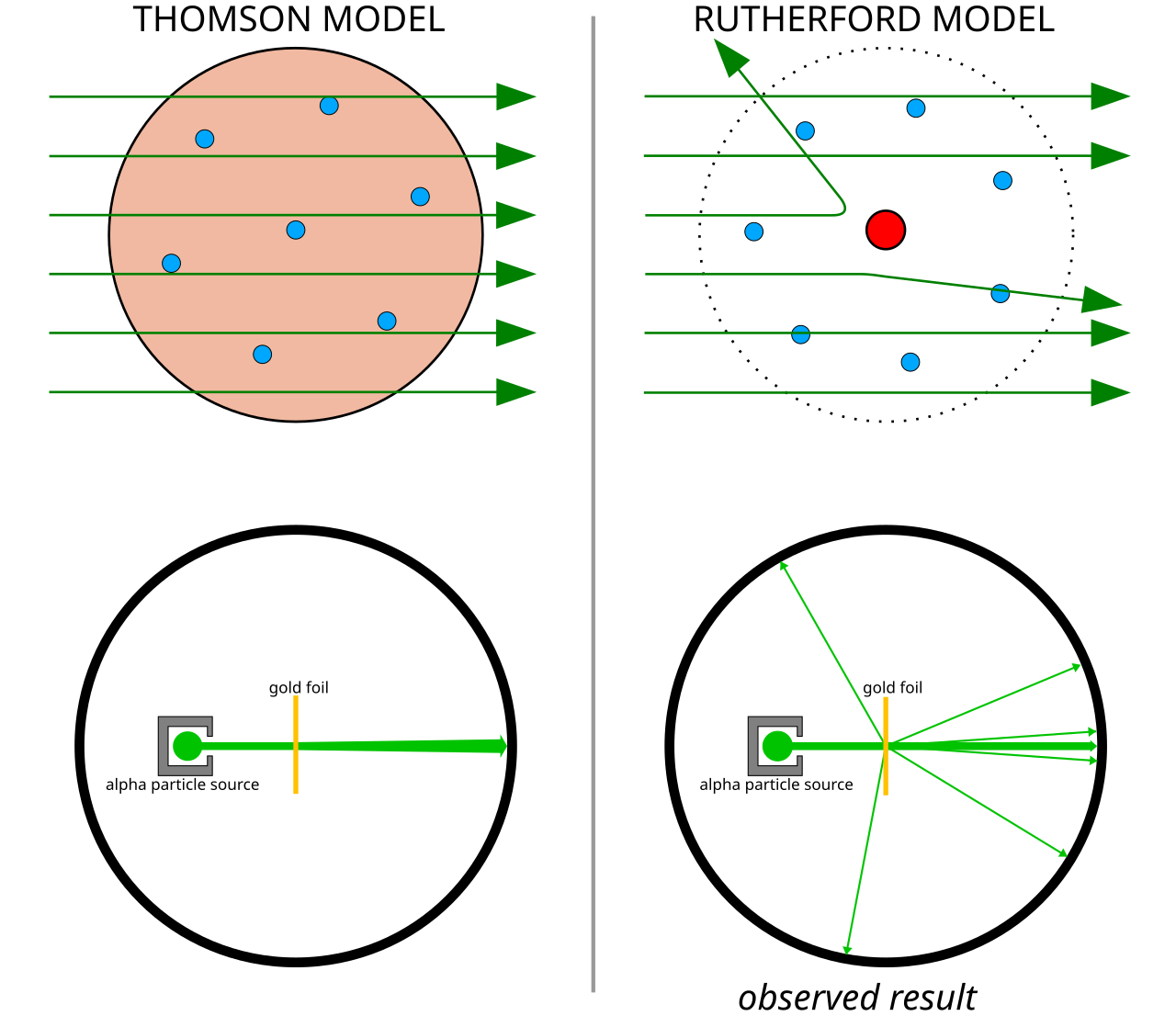
The Geiger–Marsden alpha-scattering result: a few alpha particles bounce back at large angles, which rules out Thomson’s diffuse model and demands a tiny, massive, positively charged nucleus. Image: Kurzon, CC BY 3.0, via Wikimedia Commons.
Concept context
Thomson's plum-pudding model, Rutherford's nuclear model from alpha-scattering, Bohr's postulates and hydrogen spectrum, spectral series (Lyman to Pfund), Rydberg formula, and limitations of each model.