Answer: Planck constant h = 6.63×10⁻³⁴ J·s is extremely small making lambda = h/mv = 6.63×10⁻³⁴ m.
- A Planck's constant is actually a very large number in SI units in routine practice overall
- B Planck constant h = 6.63×10⁻³⁴ J·s is extremely small making lambda = h/mv = 6.63×10⁻³⁴ m
- C The mass of one kilogram is itself enormously large on an atomic scale in most cases
- D The velocity of one metre per second is unusually small for this formula under typical conditions
Correct answer: B. Planck constant h = 6.63×10⁻³⁴ J·s is extremely small making lambda = h/mv = 6.63×10⁻³⁴ m
Explanation: lambda = h/mv = 6.63×10⁻³⁴/(1×1) = 6.63×10⁻³⁴ m. Far smaller than any measurable scale. Quantum effects negligible for macroscopic objects.
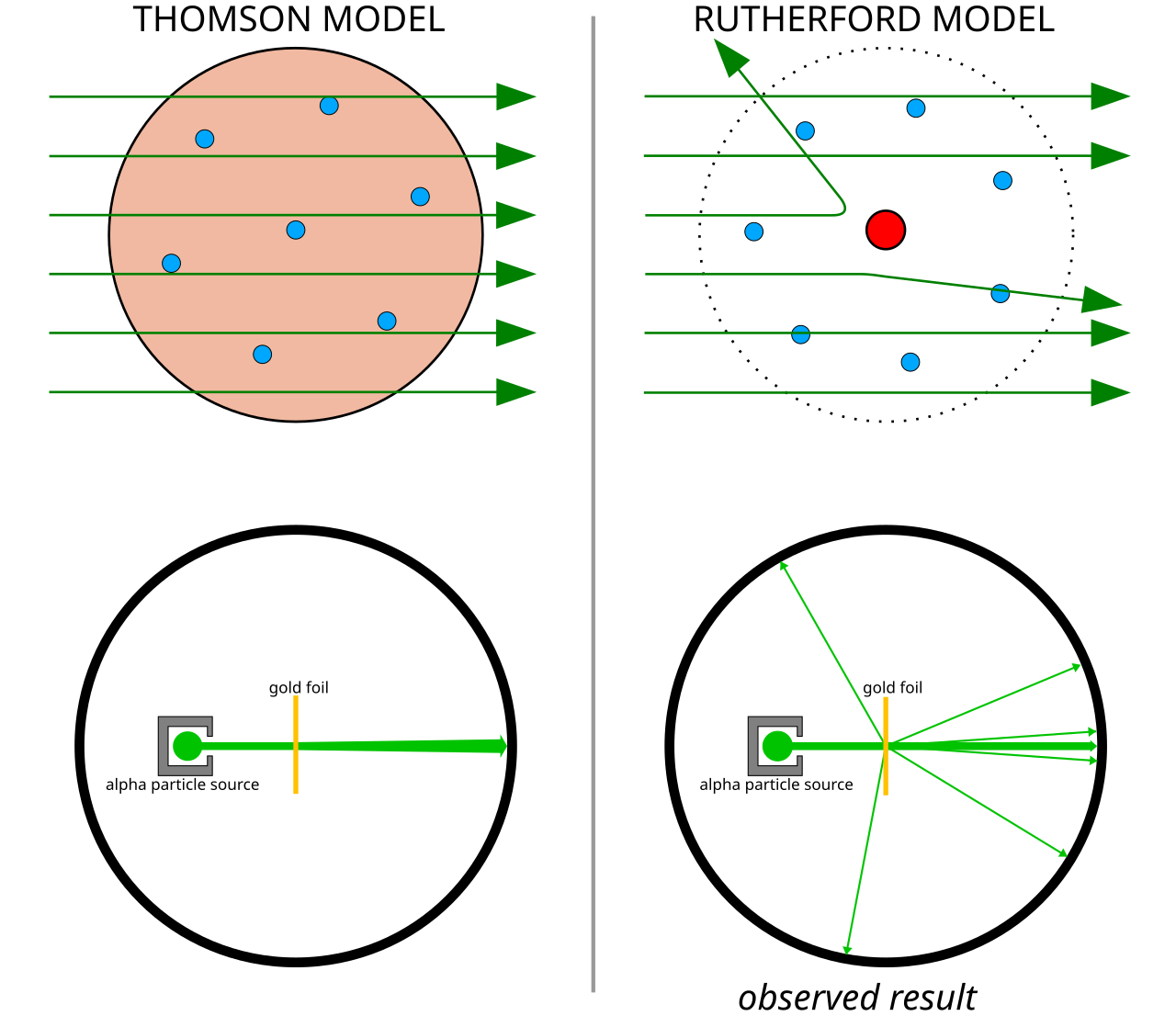
The Geiger–Marsden alpha-scattering result: a few alpha particles bounce back at large angles, which rules out Thomson’s diffuse model and demands a tiny, massive, positively charged nucleus. Image: Kurzon, CC BY 3.0, via Wikimedia Commons.
Concept context
Thomson's plum-pudding model, Rutherford's nuclear model from alpha-scattering, Bohr's postulates and hydrogen spectrum, spectral series (Lyman to Pfund), Rydberg formula, and limitations of each model.