Answer: Spin-orbit coupling (interaction of electron spin with orbital magnetic field).
- A The recoiling motion of the atomic nucleus during emission as frequently observed in practice
- B Spin-orbit coupling (interaction of electron spin with orbital magnetic field)
- C Ordinary Zeeman splitting from an externally applied magnetic field in many documented cases
- D The gravitational attraction between the electron and the nucleus according to conventional understanding
Correct answer: B. Spin-orbit coupling (interaction of electron spin with orbital magnetic field)
Explanation: Fine structure: spin-orbit interaction. Electron spin magnetic moment interacts with magnetic field seen in electron rest frame. Splits energy levels.
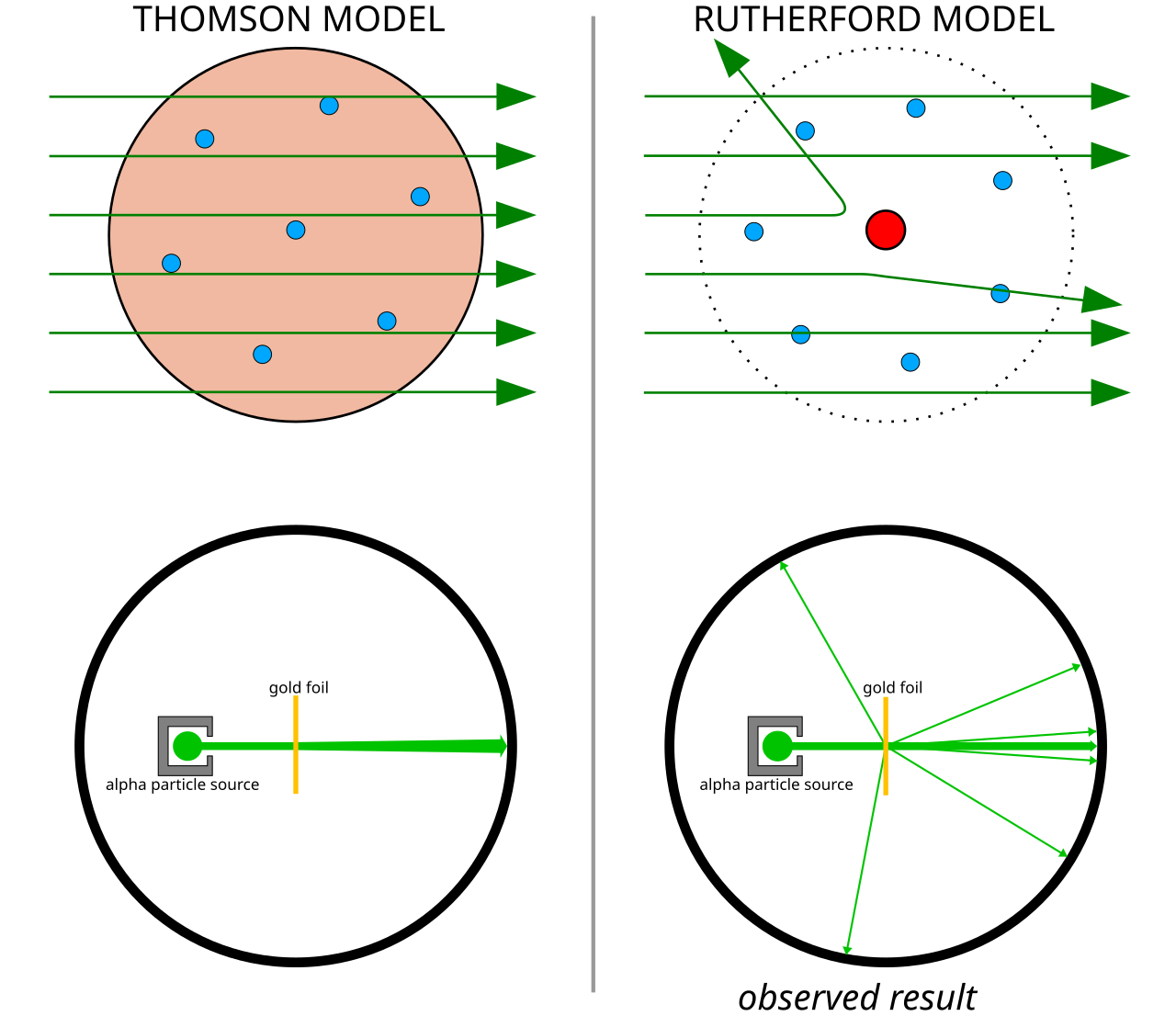
The Geiger–Marsden alpha-scattering result: a few alpha particles bounce back at large angles, which rules out Thomson’s diffuse model and demands a tiny, massive, positively charged nucleus. Image: Kurzon, CC BY 3.0, via Wikimedia Commons.
Concept context
Thomson's plum-pudding model, Rutherford's nuclear model from alpha-scattering, Bohr's postulates and hydrogen spectrum, spectral series (Lyman to Pfund), Rydberg formula, and limitations of each model.