Zaymiey

⚛️ Physics  ·  Atoms  ·  NEET & JEE

A hydrogen atom in the n = 3 state is just ionised by absorbing a photon. What is the approximate wavelength of this photon? Take h = 6.6 &times; 10<sup>-34</sup> J s and c = 3 &times; 10<sup>8</sup> m s<sup>-1</sup>.

Answer: 820 nm.

  • A 410 nm
  • B 656 nm
  • C 820 nm
  • D 1216 nm

Correct answer: C. 820 nm

Explanation: The ionisation energy from n = 3 is 13.6/9 = 1.51 eV. Converting to joules gives about 2.42 &times; 10<sup>-19</sup> J. Using &lambda; = hc/E gives approximately 820 nm.

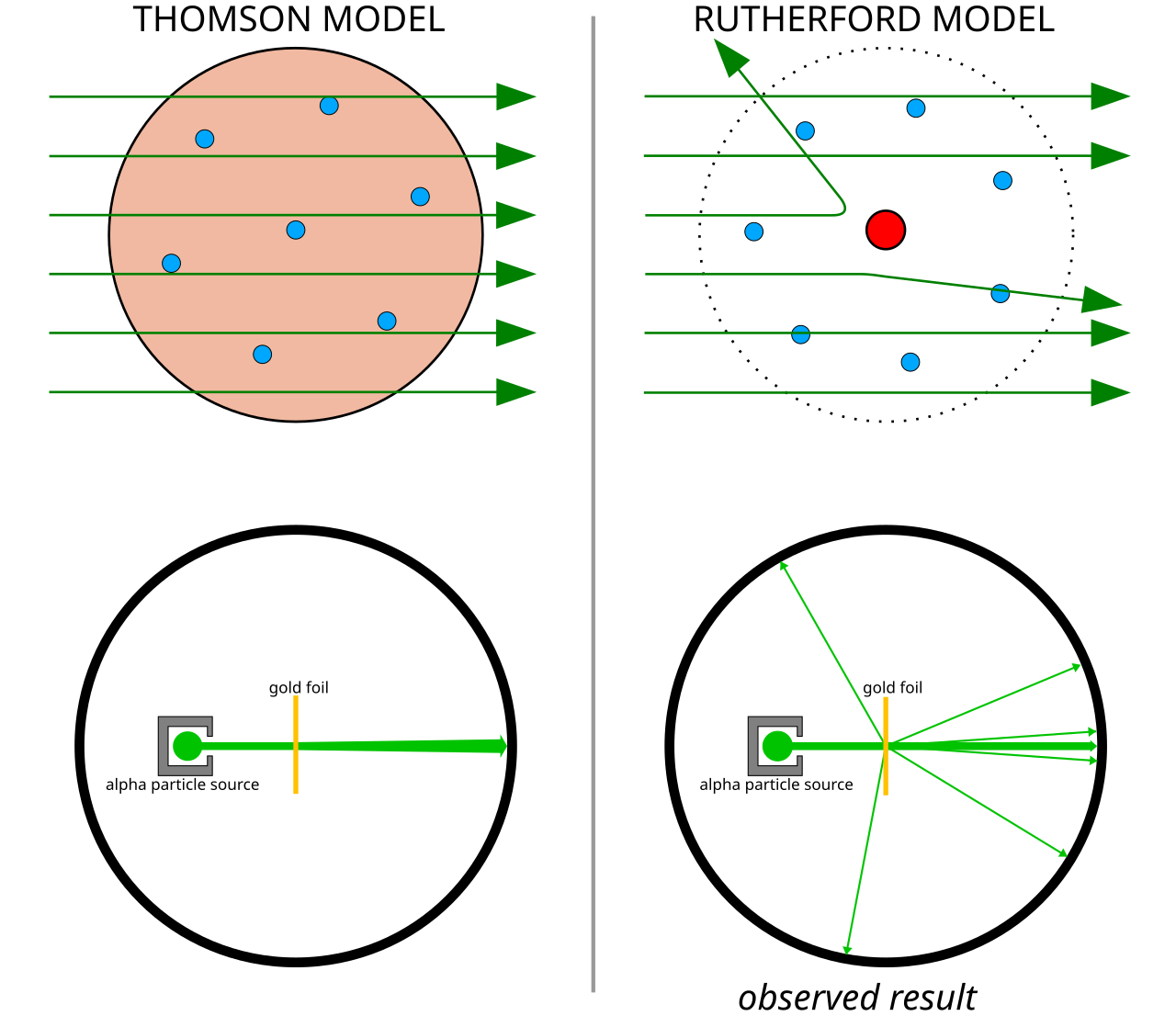
Comparison of the Thomson model and the Rutherford model of the atom: in the Thomson plum pudding model alpha particles pass almost straight through a diffuse positive sphere, while in the Rutherford model a concentrated central nucleus deflects some alpha particles through large angles, with the lower panels showing the alpha particle source and gold foil and the observed result of wide-angle scattering

The Geiger–Marsden alpha-scattering result: a few alpha particles bounce back at large angles, which rules out Thomson’s diffuse model and demands a tiny, massive, positively charged nucleus. Image: Kurzon, CC BY 3.0, via Wikimedia Commons.

Concept context

Thomson's plum-pudding model, Rutherford's nuclear model from alpha-scattering, Bohr's postulates and hydrogen spectrum, spectral series (Lyman to Pfund), Rydberg formula, and limitations of each model.

Read the full Atoms notes →