Answer: Xe has large atomic radius and low ionisation energy, making it accessible to attack by highly electronegative F.
- A Xe has large atomic radius and low ionisation energy, making it accessible to attack by highly electronegative F
- B Xenon possesses readily accessible low-energy d orbitals it can use for bonding as generally observed in typical laboratory settings
- C Xenon actually behaves chemically as a metal under ordinary laboratory conditions under usual circumstances
- D Xenon reacts readily with the vast majority of elements on the periodic table according to most researchers
Correct answer: A. Xe has large atomic radius and low ionisation energy, making it accessible to attack by highly electronegative F
Explanation: Xe's low ionisation energy (compared to Kr or Ar) and large polarisable electron cloud allow interaction with strongly electronegative F, and later oxygen-containing agents.
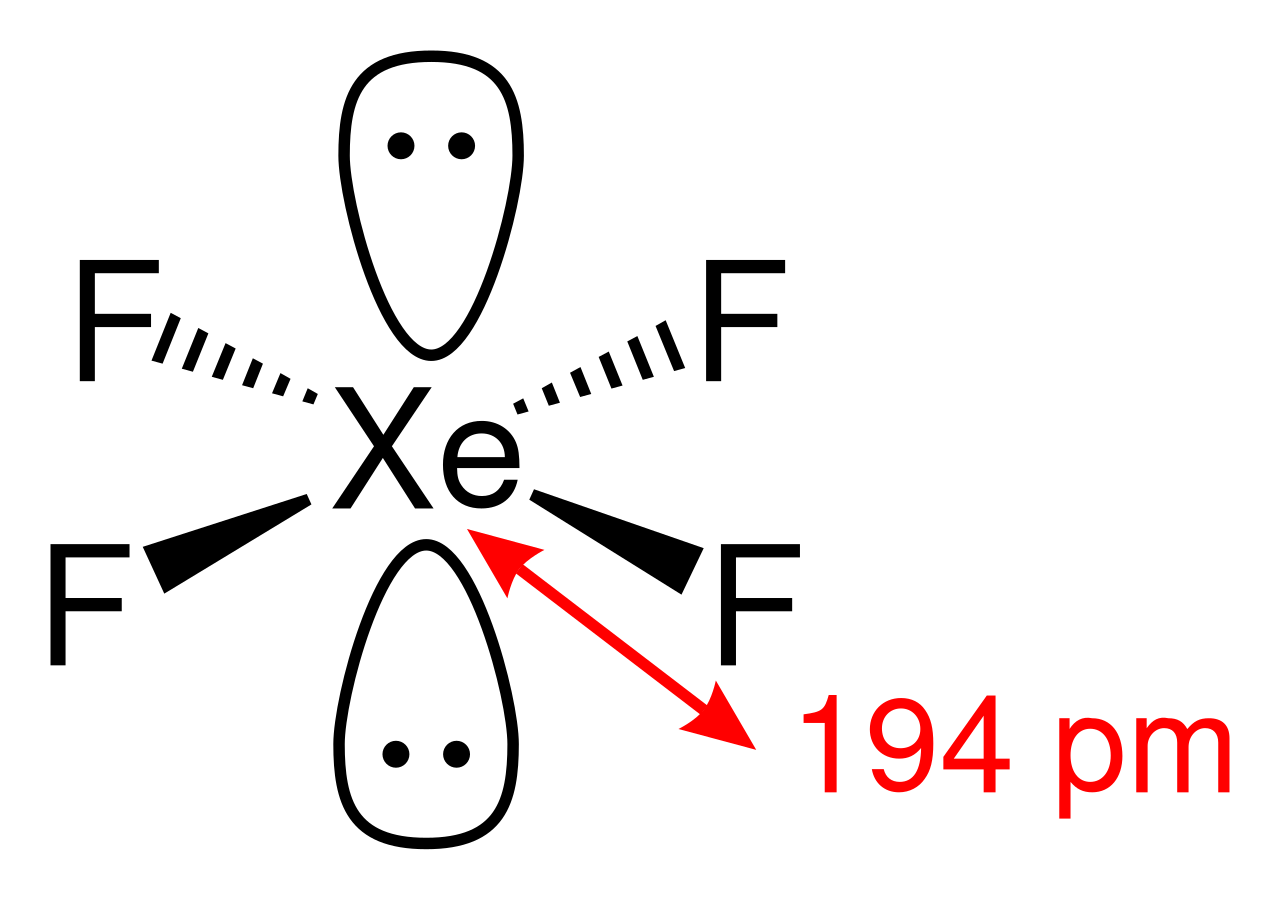
Xenon tetrafluoride (XeF4) has six electron domains around xenon — four Xe–F bonds plus two lone pairs. The lone pairs occupy opposite axial positions, leaving the four fluorine atoms in a square-planar shape (Xe–F ≈ 194 pm). Image: ChemSim, Public Domain, via Wikimedia Commons.
Concept context
Covers the nitrogen family (Group 15), oxygen family (Group 16), halogens (Group 17), and noble gases (Group 18). One of the highest-weightage inorganic chapters in NEET and JEE - includes preparation and properties of HNO₃, H₂SO₄, interhalogens, and xenon compounds.