Answer: Nitrogen has multiple stable oxidation states (-3 to +5) because of variable bonding with oxygen.
- A Nitrogen has multiple stable oxidation states (-3 to +5) because of variable bonding with oxygen
- B Nitrogen possesses accessible d orbitals that allow octet expansion in typical laboratory settings
- C Nitrogen is generally the most reactive element in the entire periodic table under usual circumstances
- D Nitrogen forms mainly ionic bonds with oxygen in each of these oxides according to most researchers
Correct answer: A. Nitrogen has multiple stable oxidation states (-3 to +5) because of variable bonding with oxygen
Explanation: Nitrogen's small size and availability of oxidation states from -3 to +5 allow diverse stable bonding arrangements with oxygen.
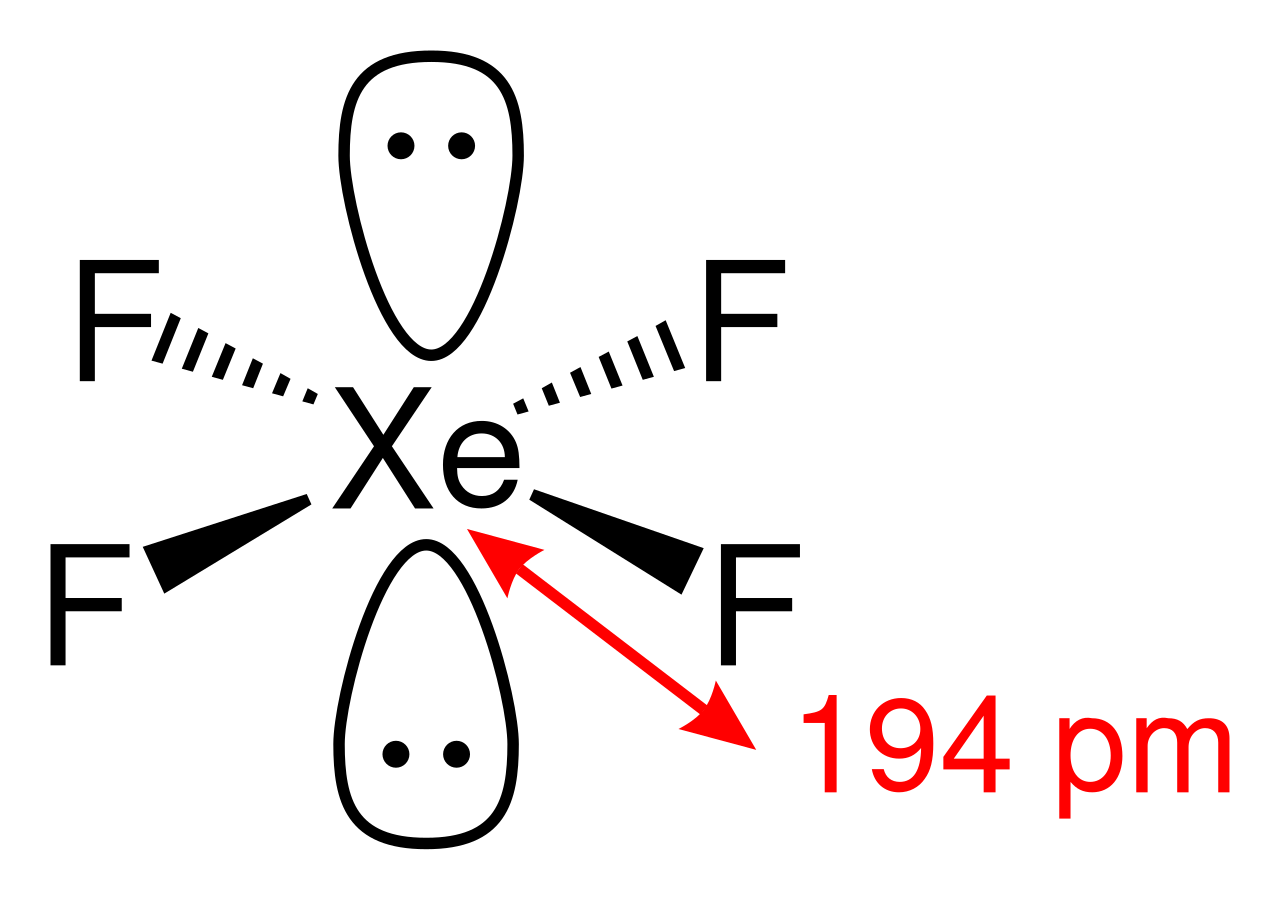
Xenon tetrafluoride (XeF4) has six electron domains around xenon — four Xe–F bonds plus two lone pairs. The lone pairs occupy opposite axial positions, leaving the four fluorine atoms in a square-planar shape (Xe–F ≈ 194 pm). Image: ChemSim, Public Domain, via Wikimedia Commons.
Concept context
Covers the nitrogen family (Group 15), oxygen family (Group 16), halogens (Group 17), and noble gases (Group 18). One of the highest-weightage inorganic chapters in NEET and JEE - includes preparation and properties of HNO₃, H₂SO₄, interhalogens, and xenon compounds.