Answer: F has the highest electronegativity and no d orbitals available for expansion of valence shell.
- A F has the highest electronegativity and no d orbitals available for expansion of valence shell
- B Fluorine actually behaves chemically as a metal rather than as a non-metal in most textbook accounts
- C Fluorine is generally a far too large an atom to ever form higher oxidation states during normal conditions
- D Fluorine atoms are said to possess no lone pairs of electrons whatsoever as generally observed
Correct answer: A. F has the highest electronegativity and no d orbitals available for expansion of valence shell
Explanation: Fluorine lacks d orbitals (in period 2) and is so electronegative it can never act as an electron donor; it always takes oxidation state -1.
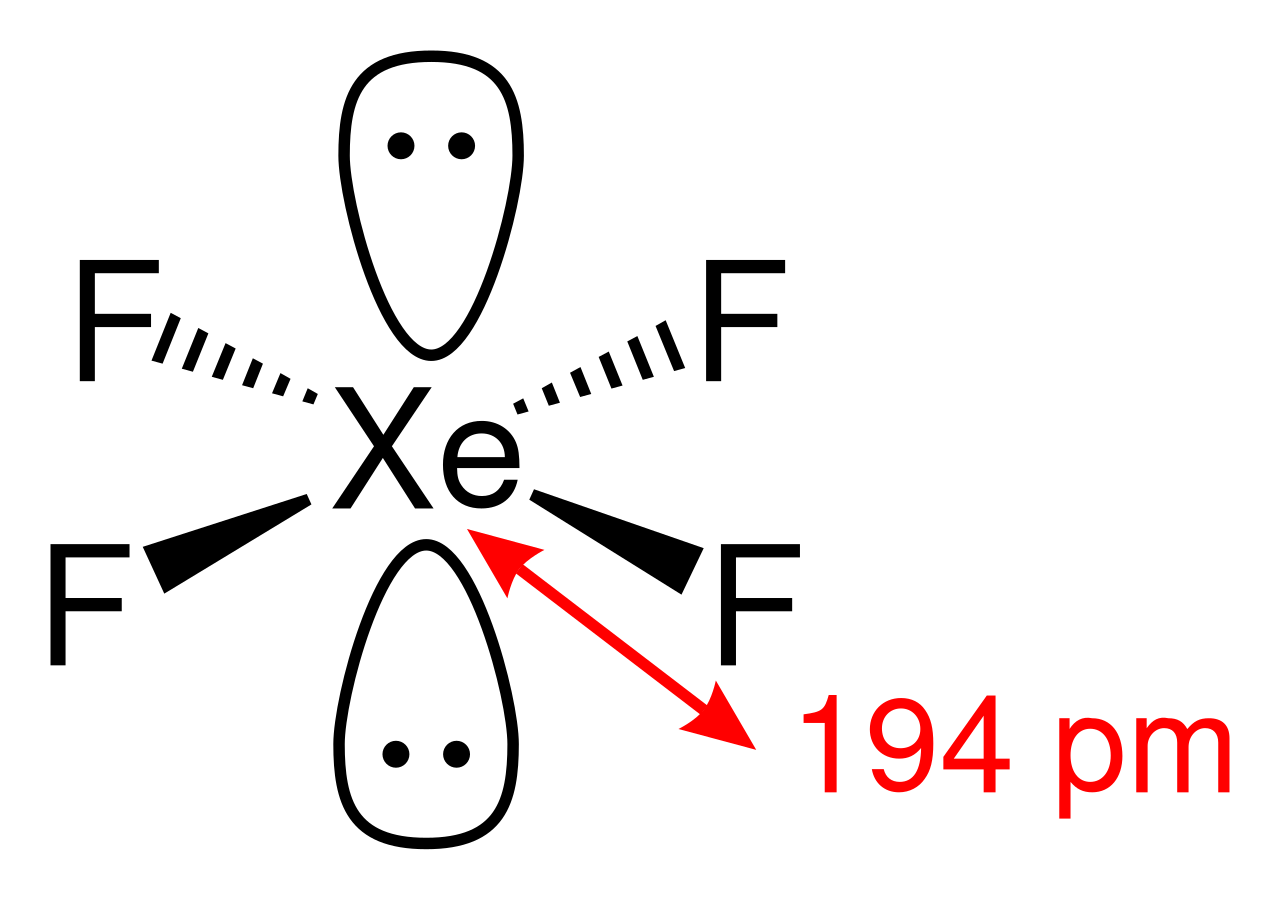
Xenon tetrafluoride (XeF4) has six electron domains around xenon — four Xe–F bonds plus two lone pairs. The lone pairs occupy opposite axial positions, leaving the four fluorine atoms in a square-planar shape (Xe–F ≈ 194 pm). Image: ChemSim, Public Domain, via Wikimedia Commons.
Concept context
Covers the nitrogen family (Group 15), oxygen family (Group 16), halogens (Group 17), and noble gases (Group 18). One of the highest-weightage inorganic chapters in NEET and JEE - includes preparation and properties of HNO₃, H₂SO₄, interhalogens, and xenon compounds.