Answer: Neurons globally scale all synaptic strengths up or down to maintain stable activity levels (compensating for prolonged changes in activity).
- A Individual synapses are selectively and permanently strengthened through long-term potentiation alone repeatedly in many documented cases
- B Neurons globally scale all synaptic strengths up or down to maintain stable activity levels (compensating for prolonged changes in activity)
- C Mainly inhibitory GABAergic synapses undergo any measurable change in synaptic strength over time according to conventional understanding
- D Synapses are permanently and irreversibly eliminated, with little compensatory scaling response occurring afterward in routine practice
Correct answer: B. Neurons globally scale all synaptic strengths up or down to maintain stable activity levels (compensating for prolonged changes in activity)
Explanation: Synaptic scaling: homeostatic mechanism. Chronic low activity → scale up all AMPA receptors. Chronic high activity → scale down. Maintains neuron firing in a functional range despite Hebbian plasticity.
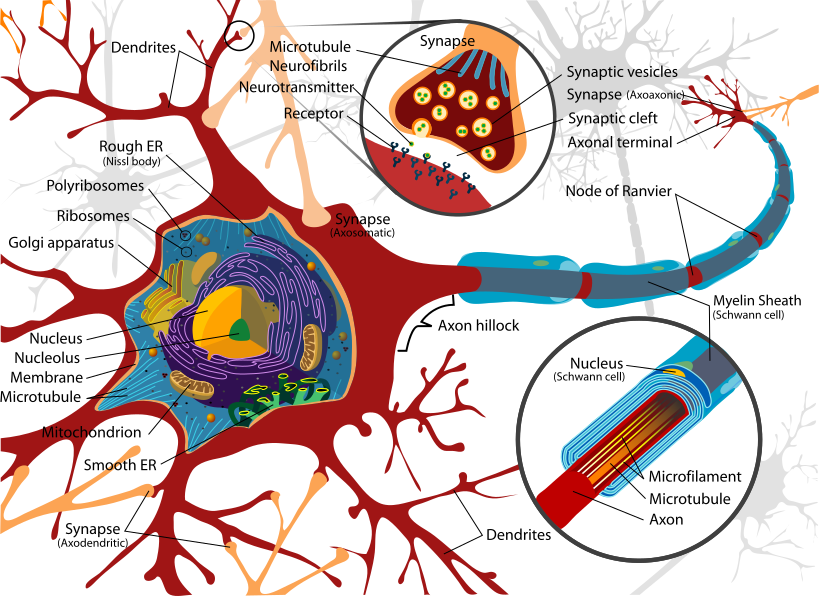
Structure of a neuron. Image: LadyofHats (Mariana Ruiz), Public Domain, via Wikimedia Commons.
Concept context
Brain, spinal cord, neurons, reflex arcs, and sense organs.