Answer: T-tubules (transverse tubules) are invaginations of the sarcolemma that penetrate deep into the muscle fibre, spreading action potentials to all sarcomeres at once.
- A T-tubules are sometimes thought to be found mainly within the nuclear envelope membrane of the skeletal muscle cell itself, and rarely found elsewhere in the cell
- B T-tubules (transverse tubules) are invaginations of the sarcolemma that penetrate deep into the muscle fibre, spreading action potentials to all sarcomeres at once
- C T-tubules are sometimes thought to function mainly as a dedicated calcium ion storage reservoir located deep within the central interior region of the muscle fibre itself
- D T-tubules are sometimes thought to be found mainly within smooth muscle tissue specifically, and are therefore largely absent from skeletal muscle fibres in general
Correct answer: B. T-tubules (transverse tubules) are invaginations of the sarcolemma that penetrate deep into the muscle fibre, spreading action potentials to all sarcomeres at once
Explanation: T-tubule system: sarcolemma invaginates as transverse tubules at each A-I band junction (two per sarcomere). They conduct action potentials rapidly to all sarcomeres simultaneously, ensuring coordinated contraction throughout the entire cell. T-tubules form triads with SR terminal cisternae (1 T-tubule flanked by 2 SR cisternae) where DHPR-RyR1 coupling occurs.
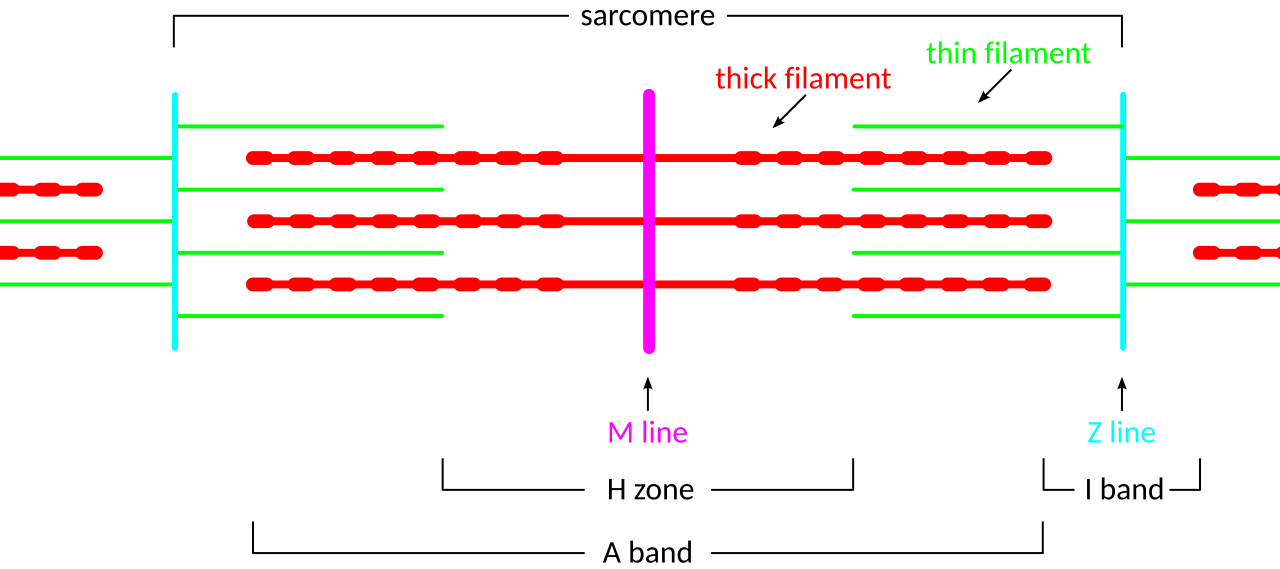
A sarcomere (Z line to Z line): during contraction the I band and H zone shorten as thin filaments slide over thick, while the A band stays the same length. Image: SlothMcCarty, CC BY-SA 3.0, via Wikimedia Commons.
Concept context
Types of movement, muscle contraction, skeletal system, joints, and disorders. Important for Class 11 and NEET.