Answer: Articular cartilage covers bone ends; synovial cavity contains synovial fluid; synovial membrane lines the joint capsule; fibrous joint capsule and ligaments stabilize the joint.
- A A joint type that largely lacks any fluid-filled cavity between its two articulating bone surfaces, unlike most movable joints in routine practice overall in most cases under typical conditions
- B Articular cartilage covers bone ends; synovial cavity contains synovial fluid; synovial membrane lines the joint capsule; fibrous joint capsule and ligaments stabilize the joint
- C Two bones that are permanently fused directly together by largely ossified, rigid connective tissue with little movement possible according to standard textbooks in general practice
- D Mainly a thin layer of articular cartilage is present at this joint, with very little synovial fluid contained inside the cavity as frequently described in most textbook accounts
Correct answer: B. Articular cartilage covers bone ends; synovial cavity contains synovial fluid; synovial membrane lines the joint capsule; fibrous joint capsule and ligaments stabilize the joint
Explanation: Synovial joint structure: bone ends covered by hyaline articular cartilage (reduces friction); joint cavity filled with synovial fluid; synovial membrane (secretes fluid) lines inner capsule; outer fibrous capsule reinforced by ligaments. Bursae (fluid sacs) may reduce friction between tendons and bone.
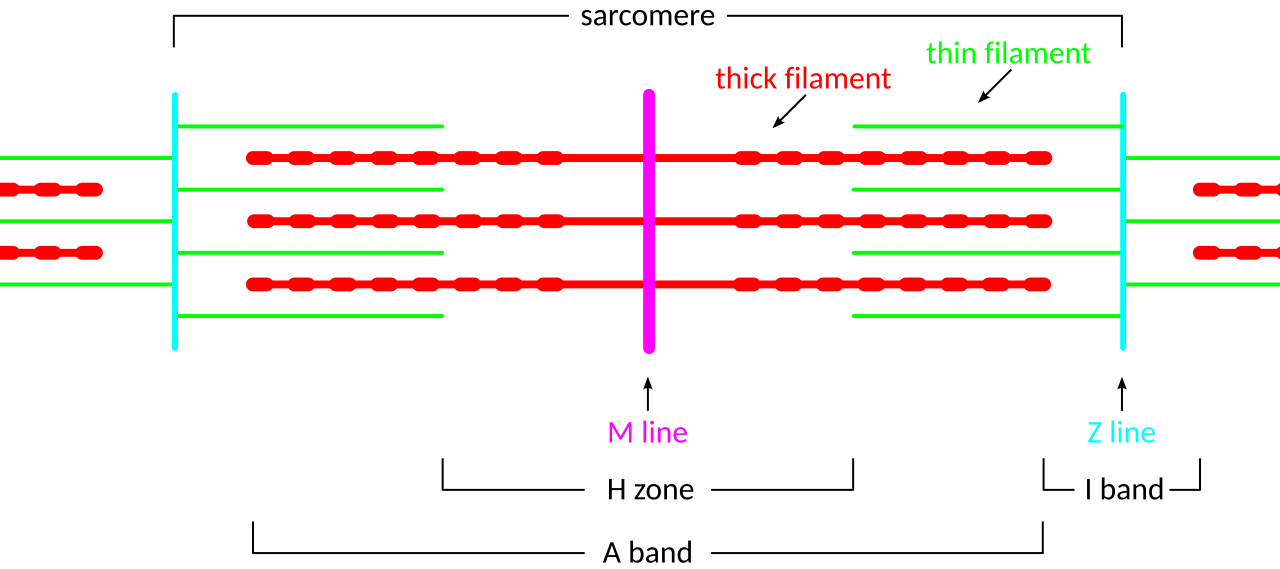
A sarcomere (Z line to Z line): during contraction the I band and H zone shorten as thin filaments slide over thick, while the A band stays the same length. Image: SlothMcCarty, CC BY-SA 3.0, via Wikimedia Commons.
Concept context
Types of movement, muscle contraction, skeletal system, joints, and disorders. Important for Class 11 and NEET.