Answer: Specialized junctions between cardiac cells containing gap junctions (allow electrical coupling) and desmosomes (mechanical coupling); allow the heart to contract as a functional syncytium.
- A They are sometimes mistaken for remnants of fibrous scar tissue that forms mainly after a person has suffered a myocardial infarction as widely reported in standard practice under most conditions encountered
- B Specialized junctions between cardiac cells containing gap junctions (allow electrical coupling) and desmosomes (mechanical coupling); allow the heart to contract as a functional syncytium
- C They function mainly as dedicated intracellular calcium storage depots specifically reserved for cardiac contraction events and signaling as frequently observed in practice in many documented cases
- D They are sometimes mistakenly thought to be found mainly within diseased or otherwise structurally damaged regions of the adult heart according to conventional understanding in routine practice
Correct answer: B. Specialized junctions between cardiac cells containing gap junctions (allow electrical coupling) and desmosomes (mechanical coupling); allow the heart to contract as a functional syncytium
Explanation: Intercalated discs are unique to cardiac muscle. They contain: (1) Gap junctions - allow action potentials to spread rapidly between cells (electrical coupling), making the heart work as a unit. (2) Fascia adherens (anchoring junctions) and desmosomes - mechanical coupling preventing cells from pulling apart during contraction.
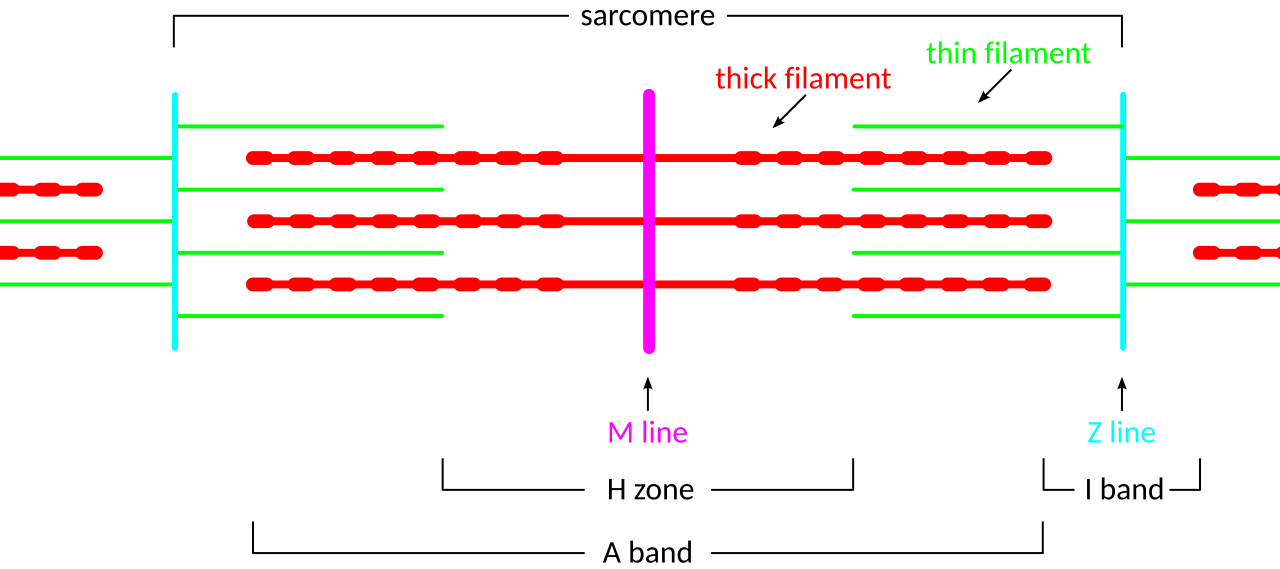
A sarcomere (Z line to Z line): during contraction the I band and H zone shorten as thin filaments slide over thick, while the A band stays the same length. Image: SlothMcCarty, CC BY-SA 3.0, via Wikimedia Commons.
Concept context
Types of movement, muscle contraction, skeletal system, joints, and disorders. Important for Class 11 and NEET.