Answer: Tropomyosin blocks myosin binding sites on actin at rest; troponin (TnC, TnI, TnT complex) senses Ca 2+ ; Ca 2+ binding to TnC moves tropomyosin away, exposing binding sites.
- A Both of these proteins are sometimes thought to be mainly structural support elements, with little regulatory signaling role in the cell as widely reported in standard practice
- B Tropomyosin blocks myosin binding sites on actin at rest; troponin (TnC, TnI, TnT complex) senses Ca<sup>2+</sup>; Ca<sup>2+</sup> binding to TnC moves tropomyosin away, exposing binding sites
- C Troponin is sometimes mistakenly thought to single-handedly supply the chemical energy required for cross-bridge cycling under most conditions encountered as frequently observed in practice
- D Tropomyosin is sometimes mistakenly described as forming the actual structural cross-bridge linking actin and myosin filaments in many documented cases according to conventional understanding
Correct answer: B. Tropomyosin blocks myosin binding sites on actin at rest; troponin (TnC, TnI, TnT complex) senses Ca<sup>2+</sup>; Ca<sup>2+</sup> binding to TnC moves tropomyosin away, exposing binding sites
Explanation: Thin filament regulation: tropomyosin is a coiled-coil protein that sits in the groove of actin, blocking myosin binding sites. Troponin complex (TnC-Ca<sup>2+</sup> sensor, TnI-inhibitory, TnT-tropomyosin binding) is anchored at intervals. Ca<sup>2+</sup> binds TnC → conformational change → TnI releases actin → tropomyosin moves → myosin binding sites exposed.
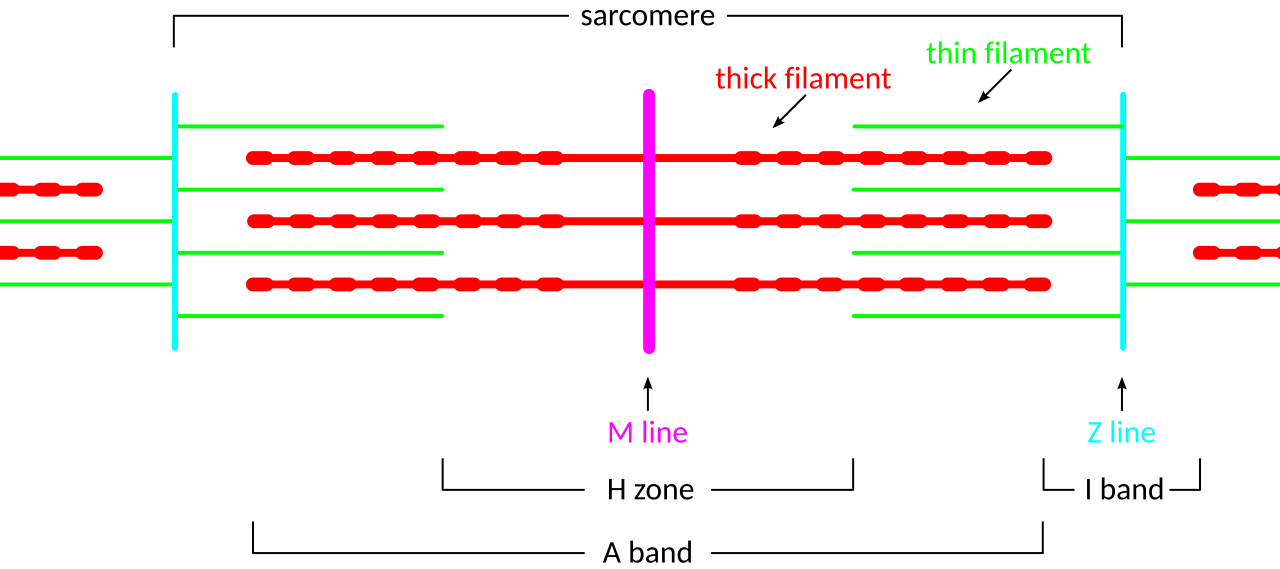
A sarcomere (Z line to Z line): during contraction the I band and H zone shorten as thin filaments slide over thick, while the A band stays the same length. Image: SlothMcCarty, CC BY-SA 3.0, via Wikimedia Commons.
Concept context
Types of movement, muscle contraction, skeletal system, joints, and disorders. Important for Class 11 and NEET.