Answer: Titin is the largest known protein; spans from Z disc to M line; acts as a molecular spring providing passive elasticity; maintains sarcomere organization; senses mechanical stretch; accounts for passive tension at long sarcomere lengths.
- A Titin is sometimes thought to actually be a small signaling protein molecule that specifically activates calcium release channels within the sarcoplasmic reticulum membrane as widely reported in standard practice under most conditions encountered
- B Titin is the largest known protein; spans from Z disc to M line; acts as a molecular spring providing passive elasticity; maintains sarcomere organization; senses mechanical stretch; accounts for passive tension at long sarcomere lengths
- C Titin is sometimes thought to be functionally, structurally, and biochemically largely identical to the regulatory protein troponin found within the thin actin filament as frequently observed in practice in many documented cases according to conventional understanding
- D Titin is sometimes thought to actually be the specific structural protein that physically forms most of the thick myosin filaments themselves within the sarcomere in routine practice overall in most cases under typical conditions according to standard textbooks
Correct answer: B. Titin is the largest known protein; spans from Z disc to M line; acts as a molecular spring providing passive elasticity; maintains sarcomere organization; senses mechanical stretch; accounts for passive tension at long sarcomere lengths
Explanation: Titin (connectin): 3,000+ kDa, spans half sarcomere from Z disc to M line. Functions: (1) Passive elasticity - spring-like PEVK region resists stretch, returns energy; (2) Sarcomere integrity - anchors thick filaments, maintains alignment; (3) Mechanosensing - triggers signaling when stretched. Mutations cause dilated cardiomyopathy and limb-girdle muscular dystrophy.
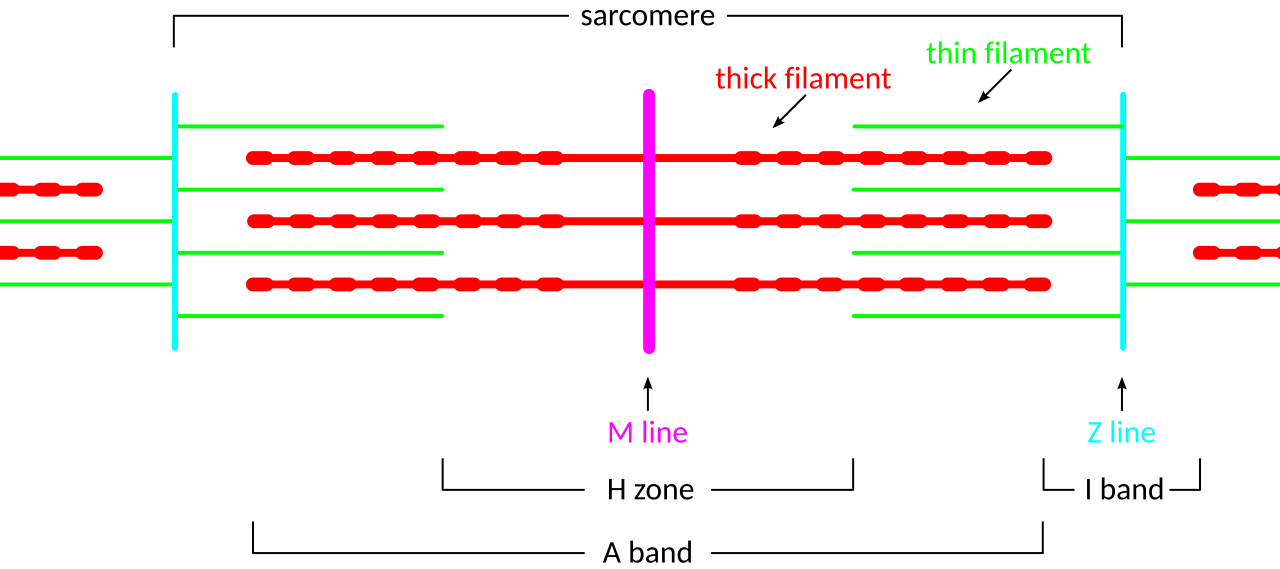
A sarcomere (Z line to Z line): during contraction the I band and H zone shorten as thin filaments slide over thick, while the A band stays the same length. Image: SlothMcCarty, CC BY-SA 3.0, via Wikimedia Commons.
Concept context
Types of movement, muscle contraction, skeletal system, joints, and disorders. Important for Class 11 and NEET.