Answer: It is a rapid phosphate buffer; donates phosphate to ADP to regenerate ATP immediately at start of intense exercise, before other metabolic pathways activate.
- A It serves as the single primary fuel source that sustains prolonged, long-duration aerobic endurance exercise lasting many hours overall in most cases under typical conditions
- B It is a rapid phosphate buffer; donates phosphate to ADP to regenerate ATP immediately at start of intense exercise, before other metabolic pathways activate
- C It serves as the main intracellular calcium storage reservoir located mainly within the muscle sarcoplasm near the SR according to standard textbooks in general practice
- D It directly and physically forms the actual actin-myosin cross-bridge structure itself during each cycle of muscle contraction as frequently described in most textbook accounts
Correct answer: B. It is a rapid phosphate buffer; donates phosphate to ADP to regenerate ATP immediately at start of intense exercise, before other metabolic pathways activate
Explanation: Creatine phosphate (phosphocreatine) provides the fastest ATP regeneration: CP + ADP → C + ATP (creatine kinase). This buffer lasts only 10-15 seconds of maximal effort. After this, glycolysis and then oxidative phosphorylation become the primary ATP sources.
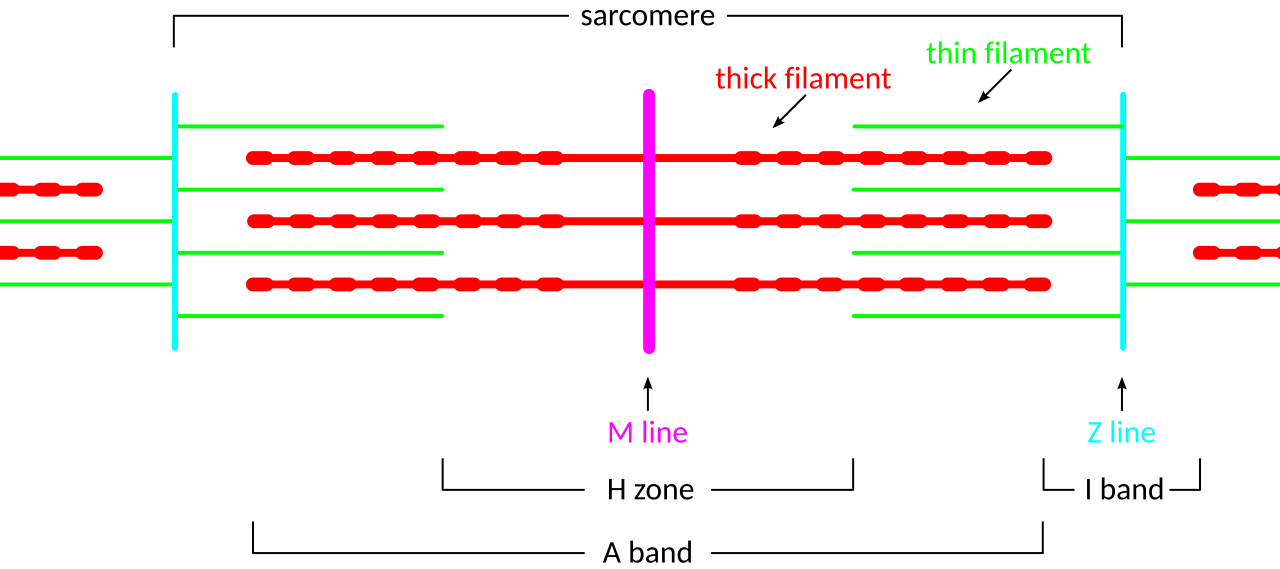
A sarcomere (Z line to Z line): during contraction the I band and H zone shorten as thin filaments slide over thick, while the A band stays the same length. Image: SlothMcCarty, CC BY-SA 3.0, via Wikimedia Commons.
Concept context
Types of movement, muscle contraction, skeletal system, joints, and disorders. Important for Class 11 and NEET.