Answer: Calsequestrin is a high-capacity, low-affinity Ca 2+ -binding protein in the SR lumen that stores large amounts of Ca 2+ for rapid release during contraction.
- A It is sometimes thought to directly and immediately activate the myosin head protein itself, thereby initiating the start of the cross-bridge cycling process from a resting state
- B Calsequestrin is a high-capacity, low-affinity Ca<sup>2+</sup>-binding protein in the SR lumen that stores large amounts of Ca<sup>2+</sup> for rapid release during contraction
- C It is sometimes thought to be simply a minor structural component protein embedded directly within the thin actin filament structure of the muscle sarcomere itself
- D It is sometimes thought to function mainly to add extra phosphate groups onto the troponin protein complex itself to regulate its overall calcium binding affinity level
Correct answer: B. Calsequestrin is a high-capacity, low-affinity Ca<sup>2+</sup>-binding protein in the SR lumen that stores large amounts of Ca<sup>2+</sup> for rapid release during contraction
Explanation: Calsequestrin stores Ca<sup>2+</sup> in the SR by binding up to 40-80 Ca<sup>2+</sup> ions per molecule. Because free Ca<sup>2+</sup> concentration is buffered low, the SR can store much more total Ca<sup>2+</sup> without the osmotic consequences of free Ca<sup>2+</sup>. Associated with ryanodine receptor complex (via junctin, triadin) and modulates RyR gating. Mutations cause catecholaminergic polymorphic ventricular tachycardia (CPVT).
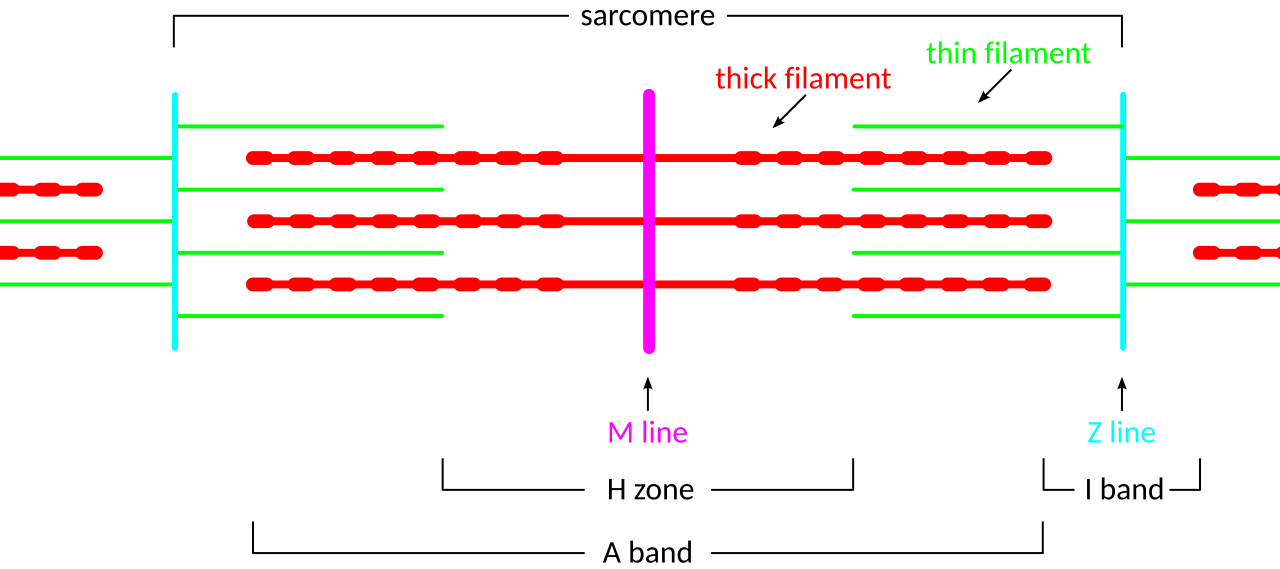
A sarcomere (Z line to Z line): during contraction the I band and H zone shorten as thin filaments slide over thick, while the A band stays the same length. Image: SlothMcCarty, CC BY-SA 3.0, via Wikimedia Commons.
Concept context
Types of movement, muscle contraction, skeletal system, joints, and disorders. Important for Class 11 and NEET.