Answer: ATP is required for: Ca 2+ pump (SERCA) to return Ca 2+ to SR; myosin head detachment from actin after power stroke; active transport of ions to restore resting potential.
- A ATP is sometimes thought to play little functional role during the relaxation phase that follows muscle contraction in the majority of cases studied as widely reported
- B ATP is required for: Ca<sup>2+</sup> pump (SERCA) to return Ca<sup>2+</sup> to SR; myosin head detachment from actin after power stroke; active transport of ions to restore resting potential
- C ATP molecules are sometimes thought to be consumed mainly during the active contraction phase, rarely during relaxation in standard practice under most conditions encountered
- D Mainly ADP molecules, rather than ATP molecules, are sometimes thought to bring about muscle fibre relaxation as frequently observed in practice in many documented cases
Correct answer: B. ATP is required for: Ca<sup>2+</sup> pump (SERCA) to return Ca<sup>2+</sup> to SR; myosin head detachment from actin after power stroke; active transport of ions to restore resting potential
Explanation: ATP has three roles in relaxation: (1) Powers SERCA Ca<sup>2+</sup>-ATPase pump that returns Ca<sup>2+</sup> to sarcoplasmic reticulum, allowing troponin-tropomyosin to re-block actin. (2) Binds myosin head after power stroke to cause detachment (without ATP = rigor mortis). (3) Powers Na+/K+ ATPase to restore ionic gradients.
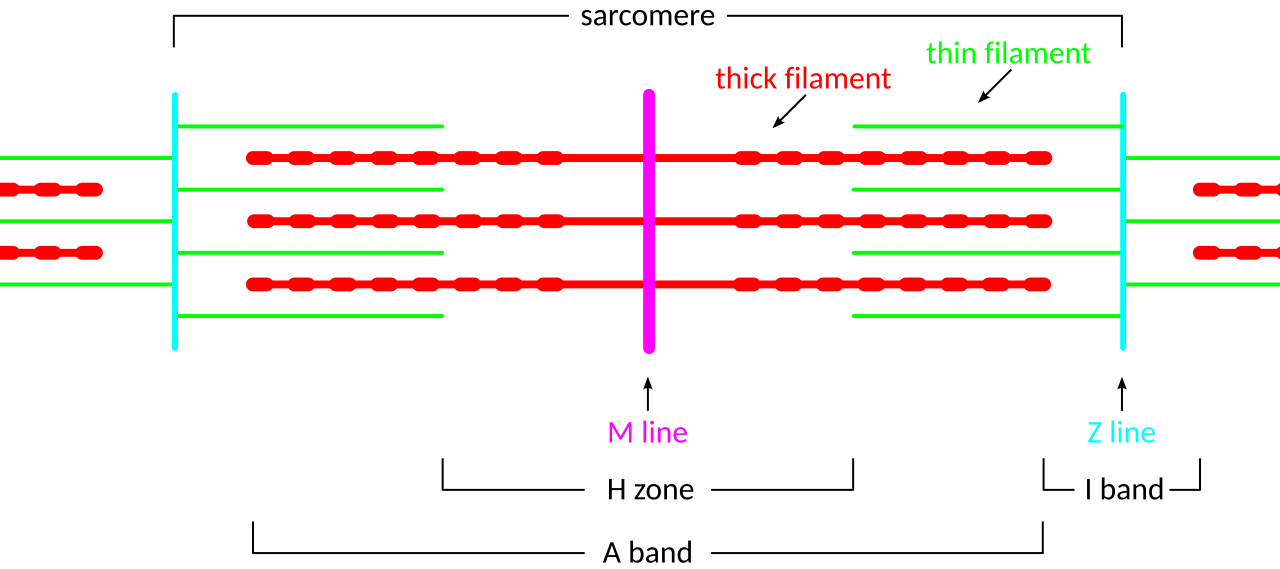
A sarcomere (Z line to Z line): during contraction the I band and H zone shorten as thin filaments slide over thick, while the A band stays the same length. Image: SlothMcCarty, CC BY-SA 3.0, via Wikimedia Commons.
Concept context
Types of movement, muscle contraction, skeletal system, joints, and disorders. Important for Class 11 and NEET.