Answer: Allows rotation only - atlas-axis joint (head rotation), radioulnar joint (forearm rotation).
- A Allows simple bending and straightening, as commonly seen at the elbow joint according to standard textbooks
- B Allows rotation only - atlas-axis joint (head rotation), radioulnar joint (forearm rotation)
- C Allows movement in all possible directions, as at the ball-and-socket shoulder joint in general practice
- D Allows mainly side-to-side gliding movement, as between adjacent carpal bones as frequently described
Correct answer: B. Allows rotation only - atlas-axis joint (head rotation), radioulnar joint (forearm rotation)
Explanation: Pivot joints allow rotation around a single axis. Atlas-axis joint: atlas rotates around the odontoid process (dens) of axis - allows head rotation (shaking 'no'). Proximal radioulnar joint: allows forearm pronation/supination.
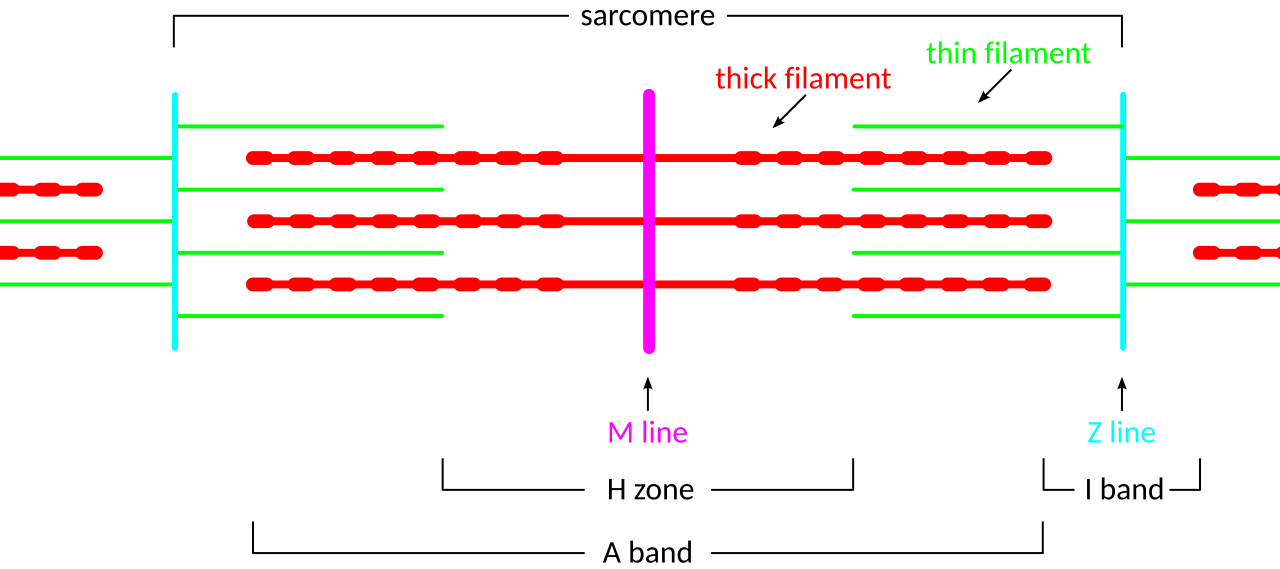
A sarcomere (Z line to Z line): during contraction the I band and H zone shorten as thin filaments slide over thick, while the A band stays the same length. Image: SlothMcCarty, CC BY-SA 3.0, via Wikimedia Commons.
Concept context
Types of movement, muscle contraction, skeletal system, joints, and disorders. Important for Class 11 and NEET.