Answer: Pelvic girdle = two hip bones (ilium, ischium, pubis fused) + sacrum; female pelvis is wider and has larger pubic angle to allow childbirth; male pelvis is narrower and more robust.
- A The entire pelvic girdle structure is sometimes mistakenly thought to be formed mainly by just the long femur bone, with little other bony contribution in typical laboratory settings
- B Pelvic girdle = two hip bones (ilium, ischium, pubis fused) + sacrum; female pelvis is wider and has larger pubic angle to allow childbirth; male pelvis is narrower and more robust
- C The pelvic girdle is sometimes thought to be structurally, dimensionally, and proportionally quite similar between adult males and females overall under usual circumstances according to most researchers
- D The pelvic girdle is sometimes mistakenly thought to be composed of just a single small fused bone structure, with few separate component bones present in the majority of cases studied
Correct answer: B. Pelvic girdle = two hip bones (ilium, ischium, pubis fused) + sacrum; female pelvis is wider and has larger pubic angle to allow childbirth; male pelvis is narrower and more robust
Explanation: Pelvic girdle: two hip bones (each = ilium + ischium + pubis fused at pubic symphysis) + sacrum. Sexual dimorphism: female pelvis = wider, shallower, larger pelvic outlet (for childbirth), pubic angle >90 degrees. Male pelvis = narrower, deeper, smaller outlet, pubic angle <90 degrees, adapted for bipedal locomotion.
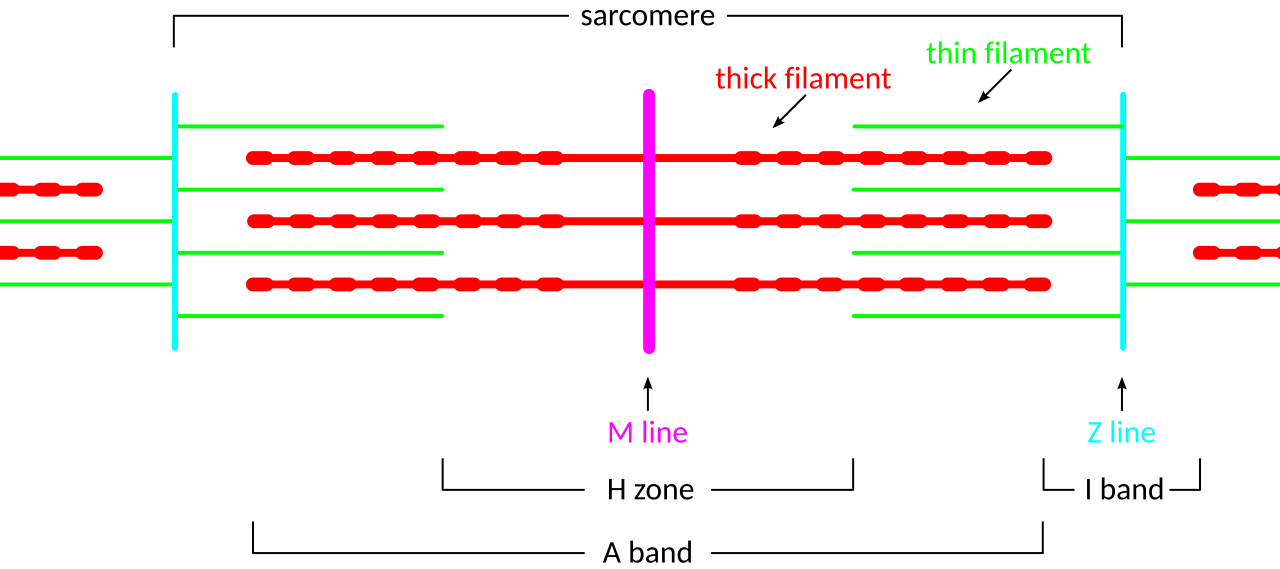
A sarcomere (Z line to Z line): during contraction the I band and H zone shorten as thin filaments slide over thick, while the A band stays the same length. Image: SlothMcCarty, CC BY-SA 3.0, via Wikimedia Commons.
Concept context
Types of movement, muscle contraction, skeletal system, joints, and disorders. Important for Class 11 and NEET.