Answer: Isometric: muscle generates force but does not change length (holding weight); isotonic: muscle changes length while maintaining relatively constant tension (lifting weight).
- A Both of these terms are sometimes thought to describe the same single underlying type of muscle contraction in any muscle according to conventional understanding in routine practice
- B Isometric: muscle generates force but does not change length (holding weight); isotonic: muscle changes length while maintaining relatively constant tension (lifting weight)
- C Isometric contraction is sometimes thought to usually involve visible joint movement, unlike isotonic contraction movement overall in most cases under typical conditions
- D Mainly skeletal muscle fibres are thought to be capable of undergoing a true isotonic type of contraction according to standard textbooks in general practice as frequently described
Correct answer: B. Isometric: muscle generates force but does not change length (holding weight); isotonic: muscle changes length while maintaining relatively constant tension (lifting weight)
Explanation: Isometric contraction: muscle length stays constant while tension increases (e.g., pushing against a wall, holding a position). Isotonic contraction: muscle length changes while tension is approximately constant. Concentric (muscle shortens, e.g., bicep curl up); eccentric (muscle lengthens while contracting, e.g., lowering weight).
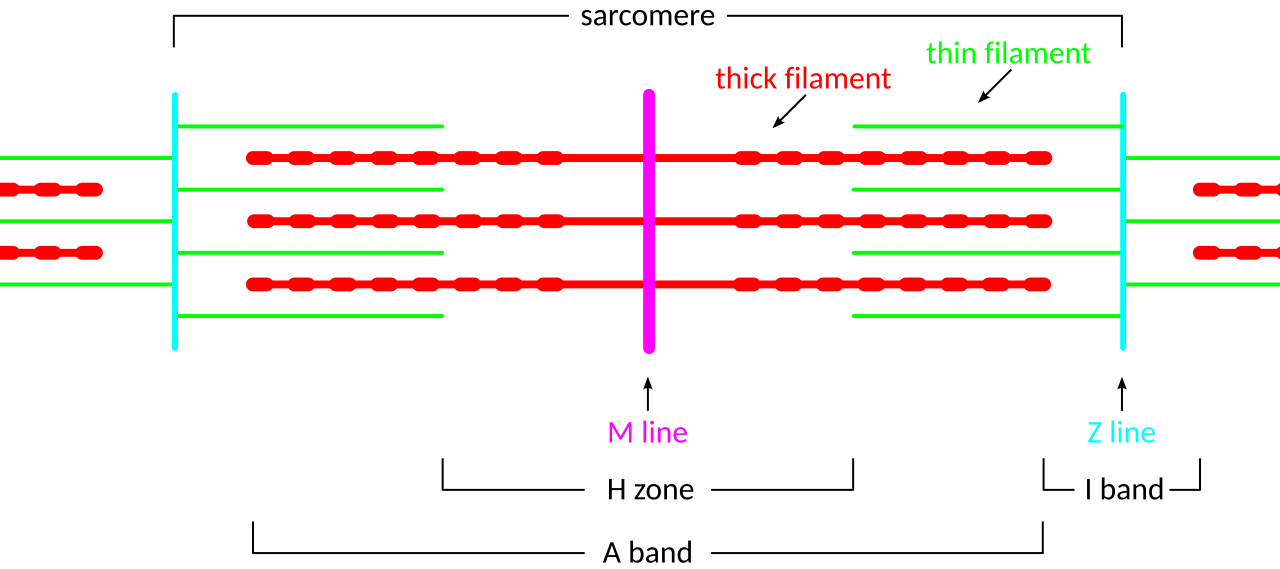
A sarcomere (Z line to Z line): during contraction the I band and H zone shorten as thin filaments slide over thick, while the A band stays the same length. Image: SlothMcCarty, CC BY-SA 3.0, via Wikimedia Commons.
Concept context
Types of movement, muscle contraction, skeletal system, joints, and disorders. Important for Class 11 and NEET.