Answer: Allows movement in all planes - hip and shoulder joints.
- A Allows movement mainly in one plane, as seen at the knee
- B Allows movement in all planes - hip and shoulder joints
- C Allows rotation mainly around a single axis, as at the atlas-axis
- D Allows almost no movement, as at the sutures in the skull
Correct answer: B. Allows movement in all planes - hip and shoulder joints
Explanation: Ball and socket joints have a rounded head fitting into a cup-shaped socket, allowing movement in all directions (flexion, extension, abduction, adduction, rotation, circumduction). Examples: hip (femur head in acetabulum) and shoulder (humerus in glenoid fossa).
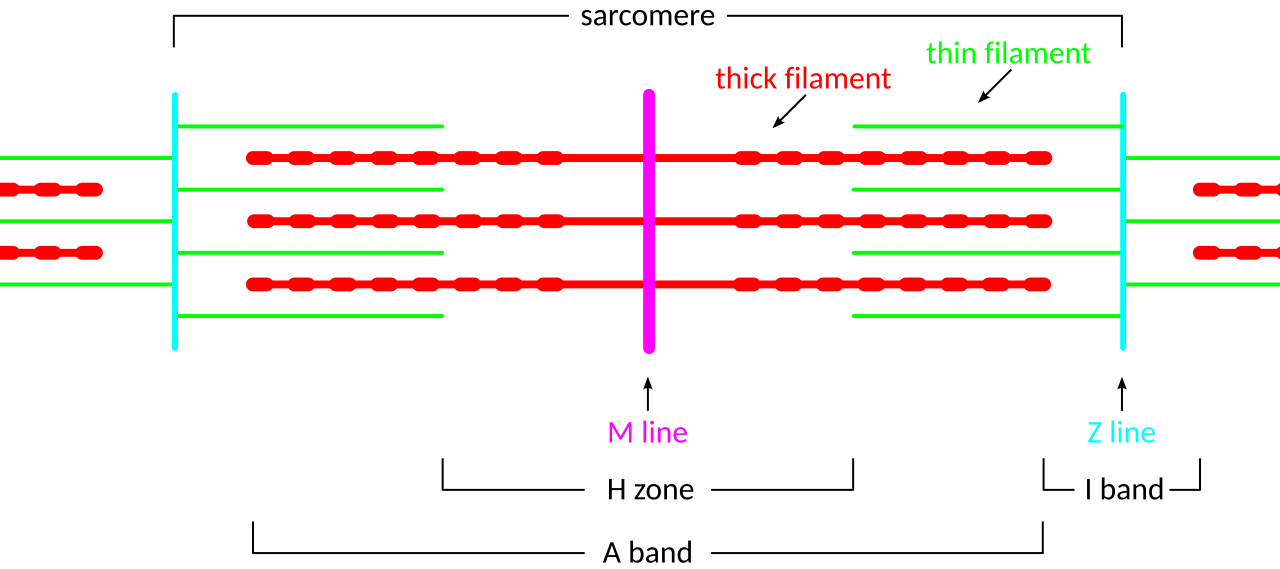
A sarcomere (Z line to Z line): during contraction the I band and H zone shorten as thin filaments slide over thick, while the A band stays the same length. Image: SlothMcCarty, CC BY-SA 3.0, via Wikimedia Commons.
Concept context
Types of movement, muscle contraction, skeletal system, joints, and disorders. Important for Class 11 and NEET.