Answer: Inflammation of tendons usually from repetitive strain or overuse; common sites: rotator cuff, Achilles tendon, patellar tendon, lateral epicondyle.
- A A localized bacterial infection that gradually spreads throughout the protective fibrous sheath surrounding a particular tendon
- B Inflammation of tendons usually from repetitive strain or overuse; common sites: rotator cuff, Achilles tendon, patellar tendon, lateral epicondyle
- C A slow, chronic degenerative disease process that specifically and primarily affects the long bones found within the limb
- D Inflammation that occurs specifically and only within the fibrous ligaments themselves, rather than within the tendons connecting muscle to bone
Correct answer: B. Inflammation of tendons usually from repetitive strain or overuse; common sites: rotator cuff, Achilles tendon, patellar tendon, lateral epicondyle
Explanation: Tendinitis is inflammation of a tendon, usually from repetitive motion, overuse, or sudden injury. Common examples: rotator cuff tendinitis (shoulder), Achilles tendinitis (heel), tennis elbow (lateral epicondylitis - extensor tendons). Symptoms: pain, swelling, reduced movement. Treatment: rest, ice, physiotherapy, NSAIDs.
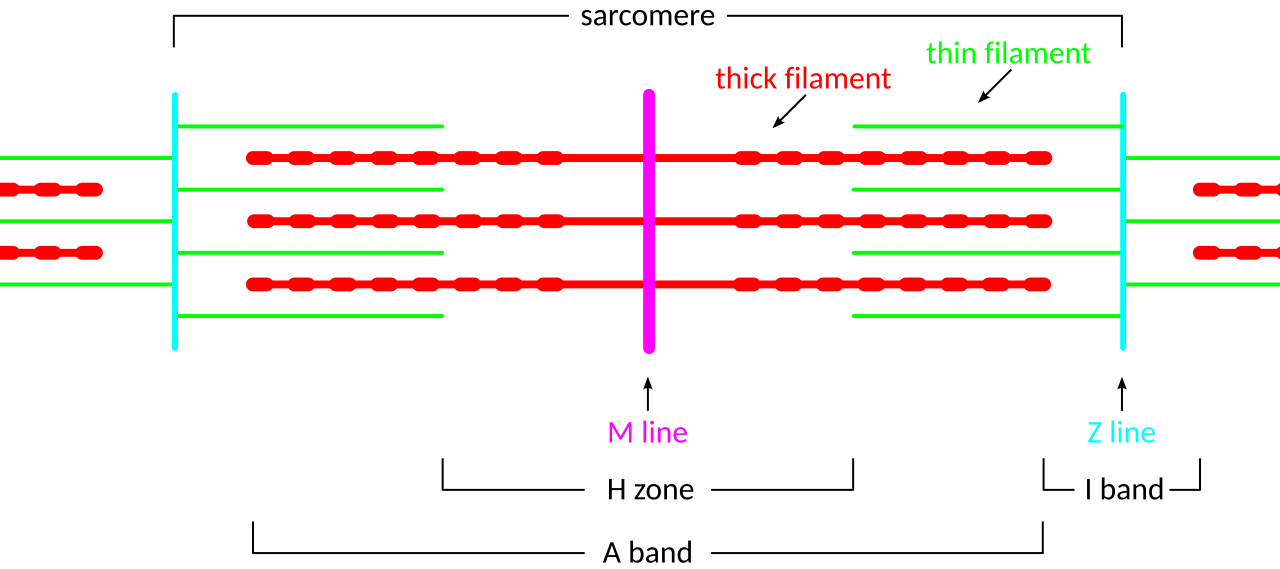
A sarcomere (Z line to Z line): during contraction the I band and H zone shorten as thin filaments slide over thick, while the A band stays the same length. Image: SlothMcCarty, CC BY-SA 3.0, via Wikimedia Commons.
Concept context
Types of movement, muscle contraction, skeletal system, joints, and disorders. Important for Class 11 and NEET.