Answer: Stiffening of muscles after death due to lack of ATP preventing myosin-actin cross-bridge detachment.
- A A general relaxation of skeletal muscles caused by sudden calcium efflux shortly after death in most textbook accounts
- B Stiffening of muscles after death due to lack of ATP preventing myosin-actin cross-bridge detachment
- C A genetic muscle disease typically caused by a mutation in the dystrophin gene itself during normal conditions
- D Normal muscle fatigue resulting from lactic acid buildup during prolonged heavy exercise as generally observed
Correct answer: B. Stiffening of muscles after death due to lack of ATP preventing myosin-actin cross-bridge detachment
Explanation: Rigor mortis: after death, ATP synthesis stops. Myosin heads remain bound to actin (cross-bridges cannot detach without ATP), causing muscles to become rigid. Starts 2-6 hours after death, peaks at 12 hours, resolves after 24-48 hours as proteins degrade.
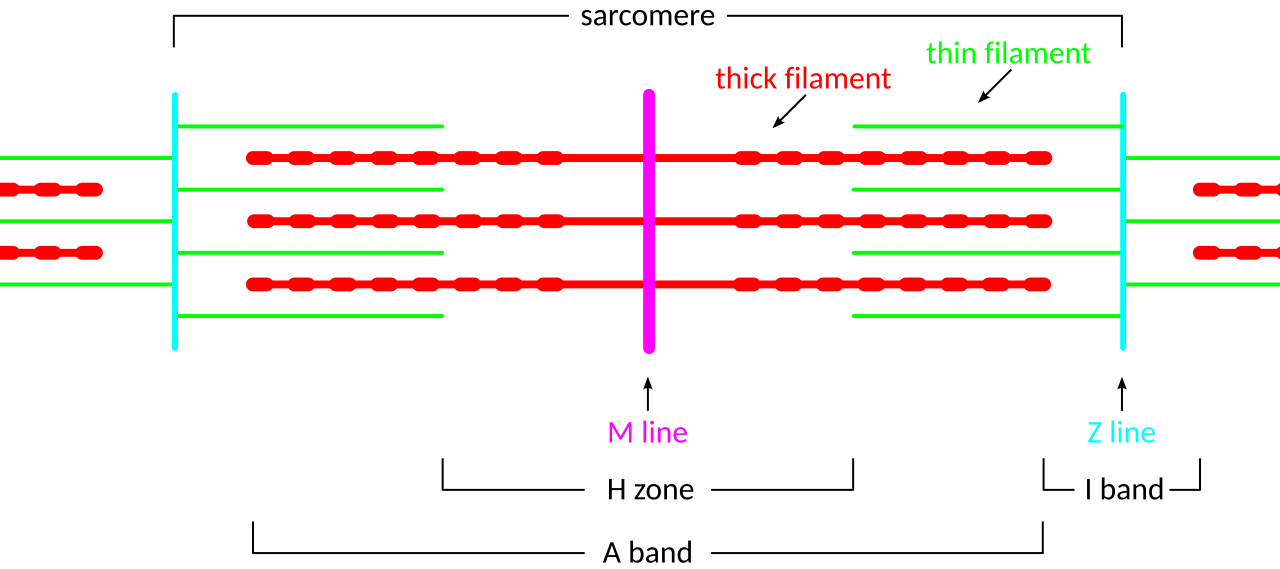
A sarcomere (Z line to Z line): during contraction the I band and H zone shorten as thin filaments slide over thick, while the A band stays the same length. Image: SlothMcCarty, CC BY-SA 3.0, via Wikimedia Commons.
Concept context
Types of movement, muscle contraction, skeletal system, joints, and disorders. Important for Class 11 and NEET.