Answer: A group of genetic diseases causing progressive muscle weakness and degeneration; most common is Duchenne MD caused by dystrophin gene mutation on X chromosome.
- A A chronic, slowly progressive degenerative disease that mainly affects the synovial joints throughout the body during normal conditions as generally observed
- B A group of genetic diseases causing progressive muscle weakness and degeneration; most common is Duchenne MD caused by dystrophin gene mutation on X chromosome
- C A disease that is sometimes thought to be caused mainly by a long-term, chronic dietary deficiency of vitamin D in typical laboratory settings under usual circumstances
- D An autoimmune disorder in which the body's own circulating antibodies are sometimes thought to attack healthy muscle fibres according to most researchers
Correct answer: B. A group of genetic diseases causing progressive muscle weakness and degeneration; most common is Duchenne MD caused by dystrophin gene mutation on X chromosome
Explanation: Muscular dystrophy: genetic diseases affecting muscle proteins. Duchenne MD: X-linked recessive, mutation in DMD gene (largest human gene), lacks dystrophin (connects cytoskeleton to ECM), affects boys, progressive weakness from early childhood, loss of ambulation by teens. Becker MD: milder form with partial dystrophin function.
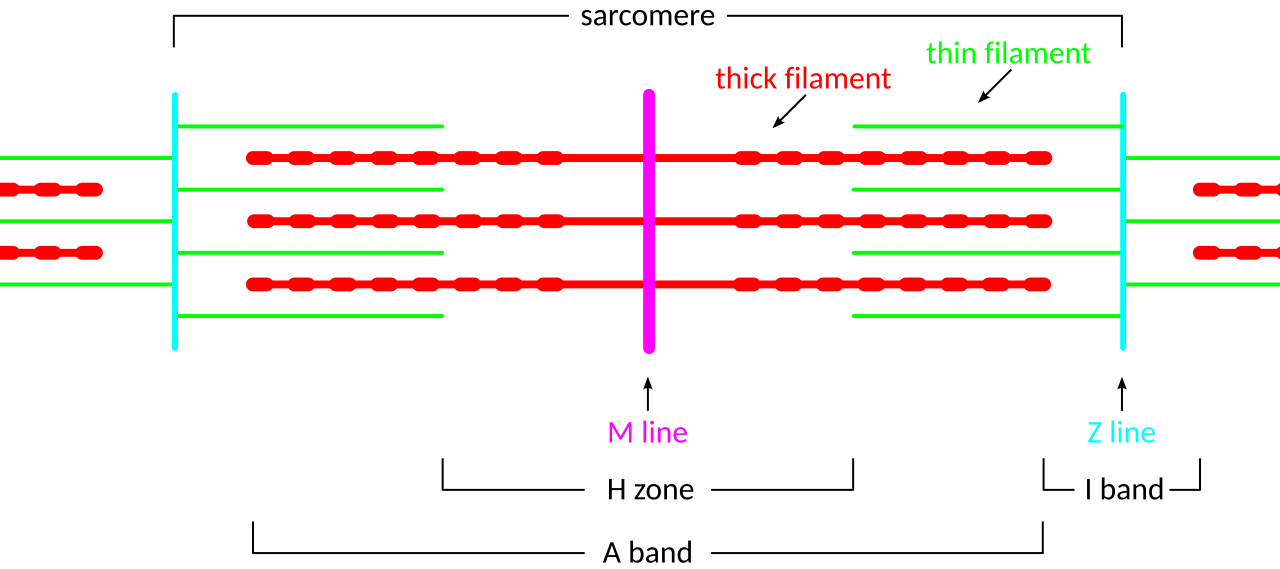
A sarcomere (Z line to Z line): during contraction the I band and H zone shorten as thin filaments slide over thick, while the A band stays the same length. Image: SlothMcCarty, CC BY-SA 3.0, via Wikimedia Commons.
Concept context
Types of movement, muscle contraction, skeletal system, joints, and disorders. Important for Class 11 and NEET.