Answer: Inability to maintain force due to: depletion of ATP and creatine phosphate, lactic acid accumulation, ion imbalances (K+ accumulates outside cell), and glycogen depletion.
- A Fatigue that is sometimes thought to be caused mainly by a temporary shortage of available oxygen reaching the muscle fibre overall in most cases under typical conditions
- B Inability to maintain force due to: depletion of ATP and creatine phosphate, lactic acid accumulation, ion imbalances (K+ accumulates outside cell), and glycogen depletion
- C Fatigue that is sometimes thought to be caused mainly by the gradual, ongoing accumulation of lactic acid within the fibre according to standard textbooks in general practice
- D Fatigue that is sometimes considered largely psychological in nature, with little underlying physiological basis involved as frequently described in most textbook accounts
Correct answer: B. Inability to maintain force due to: depletion of ATP and creatine phosphate, lactic acid accumulation, ion imbalances (K+ accumulates outside cell), and glycogen depletion
Explanation: Muscle fatigue has multiple causes: (1) Depletion of ATP and phosphocreatine (immediate); (2) Lactic acid accumulation and pH decrease (inhibit enzymatic activity); (3) Extracellular K+ accumulation (depolarizes membrane, reduces action potential amplitude); (4) Calcium reuptake failure; (5) Glycogen depletion (long exercise).
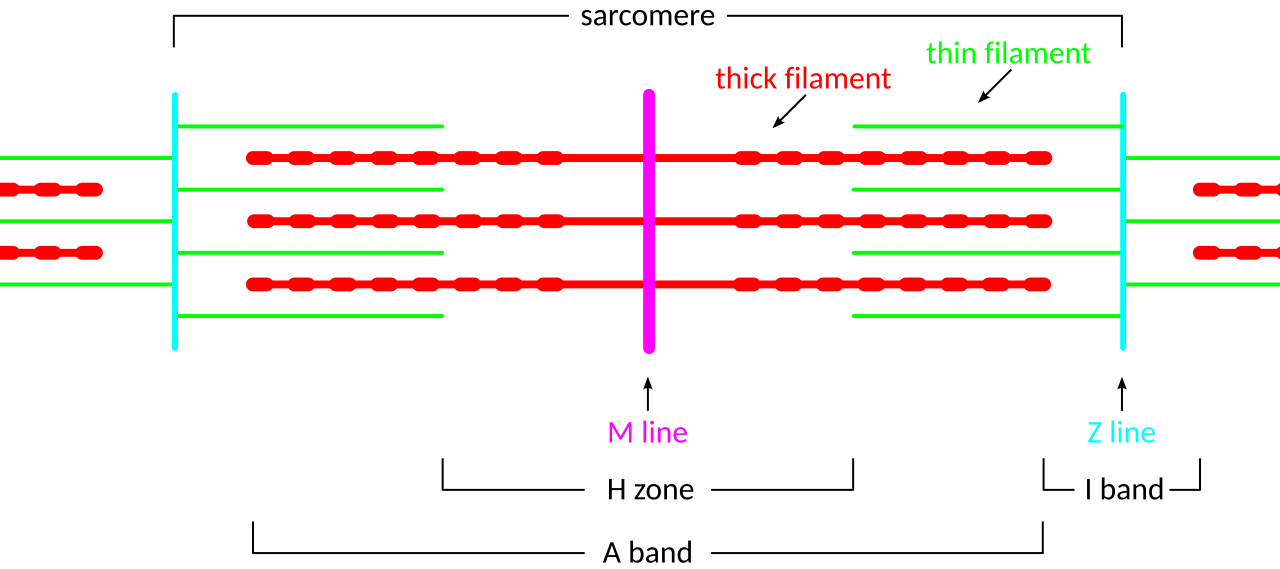
A sarcomere (Z line to Z line): during contraction the I band and H zone shorten as thin filaments slide over thick, while the A band stays the same length. Image: SlothMcCarty, CC BY-SA 3.0, via Wikimedia Commons.
Concept context
Types of movement, muscle contraction, skeletal system, joints, and disorders. Important for Class 11 and NEET.