Answer: Continuous process: osteoclasts (resorb bone) and osteoblasts (form new bone) work together; regulated by PTH, calcitonin, estrogen, and mechanical loading (Wolff's law).
- A Bone tissue is sometimes thought to never undergo any further structural change once its initial formation and ossification process has largely completed during youth
- B Continuous process: osteoclasts (resorb bone) and osteoblasts (form new bone) work together; regulated by PTH, calcitonin, estrogen, and mechanical loading (Wolff's law)
- C Bone growth and remodeling activity is sometimes thought to occur mainly up until approximately eighteen years of age at most, after which it largely ceases
- D Mainly osteoblast cells are sometimes thought to participate in the entire bone remodeling process, with osteoclast cells playing little meaningful functional role today
Correct answer: B. Continuous process: osteoclasts (resorb bone) and osteoblasts (form new bone) work together; regulated by PTH, calcitonin, estrogen, and mechanical loading (Wolff's law)
Explanation: Bone remodeling: osteoclasts (multinucleated, RANKL-activated) resorb old bone creating resorption lacunae; osteoblasts deposit new osteoid (collagen matrix) that mineralizes. Regulated by: PTH (raises Ca<sup>2+</sup> by activating osteoclasts); calcitonin (lowers Ca<sup>2+</sup> by inhibiting osteoclasts); estrogen (inhibits RANKL, protects bone); Wolff's law (mechanical stress increases bone density along stress lines).
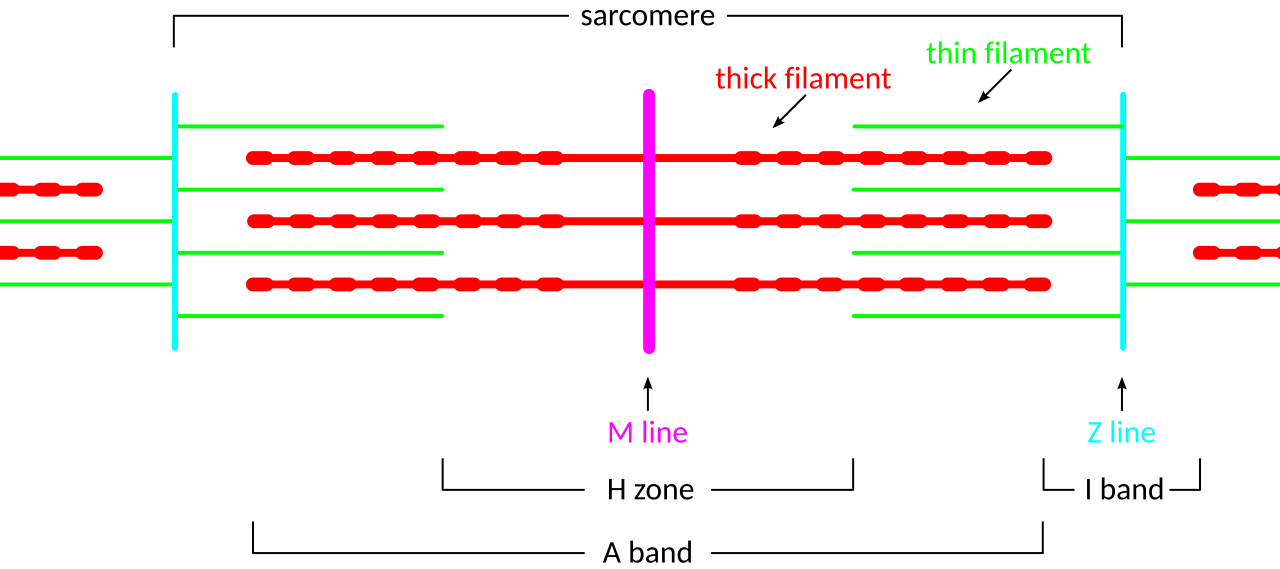
A sarcomere (Z line to Z line): during contraction the I band and H zone shorten as thin filaments slide over thick, while the A band stays the same length. Image: SlothMcCarty, CC BY-SA 3.0, via Wikimedia Commons.
Concept context
Types of movement, muscle contraction, skeletal system, joints, and disorders. Important for Class 11 and NEET.