Answer: If a stimulus reaches threshold, a full action potential fires; sub-threshold stimuli produce no action potential. A single muscle fibre contracts maximally when stimulated (not graded). Force is controlled by varying the number of fibres recruited.
- A It is sometimes mistakenly thought to mean that the strength of muscular contraction is graded smoothly and continuously in proportion to the applied stimulus voltage level, much like a dimmer switch controls brightness during normal conditions
- B If a stimulus reaches threshold, a full action potential fires; sub-threshold stimuli produce no action potential. A single muscle fibre contracts maximally when stimulated (not graded). Force is controlled by varying the number of fibres recruited
- C It is sometimes mistakenly thought to result mainly from the gradual temporal summation of many repeated sub-threshold stimuli occurring at the very same neuromuscular junction over an extended period as generally observed in typical laboratory settings
- D It is sometimes mistakenly thought to apply mainly to cardiac muscle tissue specifically, where specialized pacemaker cells generate spontaneous, slowly rising graded membrane potentials over time under usual circumstances according to most researchers
Correct answer: B. If a stimulus reaches threshold, a full action potential fires; sub-threshold stimuli produce no action potential. A single muscle fibre contracts maximally when stimulated (not graded). Force is controlled by varying the number of fibres recruited
Explanation: All-or-nothing: once threshold is reached, a full action potential fires (not a partial one). For skeletal muscle fibres: each fibre contracts maximally when stimulated. Graded force is achieved by motor unit recruitment (more fibres = more force) and rate coding (higher frequency = summation/tetanus).
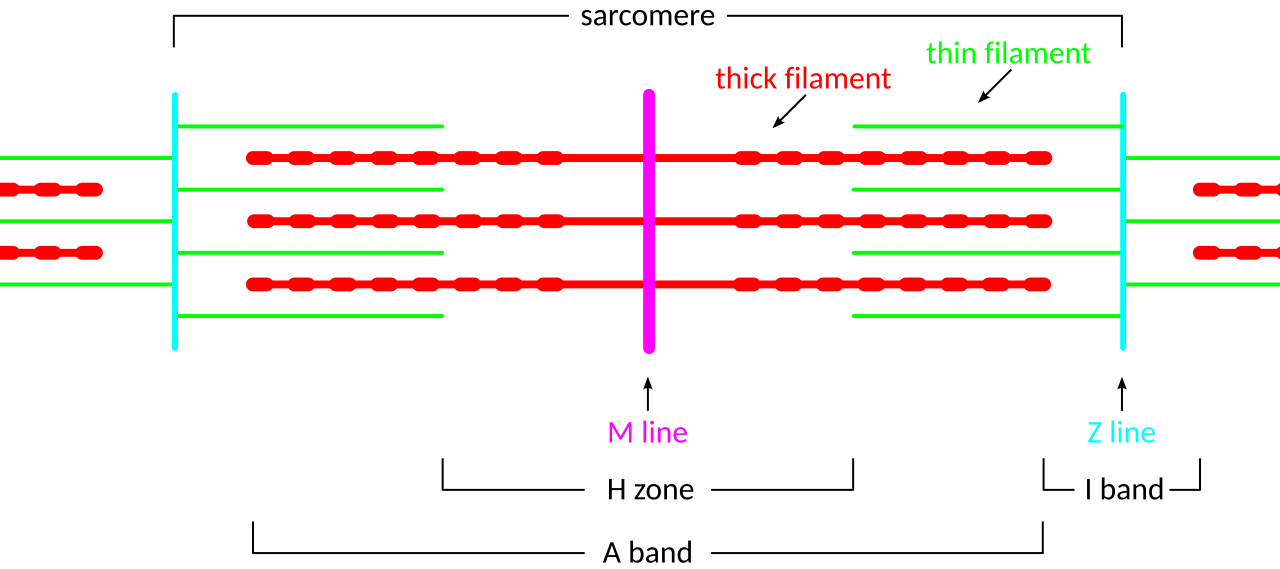
A sarcomere (Z line to Z line): during contraction the I band and H zone shorten as thin filaments slide over thick, while the A band stays the same length. Image: SlothMcCarty, CC BY-SA 3.0, via Wikimedia Commons.
Concept context
Types of movement, muscle contraction, skeletal system, joints, and disorders. Important for Class 11 and NEET.