Answer: Thin actin filaments slide over thick myosin filaments using cross-bridge cycling powered by ATP; the sarcomere shortens while filament lengths stay constant.
- A Muscle contracts by folding the thin actin filaments into tightly compacted coils along the sarcomere structure as generally observed in typical laboratory settings
- B Thin actin filaments slide over thick myosin filaments using cross-bridge cycling powered by ATP; the sarcomere shortens while filament lengths stay constant
- C Myosin filaments physically shorten in their overall structural length during the course of muscle contraction itself under usual circumstances according to most researchers
- D Both the thin actin and thick myosin filaments shorten together by a roughly equal amount during contraction in the majority of cases studied as widely reported
Correct answer: B. Thin actin filaments slide over thick myosin filaments using cross-bridge cycling powered by ATP; the sarcomere shortens while filament lengths stay constant
Explanation: Sliding filament theory (Huxley, 1954): myosin heads form cross-bridges with actin; using ATP hydrolysis, heads pivot (power stroke) pulling actin toward center; new ATP allows detachment; heads reset and cycle repeats. Result: actin slides over myosin, Z discs come closer, sarcomere shortens, muscle contracts.
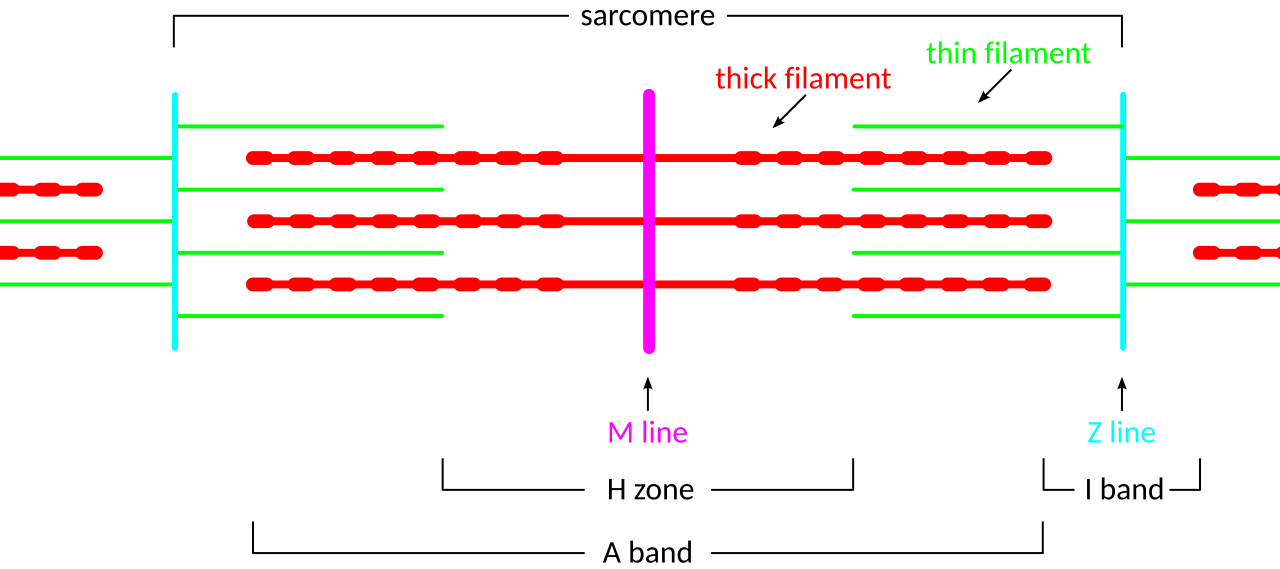
A sarcomere (Z line to Z line): during contraction the I band and H zone shorten as thin filaments slide over thick, while the A band stays the same length. Image: SlothMcCarty, CC BY-SA 3.0, via Wikimedia Commons.
Concept context
Types of movement, muscle contraction, skeletal system, joints, and disorders. Important for Class 11 and NEET.